
 Worksheets
Atomic theory of an atom
Total questions: 25
Worksheet time: 18mins
Name
Class
Date
1.
Who stated that atoms cannot be divided?
a)
Democritus
b)
Dalton
c)
Thomson
d)
Bohr
2.
In an atom, electrons move in definite orbits around the nucleus.
a)
Thomson
b)
Rutherford
c)
Bohr
d)
Democritus
3.

What scientist is best known for his "Plum Pudding" model of the atom?
a)
J.J. Thomson
b)
Ernest Rutherford
c)
John Dalton
d)
Democritus
4.

What contribution did John Dalton make to atomic theory?
a)
He discovered that every atom was positively charged.
b)
He discovered that every element consisted of one type of atom that couldn't be divided.
c)
He discovered that atoms had nuclei.
d)
He discovered that atoms could be divided into smaller parts.
5.

Place the following scientists in order, from earliest to latest:
Rutherford, Dalton, Bohr, Thomson
Rutherford, Dalton, Bohr, Thomson
a)
Dalton, Rutherford, Bohr, Thomson
b)
Thomson, Dalton, Rutherford, Bohr
c)
Dalton, Thomson, Rutherford, Bohr
d)
Bohr, Dalton, Rutherford, Thomson
6.
Rutherford's gold foil experiment provided evidence that...
a)
negative and positive charges are spread evenly throughout the atom.
b)
alpha particles have a positive charge.
c)
gold is not a dense as previously thought.
d)
there is a dense positively charged nucleus at the center of an atom.
7.

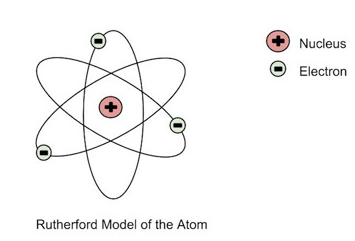
Who came up with the model of an atom pictured?
a)
J.J. Thompson
b)
Ernest Rutherford
c)
Neils Bohr
d)
James Chadwick
8.
The first person to propose a theory about an atom called the Atomos Theory was
a)
Democritus
b)
Rutherford
c)
Dalton
d)
Aristotle
9.
Who discovered the nucleus using the gold foil experiment?
a)
Democritus
b)
Robert Millikan
c)
James Chadwick
d)
Ernest Rutherford
10.
He discovered the electron using cathode ray tube experiment.
a)
Joseph Thomson
b)
John Dalton
c)
Ernest Rutherford
d)
Robert Millikan
11.
His atomic model was depicted similar to a planetary/solar system
a)
Niels Bohr
b)
Joseph Thomson
c)
Ernest Rutherford
d)
Democritus
12.
How did Thomson build upon Dalton's model?
a)
His model was the same.
b)
He put electrons in orbitals.
c)
He discovered the nucleus.
d)
He discovere subatomic particles (electron).
13.

Who's model is this?
a)
Millikan
b)
Rutherford
c)
Thomson
d)
Bohr
14.
How did each model of the atom help to develop the atomic theory?
a)
Each model provided opinions that were added.
b)
Each model showed different properties of the same structure.
c)
Each model showed new particles that had been discovered.
d)
Each model built upon the other to show new particles or properties of previously discovered particles.
15.
JJ Thomson discovered what subatomic particle
a)
nucleus
b)
neutron
c)
proton
d)
electron
16.
This particle balances the charges from the protons to make the atom neutral
a)
proton
b)
electron
c)
neutron
d)
nucleus
17.
The smallest unit of a pure substance that has the properties of that substance
a)
element
b)
atom
c)
neutron
d)
compound
18.
Atoms are made up of three basic parts, which are -
a)
Protons, neutrons, electrons
b)
neutrinos, protons, neutrons
c)
quarks, protons, electrons
d)
electrons, neutrons, and quarks
19.
The nucleus is made up of -
a)
neutrons and electrons
b)
protons and neutrons
c)
protons and electrons
d)
electrons and quarks
20.
Protons have this charge -
a)
positive
b)
negative
c)
neutral
d)
no charge
21.
Electrons have this charge -
a)
positive
b)
negative
c)
neutral
d)
no charge
22.
Neutrons have this charge -
a)
positive
b)
negative
c)
neutral
d)
They don't exist
23.
An atom's overall charge is ________.
a)
positive
b)
depends
c)
neutral
d)
negative
24.

J.J. Thomson provided evidence that an atom...
a)
is the smallest particle of matter
b)
contains negatively charged particles
c)
has an overall negative charge
d)
has an overall positive charge
25.

Rutherford's gold foil experiment provided evidence that...
a)
negative and positive charges are spread evenly throughout the atom.
b)
alpha particles have a positive charge.
c)
gold is not a dense as previously thought.
d)
there is a dense positively charged nucleus at the center of an atom.
100 %

