
 Worksheets
Ap Euro, Modern World Identification Quiz
Total questions: 53
Worksheet time: 29mins
Vocab word: Polis
Greek word for City-State, used to identify not only the city but the citizens and land around it as well
Term for mega-city
Autocratic Government organization
Plato was the prize student of the great Socrates, one of the most renowned philosophers not only of his era but of all time.
True
False

Why was Socrates put to death?
Corrupting the youth of Athens
Teaching Alexander the Great how to conquer the world
Loving knowledge
Tooting in public

What was Plato's School called and how did it influence Aristotle's thoughts on Science?
Academy
Lyceum
Mill Creek
Harvard

What happened to Alexander's empire after he died?
Alexander's son Philip took over
Greece conquered Macedonia
Alexander's empire fell apart, ruled over by his generals as three different kingdoms of varying chronological lengths
Sparta won the Peloponnesian War
Who was the greatest orator in early Roman history? He decried the Catalinian conspiracy only to lose out to the First Triumvirate and its growing influence. He also said that, "Unpopularity earned by doing what is right, is Glory"
Seneca
Cicero
Cato
Diocletian
What religion did Roman Emperor Constantine convert to on his death bed, signaling with the passage of the Edict of Milan that this religion could thrive in the Roman Empire?
Islam
Judaism
Hinduism
Christianity

Where did the Vikings come from as they traded, invaded and state built in the 9th to 12th centuries?
Germanic Kingdoms
Iceland
Scandinavia
North Africa
What empire(s) claims descent from Charlemagne and his Frankish Kingdoms?
Holy Roman Empire
French Empire
Prussian Empire
What nationality/ethnic group was Charlemagne part of?
Romans
Gauls
Germanic Franks
Germanic Goths

What was the relationship between Julius Caesar and Augustus Caesar?
Augustus was a daughter of Julius
Augustus was a brother of Julius
Augustus was an adopted son of Julius
Augustus was a biological son of Julius
Who was the leader of the Normans (Vikings who settled in Northern France) during the Norman Conquest of England in 1066?
William the Conqueror
Harold Godwinson
Alfred the Great
Tiberius Coachius Hayesius Maximus

Which answer choice best describes the Black Plague's impact in Europe?
People started to question the church when it could not provide divine cures
1/3 of the population of Europe died
It contributed to the decline of feudalism, by allowing peasants left alive to charge for their services
All above are correct
A period that lasted from about 500 CE to about 1500 CE in Region of Europe
The Medieval Period
The Renaissance
The Enlightenment
The Age of Aquarius
What two Nations fought in the Hundred Years' War in Europe from 1337 to 1453?
England and Scandinavia
England and France
France and Spain
Germany and France

Who led the French to victory in a battle at Orleans during the Hundred Years war, but was later burned at the stake as a heretic?
King Henry III
King Edward I
Joan of Arc
Which answer choice best describes the result of the Babylonian Captivity and Great Schism within the Roman Catholic Church during the Renaissance was.
a decrease in papal authority
the Protestant Reformation
a decrease in the Church's moral authority
all of these are effects
The heart of the Buddha's teachings is contained in what main conceptual theory of salvation, which in turn defines the core of Buddhism?
The Four Noble Truths
Nirvana
Dharma
Chinese Food

Hammurabi was best known for his _______. A set of laws that governed life in the Babylonian empire.
Beard
Code
Consequences
Sword

During the Early Middle Ages, which group gained power by maintaining a system of protection, order, and stability?
merchants
monarchs
nobles
peasants
Patriarchal, patriarchy, patriarch
Dominated and led by men as the favored or more selected gender
Representative body of advisers to the King
Landowners who created laws for Rome
Social class with nobles, knights, and peasants
Belief in multiple gods, or a pantheon. Usually older religions, gods have anthropomorphic or human-like emotions or characteristics.
Monotheistic
Polytheistic
Greek Philosophers
Universalizing
System of social organization developed in India, and other civilizations characterized by little or no social mobility and often associates occupations with different levels.
Oligarchy
Caste System
Class System
Utopian Socialism
Style of government, used most notably in Athens, Greece, where all citizens voted on key decisions of the state
Direct Democracy
Oligarchy
Tyranny
Feudalism
Process of arriving at informed conclusions from questioning life to stimulate critical thinking. Often involves a question and answer approach, and first used by one of Coach Hayes' favorite teachers of all time!
Socratic Method
Philosophy
Plato
Aristotle
Medieval Social Caste system with nobles, knights, clergy and peasants defining the demography.
Guild System
Feudalism
Manorialism
Hanseatic League
Belief in one singular deity, that usually also composes the concepts of Omnipresence and Omnipotence.
Monotheistic
Polytheistic
A Pharoah
Plebeian
Which of the following was a result of the Neolithic Revolution in which early man began to use systematic agriculture for food production rather than hunting and gathering?
Gender equality
Pastoralism
Decreased social hierarchy
Specialization of labor
Which of the following was the origin of the South Asian belief system known as Hinduism?
Zoroastrianism in central asia
Buddhism
Judaism, and the Hebrew herders of Sumeria that branched off from Abraham
Vedic religions brought by aryans into South Asia
Which of the following describes women’s status in the classical civilizations?
Upper-class women had a tendency to live less restricted lives than lower-class women.
Women in general experienced fewer restrictions compared to those living in pastoral societies.
Public life in general was a male domain, while women’s roles took place mostly in domestic settings.
Women in general experienced fewer restrictions in South Asia/Hindu India as compared to those who lived in early Neolithic agricultural village societies.

Which school of thought contended that the best way to govern was to lead the people by virtue and the rules of propriety? (sample stem source added)
Legalism
Confucianism
Greek rationalism
None of the above

This is the spreading out of culture, cultural traits, or a cultural pattern from a central point.
Syncretism
Cultural Obtrusion
Cultural Diffusion
Cultural Appropriation

Who is the founder of Buddhism? (if you get this wrong I will hit you with a hammer)
Jesus
Siddhartha Gautama
Abraham
Mohammed
Which of the following religions has the "5 pillars of faith" as one of its core philosophical platforms. These Pillars define not only the core values of it, but also the religious process of the devout.
Hinduism
Buddhism
Islam
Judaism

A term to describe the profound peace of mind. It is the state of being free from suffering and entering a state of sublime detachment.
Nirvana
Karma
Moksha
Rig Veda
Is the concept that every action has a universal consequence that ultimately weigh upon our salvation. The cycle of cause and effect which creates.
Nirvana
Karma
Samsara
Dharma

Who do Jews, Christians, and Muslims trace their roots back to?
Abraham, and his monotheistic principals
Muhammad, and his Five Pillars
Moses, and his Ten Commandments
Constantine, and his Edict of Milan

What is the emphasis of Daoism (or Taoism) in its base philosophical canon?
living in harmony with nature and "the way"
forging a path for oneself through effort and rule
living in strict discipline, and social order
Which Chinese philosophy teaches respect at home and in society called filial piety as well as the importance of Social Hierarchy and the 'Golden Rule'?
Confucianism
Daoism
Legalism

What famous leader did Aristotle tutor?
Hippocrates the Doctor
Marathon the Runner
Alexander the Great
Socrates the Philosopher
Spiritual and political leaders of the Muslims and Islamic States were called what? (fyi Sultan is a turkic term, not traditionally islamic)
scholars.
caliphs.
traders.
khans.
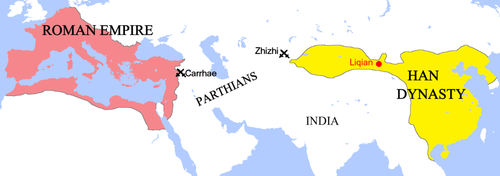
Downfall of Civilizations question! The fall of traditional Rome and the Han Dynasty were caused by ________?
invasions from nomadic tribes
high taxes
a weak central government
all of the above

McDonald's adopting 'Sushi' as it opens its restaurant in Tokyo is a great example of....
Syncretism, adopting regional cultural practices/customs to become more accepted in a new place
Involuntary Association, having to conform to new kingdoms
Utopian Socialism, absorbing all cultures to eliminate singularities and potentially fight godzilla
False Advertisement, McDonald's taking its unhealthy foods and shaping them into healthy food items to cloud consumers

Which statement is best associated with the image?
Diaspora
IOMS
Hybridization
Voluntary Association

Which of the following is NOT closely associated with the expansion of the Mongol Empire?
Golden Horde and their invasion of Eastern Europe
Genghis Khan and his Code of Yassa
Kublai Khan and his Great Khanate of China
Technology of the Stirrup and Composite Bow
The Spread of Buddhism along the Silk Road due to trade

