

wayground logo

Free Printable Worksheets

Font size

S
M
L
XL
Worksheets

Refraction through Lenses

Total questions: 20

Worksheet time: 34mins
Name
Class
Date
1.
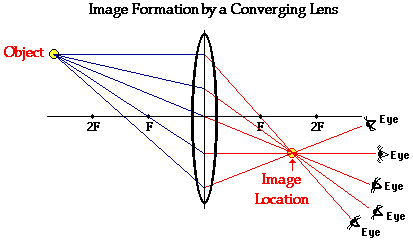
This image is.....
a)
inverted and smaller
b)
inverted and larger
c)
not inverted and smaller
d)
not inverted and larger
2.
An incident ray that is parallel to the principal axis...
a)
will reflect parallel to the principal axis
b)
will refract through the focal point
c)
will reflect through the center of curvature
d)
will continue along the same path through the lens
3.
a real image...
a)
is produced by virtual rays and can be projected on a screen
b)
is produced by real rays and cannot be projected on a screen
c)
is produced by virtual images and cannot be projected on a screen
d)
is produced by real rays and can be projected on a screen
4.
What is Nearsightedness? 
a)
condition that has difficulty seeing things that are close 
b)
condition that has difficulty seeing things that are far away
5.

The focal length of this lens is _______.

a)

negative because it can form real images

b)

positive because it can form real images

c)

negative because it can form virtual images

d)

could be positive or negative depending on the image formed

6.

A person standing in front of a lens creates an image that is both smaller than the original and closer to the lens. Classify the image formed in this scenario.

a)

real, inverted

b)

real, upright

c)

virtual, inverted

d)

virtual, upright

7.
Which describes a convex lens?
a)
triangular in shape
b)
more transparent in the middle
c)
thicker on the edges than in the middle
d)
thicker in the middle than on the edges
8.
A converging lens is also known as a ____ lens.
a)
convex
b)
concave
c)
double
d)
refracted
9.

What type of lens do you have in your eye?

a)

Concave

b)

Prismatic

c)

Objective

d)

Convex

10.
When an object is placed on the focal point in front of a convex lens, the image produced is ___.
a)
real, reduced, and inverted
b)
real, enlarged, and inverted
c)
real, true, and inverted
d)
There is no image
11.
When an object is placed between the focal point and the convex lens, the image produced is ___.
a)
real, reduced, and inverted
b)
real, enlarged, and inverted
c)
virtual, enlarged, and upright
d)
virtual, reduced, and upright
12.
If an object's distance from a convex lens were increased, the image would become which of the following?
a)
Larger and virtual
b)
Larger, only
c)
Smaller, only
d)
Smaller and virtual
13.
What kind of lens is a magnifying glass?
a)
Convex Lens
b)
Concave Lens
14.
A converging lens has a focal length of 30 cm. A 5 cm tall candle is placed at a distance of 10 cm in front of the lens. Determine the image distance.
a)
- 45 cm
b)
-30 cm
c)
-15 cm
d)
6 cm
15.
A convex lens has a focal length f.  If an object is placed at 2f at what distance will the image appear?
a)
2f
b)
f
c)
between f and 2f
d)
infinity
16.
An object of height 4 cm is placed 10 cm away from a concave lens of focal length 6 cm as shown below.Image is 
a)
virtual.inverted
b)
virtual,upright
c)
real,inverted
d)
real,upright
17.
An object is located 15 m from a converging lens with focal length 10 m.If the object is 2 cm tall, find the image height if the image is located at 30 m.
a)
4 m
b)
-4m
c)
1m
d)
-1m
18.

Which of the following are uses for convex lenses? (Choose all that are correct)

a)

Camera lens

b)

Telescope lens

c)

Microscope lens

d)

Magnify glass

19.

A ____ is a curved piece of glass or other transparent material that refracts light, (pg. 115-116)

a)

mirror

b)

lens

c)

window

d)

prism

20.

The type of image formed by a lens depends upon the ____ of the lens and the position of the object. (pg. 115-116)

a)

size

b)

shape

c)

color
