
 Worksheets
Kinematics - Vocabulary
Total questions: 30
Worksheet time: 32mins
What does UAM stand for?
Uniformly Accelerated Motion
Understood Acceleration & Movement
Uniform And Moving
You Are Moving.
What are the units of measurement for velocity?
m
sec
m/sec
m/sec2
m*sec
What are the units of measurement for acceleration?
m
sec
m/sec
m/sec2
m*sec
Kinematics is the study of
forces and inertia.
Newton's 3 laws.
describing motion.
gravity in our solar system.
Which of the following statements is true?
Speed is a scalar | Velocity is a vector
Speed is a vector | Velocity is a scalar
Speed and velocity are the same thing.
Speed can be negative.
What is a vector?
Magnitude Only
Magnitude and Direction
Direction Only
Pathway
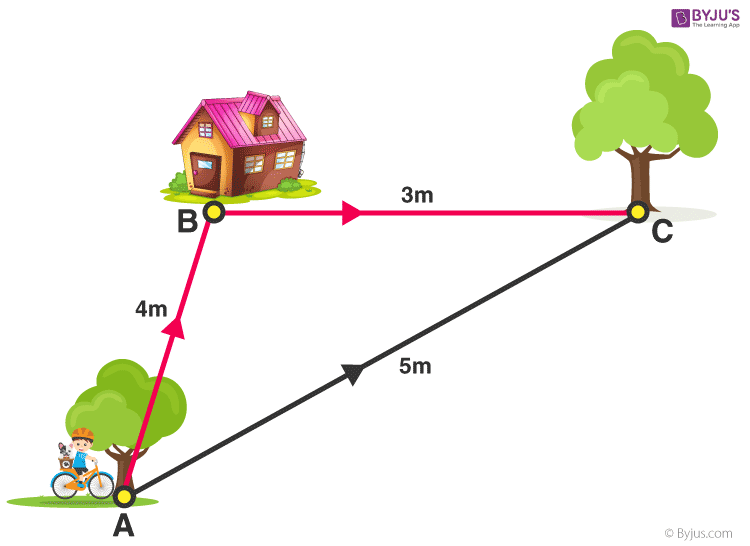
The girl bikes from A to B to C. What is her distance travelled?
3 m
4 m
5 m
7 m
12 m
The girl bikes from A to B to C. What is her displacement?
3 m
4 m
5 m
7 m
12 m
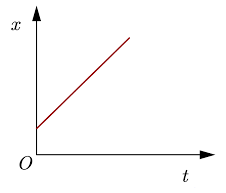
What type of graph is this?
Position v. time graph
Velocity v. time graph
Acceleration v. time graph
Speed v. time graph
The graph is wrong because the x is on the wrong axis.
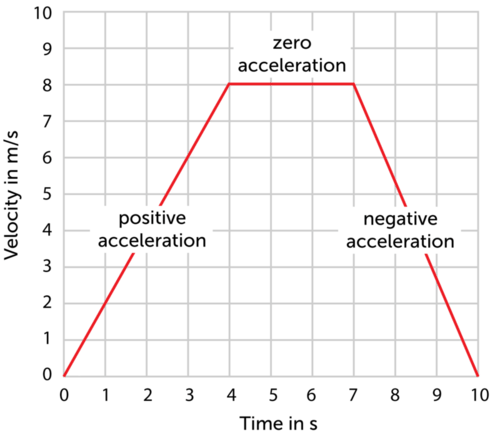
What type of graph is this?
Position v. time graph
Velocity v. time graph
Acceleration v. time graph
Speed v. time graph
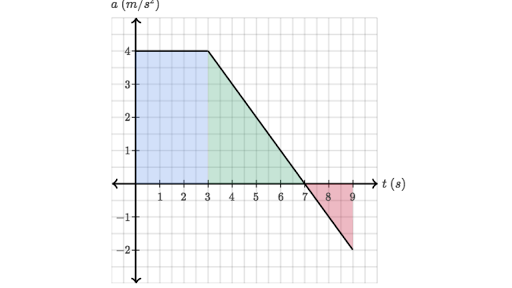
What type of graph is this?
Position v. time graph
Velocity v. time graph
Acceleration v. time graph
Speed v. time graph
Primary colors graph
The unit of measurement, meter m, can be used to measure which of the following quantities? (Select all that apply)
Distance (d)
Height (y)
Mass (m)
Displacement (Δd)
Position (x)
Which of the following are considered vectors? (Select all that apply)
Distance
Displacement
Speed
Velocity
Acceleration
Which of these could be considered scalars? (Select all that apply)
Distance
Position
Speed
Acceleration
Time
Negative acceleration:
means getting faster and faster.
means getting slower and slower.
means changing motion toward the negative direction.
means changing motion in the downward direction.
doesn't exist. You can not "negatively accelerate".
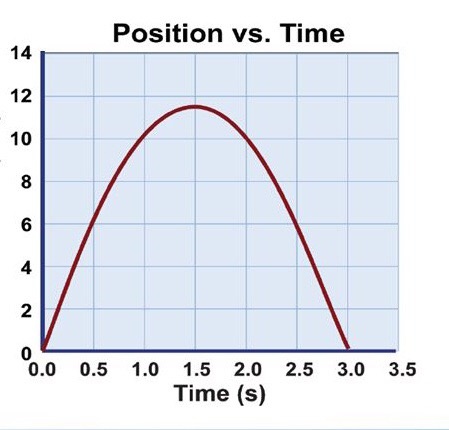
On a position vs. time graph, concave down always means:
Slowing down.
Speeding up.
Positive acceleration.
Negative acceleration.
Constant velocity
An object is launched in the sky with a significant velocity of 100 m/sec upward. If the acceleration of gravity is down, what will happen?
The object will continue upward, but start slowing down.
The object will start going down, and speeding up.
Impossible. Acceleration and velocity must always be in the same direction.
The object will continue upward with a constant velocity, because its too fast for gravity to affect it.
The object will continue upward, and speeding up.
What does the greek letter delta Δ mean? (Select all that apply)
Distance
Difference
Subtraction
Change
Displacement
A negative velocity means:
Slowing down.
Going very, very slow.
A dangerous speed.
An object moving in the negative direction.
Impossible. You can't be slower than 0 m/s.
Which of the following is impossible:
Negative displacement.
Negative velocity.
Negative acceleration.
Negative speed.
Negative position.
(Select all that apply)
Acceleration means:
slowing down.
speeding up.
changing direction.
going very fast.
balanced forces.
Changing the velocity means acceleration. However, if you change the acceleration of an object, that is called:
Absement
Speed
Jerk
Derivative
Integral
Which of the following is the more accurate version of the gravitational field on planet earth?
10 m/s
10 m/s2
9.81 m/s
9.81 m/s2
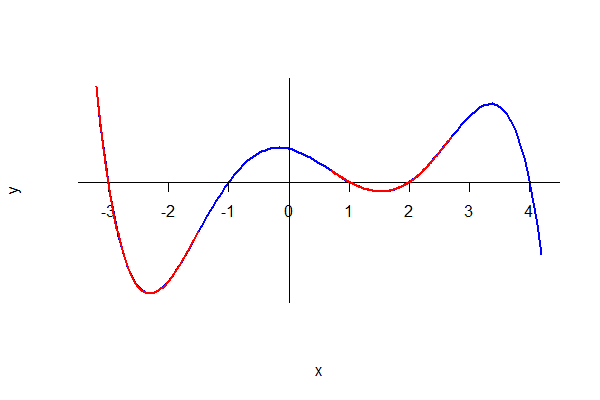
What is the red parts of the curve called?
Concave Up
Concave Down
What are the blue parts of the curve called?
Concave Up
Concave Down
Your velocity at a certain moment is called:
Instantaneous Velocity
Average Velocity
Tangential Velocity
Constant Velocity
Uniformly Accelerated Motion
A man walks around a 1 mi nascar track in a half hour, and stops where he started. What was his average velocity?
0 mph
0.5 mph
1.0 mph
2.0 mph
A man walks around a 1 mi nascar track in a half hour, and stops where he started. What was his average speed?
0 mph
0.5 mph
1.0 mph
2.0 mph
The gravitational field is approximately 10 m/s2. What does this mean?
Things fall at a constant velocity of 10 m/s.
Things falling get faster by 10 m/s for every second that goes by.
Things falling eventually reach a terminal velocity of 10 m/s.
Things falling move 10 meters every second that goes by.
Acceleration is calculated by:
how far an object goes divided by the time to get there.
total falling time divided by terminal velocity.
change in velocity divided by time needed to accomplish change.
change in velocity divided by distance to accomplish change.

