wayground logo

Free Printable Worksheets

NEW

Font size

S
M
L
XL
Worksheets

Revision chapter 5 : Circular Motion

Total questions: 20

Worksheet time: 24mins
Name
Class
Date
1.
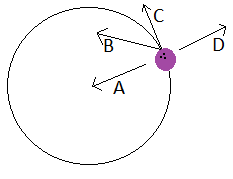
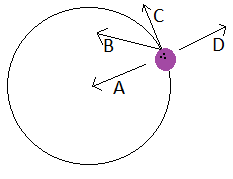
Which represents the acceleration of the ball?
a)
A
b)
B
c)
C
d)
D
2.
Which of the following depict the speed of the blowing ball?
a)
A
b)
B
c)
C
d)
D
3.
Calculate the velocity of an object moved around a circle with a radius of 1.65 m and an acceleration of 3.5 m/s2.
a)
2.4 m/s
b)
3.6 m/s
c)
3.9 m/s
d)
4.2 m/s
4.
Calculate the mass of an object if it took 20 N to rotate it in a circle with a radius of 2 meters with a velocity of 4 m/s
a)
4.1 kg
b)
3.6 kg
c)
2.5 kg
d)
1.8 kg
5.
Calculate the centripetal force required to make a 5 kg ball move 4 m/s in a circle with a radius of 2 m.
a)
10 N
b)
20 N
c)
30 N
d)
40  N
6.

Two object each have masses of 9,000,000 kg and are 1 meter apart from each other. What's the force of gravity between them?

a)

5402 N

b)

6320 N

c)

7541 N

d)

7945 N

7.

What's the centripetal acceleration of a .2 kg yoyo spun in a circle with a radius of .7 meters at a velocity of 3 m/s?

a)

8.23 m/s2

b)

10.54 m/s2

c)

12.86 m/s2

d)

17.39 m/s2

8.

Centripetal force is an acceleration of an object moving in circular path whose direction is _________________________of the circular path and whose magnitude is equal to the square of the speed divided by the radius.

a)

towards the tangent

b)

towards the centre

c)

towards the minimum point

d)

towards the maximum point

9.

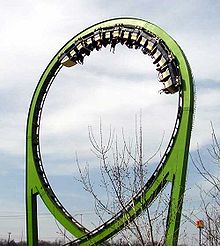
Where is the net force when the rollercoaster is at the top of the loop?

a)

Towards the sky

b)

Towards the Right

c)

Towards the left

d)

Towards the center of the circle

10.

In uniform circular motion, the magnitude of the _______________________of an object is constant but the __________ is continually changing.

a)

speed, acceleration

b)

speed, direction

c)

acceleration, speed

d)

acceleration, velocity

11.
The velocity is always _____ to the line of a circle. 
a)
outwards
b)
towards the center
c)
tangent
d)
faster
12.
Which statement is true about an object that is traveling in uniform circular motion?
a)
The speed of the object varies.
b)
The net force on the object is directed toward the center of the circular path.
c)
The direction of the object's velocity is constant.
d)
The net force on the object is directed away from the center of the circular path.
13.

________________________ defined as the number of revolutions (cycles/rotations) completed in one second.

a)

frequency

b)

period

c)

distance

d)

centripetal acceleration

14.
Which of the following is the unit for centripetal force?
a)
J
b)
m/s2
c)
kg⋅m/s
d)
N
15.
The time taken for one complete circuit is called the... 
a)
Period
b)
Frequency 
c)
Angular velocity
16.

Why does an object experiencing uniform circular motion have an acceleration?

a)

because it ir changing speed

b)

because it is changing direction

c)

because it is moving n a straight line

d)

because it has mass

17.

In this diagram, what do the red arrows represent?

a)

the acceleration vector

b)

the velocity vector

c)

the centripetal force vector

d)

the force of gravity

18.
What happens to the centripetal force exerted on an object if you triple the velocity?
a)
it increases to 3X
b)
it decreases to 6X
c)
it increases to 6X
d)
it increases to 9X
19.

Centripetal force is...

a)

the inward force acting on a body moving at constant speed in a circle

b)

the outwards force acting on a body moving at constant speed in a circle

20.
A horse gallops around a circular arena.  The centripetal force on the horse is ___.
a)
directed outward
b)
tension
c)
directed toward the center of the arena
d)
9.8 N