
 Worksheets
Sub work 3rd week Honors
Total questions: 75
Worksheet time: 1hrs 4mins
Which of the following has the highest frequency?


Which wave below has the lowest energy?


Which has the highest frequency?
Violet
Orange
Yellow
Blue
If frequency increases, wavelength______
decreases
stays the same
increases
If frequency increases, energy ______
decreases
stays the same
increases
Which color on the visible spectrum has the largest wavelength?
R
Y
G
V


Which of the following best explains why CO2 gas is easily compressible but solid CO2 (dry ice) is incompressible?
The molecules of CO2 gas are much closer together than the molecules in dry ice.
The molecules of solid CO2 are much closer together than the molecules of CO2 gas.
The molecules of CO2 gas are much smaller than the molecules of solid CO2 .
The molecules of CO2 gas attract one another, while the molecules of the solid CO2 repel one another.
Which state of matter is compressible?
Solid
Liquid
Gas
None
Which state of matter has the highest energy level
Solid
Liquid
Gas
They all have the same
Liquids are compressible
True
False
Gases can be compressed because their particles are...
close together
far apart
high energy
low energy
What holds particles of matter together?
volume
attractive forces
energy
temperature
Compressibility essentially means that you can 'squish' it into a smaller size
True
False
Solid is the only state of matter where the volume can change
True
False
CHECK ALL THAT APPLY to metals
ductile
malleable
poor conductors
generally solids at room temperature
CHECK ALL THAT APPLY to nonmetals
ductile
malleable
poor conductors
generally gases at room temperature
What does malleable mean?
shiny
dull
easily broken
can be drawn into wires
can be hammered without breaking
What does luster mean?
shiny
dull
easily broken
can be drawn into wires
can be hammered without breaking
Nonmetals are ______ conductors
poor
good
Most atoms want ___ valence electrons
1
2
8
12
valence electrons refer to..
innermost electrons
outermost electrons
all electrons
Arsenic (As) is a....
metal
non-metal
metalloid
If there is a + oxidation state, the atom ____ electrons
gained
lost
If there is a - oxidation state, the atom ____ electrons
gained
lost
Which periodic table family reacts rapidly and explosively with water?
alkali metals
alkali earth metals
transition metals
halogens
noble gases
Which periodic table family is very reactive
alkali metals
alkali earth metals
transition metals
halogens
noble gases
Potassium (K) is an example of which periodic table family?
alkali metals
alkali earth metals
transition metals
halogens
noble gases
Copper (Cu) is an example of which periodic table family?
alkali metals
alkali earth metals
transition metals
halogens
noble gases
Sodium (Na) is a....
metal
non-metal
metalloid
Which periodic table family is rarely found by itself in nature?
alkali metals
alkali earth metals
transition metals
halogens
noble gases
Copper (Cu) is an example of which periodic table family?
alkali metals
alkali earth metals
transition metals
halogens
noble gases
Florine (F) is an example of which periodic table family?
alkali metals
alkali earth metals
transition metals
halogens
noble gases
Calcium (Ca) is an example of which periodic table family?
alkali metals
alkali earth metals
transition metals
halogens
noble gases
Which periodic table family has an oxidation state of -1
alkali metals
alkali earth metals
transition metals
halogens
noble gases
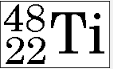
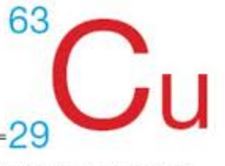
How many neutrons does Phosphorus (P) have?
15
16
30
31


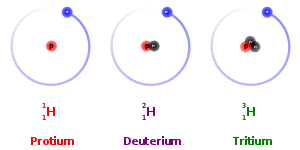


An isotope is:
An atom that has gained or lost electrons
An atom that has gained or lost neutrons
An atom that has gained or lost protons
An atom that is neutrally charged
If you have two isotopes and one has a percent abundance of 70%, what is the percent abundance of the second isotope? (remember there are ONLY two isotopes and you need 100%)
70
30
100
20
One atom contains 31 protons and 32 neutrons. Another atom of the same element has a mass number of 64. How many protons and neutrons does this unknown atom have?
31 protons & 32 neutrons
31 protons & 33 neutrons
32 protons & 33 neutrons
32 protons & 30 neutrons
What is the average atomic mass of an element if it has two isotopes, one with a percent abundance of 80% and a mass of 44, and one with a percent abundance of 20% and a mass of 46?
44.2
44.4
44.6
44.8
Gallium is an element found in lasers used in compact disc players. In a sample of gallium, there is 60.10% of 69Ga (atomic mass 68.926) atoms and 39.90% of 71Ga (atomic mass 70.925) atoms.
67. 76 amu
68.93 amu
69.72 amu
74.50 amu
What is the average atomic mass of Sulfur:
32S 95.02
33S 0.75
34S 4.23
32.1 amu
31.8 amu
32.3 amu
33.7 amu
What is the average atomic mass of carbon using isotopic composition: Carbon -12 (98.89%), Carbon-13 (1.11%), Carbon-14 (0.01%)
12.01 amu
12.11 amu
12.23
12.03
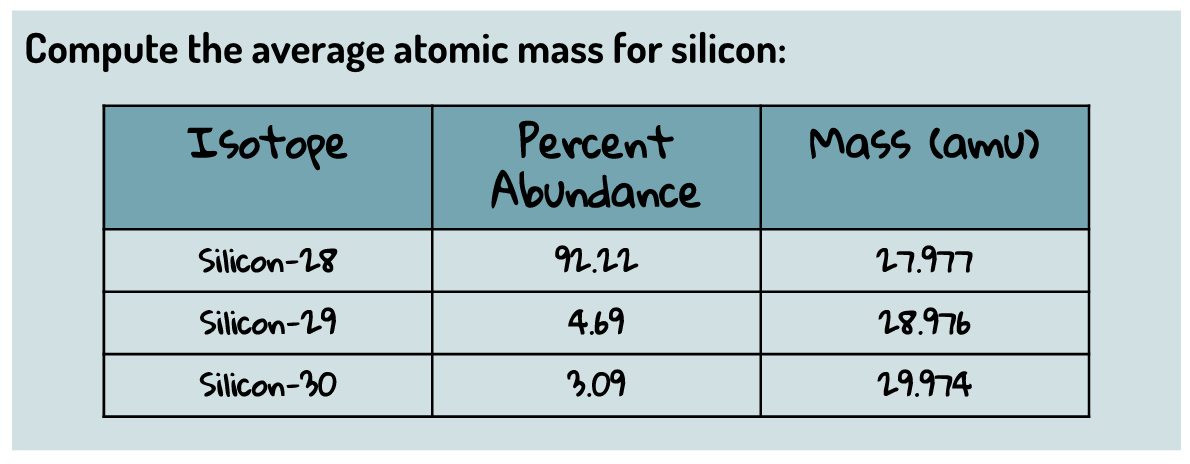
What is the average mass of this element?
The average atomic mass of an element is the ___.
average of the mass number and the atomic number for the element
weighted average of the masses of the isotopes of the element
total mass of the isotopes of the element
total number of subatomic particles in the nucleus
what is the average atomic mass of an element that has four isotopes? X-20 60%, X-21 20%, X-22 15%, & X-23 5%.
20.35 amu
20.45 amu
20.55 amu
20.65 amu
what is the average atomic mass of an element that has five isotopes? X-31 50%, X-32 20%, X-33 15%, X-34 10% & X-35 5%.
32 amu
31 amu
31.5 amu
32.5 amu
Magnesium has 3 isotopes: Mg-24 78.70%,
Mg-25 10.13%, and Mg-26 11.17% abundance.
Calculate the average atomic mass.
22.11 amu
24.31 amu
26.52 amu
25.76 amu

A
B
C
D
what is the average atomic mass of an element that has five isotopes? X-31 50%, X-32 20%, X-33 15%, X-34 10% & X-35 5%.
32 amu
31 amu
31.5 amu
32.5 amu
What unit is the average atomic mass traditionally recorded in?
m
Hz
amu
g
Element X has 2 naturally occurring isotopes. The first isotope has an atomic mass of 44.00 amu and its natural abundance is 74.18%. The second isotope has an atomic mass of 41.10 amu. What is the atomic mass of Element X?
(remember that your % abundances adds up to 100%. So you can find your other % abundance: 74.18% + # =100%)
43.25 amu
43.02 amu
43.47 amu
43.77 amu
One atom contains 20 protons and 21 neutrons. Another atom of the same element has a mass number of 44. How many protons and neutrons does this unknown atom have?
20 protons & 21 neutrons
20 protons & 24 neutrons
21 protons & 21 neutrons
21 protons & 24 neutrons
I. 7735X II. 7733X III. 8137X IV. 8135 X
Atom 2 has Mass= 14 Electrons=6
Are these atoms isotopes of each other or different elements?

Rubidium has two naturally occurring isotopes, 85Rb (relative mass 84.9118 amu) and 87Rb (relative mass 86.9092 amu). The abundance of 87Rb is 27.8%, If rubidium has an average atomic mass of 85.47 amu, what is the % abundance of 85Rb (in percent)?
27.9%
72.1%
74.63%
34.29%

