
 Worksheets
Basic Dysrhythmia Quiz (Norton)
Total questions: 25
Worksheet time: 50mins

atrial fibrillation
atrial flutter
2nd degree Mobitz I (Wenckebach)
Normal Sinus Rhythm with PAC

NSR with PVC
2nd degree Mobitz II
1st degree heart block
NSR

V-tach
Torsade de Pointe
SVT
a-fib

NSR
1st degree heart block
Sinus Brady
sinus arrhythmia

Sinus Brady
NSR with PAC
NSR
1st degree heart block

2nd degree Mobitz type I (wenckebach)
2nd degree Mobitz type II
Sinus arrhythmia
NSR with PAC

Junctional rhythm
A-fib
idioventricular
Sinus Brady

3rd degree heart block
2nd degree Mobitz type II
Sinus brady
A-flutter
What is the normal PR interval?
(a)
What is normal QRS interval range?
(a)

A-flutter
Sinus Tach
SVT
V-Tach

Idioventricular
NSR with unifocal PVC's
NSR
V-tach

A-fib
NSR
Sinus Tach
SVT

3rd degree heart block
NRS
Sinus arrhythmia
sinus tach

V-fib
A-fib
V-tach
SVT

NSR
Sinus Tach
NSR with PVC
NSR with PAC

v-tach
torsades de pointe
3rd degree heart block
asystole

1st degree heart block
NSR with pause
Sinus arrhythmia
Sinus Brady

a-flutter
a-fib
NSR w/ PAC
V-fib

3rd degree heart block
NSR
idioventricular
V-tach
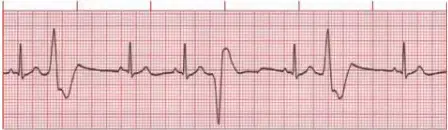
Idioventricular
NSR w/ PAC
NSR w/ multifocal PVC
Sinus arrhythmia
Match the following
Heart rate less than 60
Bradycardia
Heart rate greater than 100
Tachycardia
Irregular sawtooth rhythm
Atrial Flutter
STEMI
Myocardial Infarct
Non STEMI
Myocardial Ischemia
What is a normal QT interval?
(a)

NSR with PAC
2nd degree Mobitz 1 (Wenckebach)
A-fib
2nd degree Mobitz 2
Which wave represents atrial contraction?
P
QRS
T

