
Font size
S
M
L
XL
 Worksheets
Enzyme - Activity and assay
Total questions: 12
Worksheet time: 7mins
Name
Class
Date
1.
Name of the participant
4 lines
2.
Register Number
4 lines
3.
What is the name for the mechanism of enzyme activity?
a)
Lock and key
b)
jigsaw puzzle
c)
hammer and nail
d)
two hands pattern
4.
What is another name for enzymes?
a)
chemical catalysts
b)
microorganisms
c)
biological catalysts
d)
inorganic catalysts
5.
What factors affect an enzyme's reaction rate?
a)
temperature
b)
pH
c)
substrate concentration
d)
all of these
6.
Where do substrates bind on an enzyme?
a)
voltage-gated channels
b)
surface receptor
c)
calcium channels
d)
active site
7.
Which of these is most likely an enzyme?
a)
Sucrose
b)
Galactose
c)
Fructose
d)
Amylase
8.
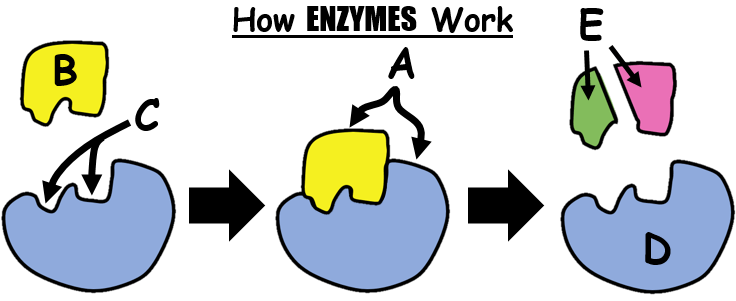
Letter B...
a)
active site
b)
enzyme
c)
substrate
d)
products
9.
What is the energy needed to start an chemical reaction referred to?
a)
Cascading Energy
b)
Potential Energy
c)
Kinetic Energy
d)
Activation energy
10.
Most enzymes are composed of .....
a)
Lipids
b)
Carbohydrates
c)
Proteins
d)
Nucleic Acids
11.
The salivary amylase hydrolyses starch into __________.
a)
Lipids
b)
Carbohydrate.
c)
Maltose
d)
Fats
12.
Enzymes are capable of increasing the rate of a chemical reaction within a living cell. Enzymes accomplish this through which of the following means?
a)
reducing the number of products
b)
reducing the activation energy
c)
increasing the temperature of the cell
d)
increasing the concentration of reactants
Reset

