wayground logo

Free Printable Worksheets

NEW

Font size

S
M
L
XL
Worksheets

Unit 1B Review (pre-AP)

Total questions: 28

Worksheet time: 42mins

Name
Class
Date
1.

The diagram represents two solids and the temperature of each. What occurs when the two solids are placed in contact with each other?

a)

Heat energy flows from solid A to solid B. Solid A decreases in temperature

b)

Heat energy flows from solid A to solid B. Solid A increases in temperature

c)

Heat energy flows from solid B to solid A. Solid B decreases in temperature.

d)

Heat energy flows from solid B to solid A. Solid B increases in temperature.

2.
The amount of energy required to raise the temperature 1ºC for every kilogram is called____?
a)
Thermal Energy
b)
Specific Heat
c)
Temperature
d)
Kinetic Energy
3.

What unit do you use to measure Heat Energy?

a)

J/Kg ºC

b)

Kg

c)

ºC

d)

J

4.
What is the symbol for Specific Heat
a)
Q
b)
t
c)
m
d)
C
5.

What is the equation to measure change in Heat Energy?

a)

Q=mc∆t

b)

Q=mc

c)

Q= ∆mct

d)

m=QC

6.
What does temperature measure?
a)
Heat
b)
ºC
c)
Kinetic Energy
d)
Thermal Energy
7.
How does heat flow?
a)
Always from cold to warm
b)
Always from warm to cold
c)
Both warm to cold & cold to warm
d)
It depends on the temperature
8.
What would be the effect on the particles if more heat is supplied to the system?
a)
They would slow down
b)
They would stop moving
c)
They would speed up
d)
There would be no effect
9.
A sample of iron receives 50.J of heat energy that raises the temperature of the iron 25.0°C. If iron has a specific heat of  0.10 J/g°C, what is the mass of the iron sample?
a)
25 g
b)
30 g
c)
20 g
d)
50 g
10.
Water exists as a _____________ at 700 mmHg and 50 °C.
a)
solid
b)
liquid
c)
gas
d)
supercritical fluid
11.
What phase change(s) may occur at pressures below 4.58 mmHg?
a)
sublimation/deposition
b)
melting/freezing
c)
all phase changes are possible at these pressures
d)
vaporization/condensation
12.
What is true regarding CO2 for temperatures above 31 °C?
a)
It can never be liquified.
b)
It decomposes.
c)
It has a high pressure.
d)
It is a plasma.
13.
What is the normal melting point of CO2?
a)
-78.5 °C
b)
-56.7 °C
c)
31 °C
d)
It doesn't have a normal melting point.
14.
What state of matter is Z?
a)
solid 
b)
liquid
c)
gas
d)
supercritical fluid
15.
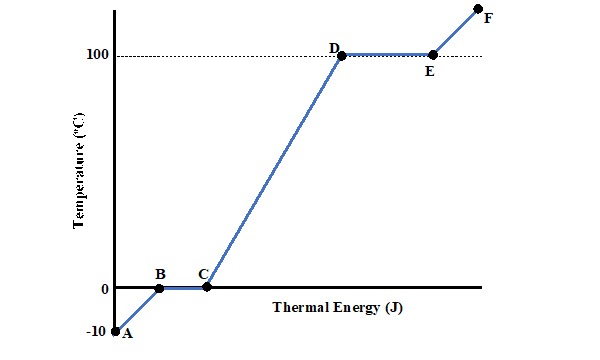
What line segment represents only the solid state?
a)
A-B
b)
B-C
c)
C-D
d)
D-E
16.

Between which two points is Heat of Fusion?

a)

A <----> B

b)

B <----> C

c)

C <----> D

d)

D <----> E

e)

E <----> F

17.

Between which two points is Heat of Vaporization?

a)

A <----> B

b)

B <----> C

c)

C <----> D

d)

D <----> E

e)

E <----> F

18.
In which segment is the kinetic energy remaining constant?
a)
A-B
b)
B-C
c)
C-D
d)
E-F
19.
A substance's heating curve is shown in the graph.  What is its boiling point?
a)
100 C
b)
60 C
c)
80 C
d)
20 C
20.
The graph shows a cooling curve for an unknown substance.  What is happening during segment DE?
a)
boiling
b)
condensation
c)
freezing
d)
melting
21.

How much energy would it take to heat 100g water from 20C to 75C?

a)

229.9 J

b)

22990 J

c)

-24975 J

d)

-22990 J

22.

How energy does it take to heat 60g of ice at -20C to a temperature of 75C?

a)

-19980 J

b)

2460 J

c)

19980 J

d)

41250 J

23.
If I have 5.6 liters of gas in a piston at a pressure of 1.5 atm and compress the gas until its volume is 4.8 L, what will the new pressure inside the piston be?
a)
1.75 atm
b)
1.8 atm
c)
1.3 atm
d)
1.29 atm
24.
A gas at 928 kpa, 129 C occupies a volume of 569 L. Calculate the volume at 319 kpa and 32 C.
a)
410.61 L
b)
418.18 L
c)
1100 L
d)

1256 L

25.
When Pressure increases then the Volume must...
a)
Increase
b)
decrease
26.
When Volume increases then Pressure must...
a)
Increase
b)
Decrease
27.
What type of relationship to pressure and volume have?
a)
direct
b)
inverse
c)
no relationship
d)
I don't know
28.
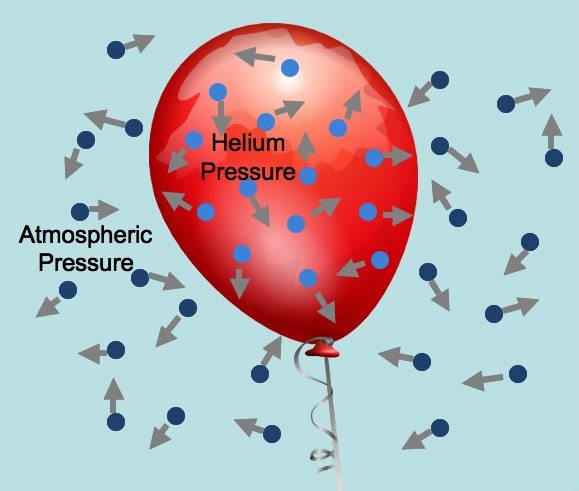
What causes pressure?
a)
The walls of the container
b)
The vacuum in the container
c)
The collisions of the particles
d)
Atmospheric pressure acting on the outside walls