wayground logo

Free Printable Worksheets

NEW

Font size

S
M
L
XL
Worksheets

Matter Test Review

Total questions: 46

Worksheet time: 43mins

Name
Class
Date
1.
Which state of matter has the most tightly packed molecules?
a)
solid
b)
liquid
c)
gas
2.
Which has the greatest distance between particles?
a)
Solid
b)
Liquid
c)
Gas
d)
The distance is the same
3.

The amount of space something takes up.

a)

mass

b)

density

c)

volume

d)

temperature

4.
Jack has a rock. The rock has a mass of 14g and a volume of 2cm3. What is the density of the rock?
a)
7 mL
b)
7 g/cm3
c)
28 g/cm3
d)
1/7 g/cm3
5.
What units can be used to express density?
a)
g/mL
b)
grams
c)
millimeters
d)
milliliters
6.
When a substance melts, the kinetic energy _____________.
a)
decreases
b)
stays the same
c)
increases
d)
decreases then increases
7.
What takes place when a liquid changes to a gas?
a)
condensation
b)
melting
c)
evaporation
d)
freezing
8.
What is the average kinetic energy of a substance called?
a)
volume
b)
temperature
c)
pressure
d)
movement
9.
What takes place when a solid changes to a liquid?
a)
condensation
b)
freezing
c)
melting
d)
evaporation
10.
If you have a liquid that changes to a gas, explain it's freedom of movement in both phases.
a)
molecules move away from each other, then around each other
b)
molecules move in place, then around each other
c)
molecules move around each other, then away from each other
d)
molecules move around each other, then in place
11.
If molecules in a substance move in place and energy is transferred into the substance
a)
then molecules move slower, and it will be a solid
b)
then molecules will move faster, and it will be a liquid
c)
then molecules will move faster, and it will be a solid
d)
then molecules will move slower, and it will be a liquid
12.
During a phase change what happens to temperature?
a)
it increases
b)
it decreases
c)
depends; if being heated it increases, if being cooled it decreases
d)
stays constant
13.
What is deposition?
a)
Phase change from gas to solid
b)
phase change from liquid to solid
c)
Phase change from solid to gas
d)
Phase change from liquid to gas
14.
7. All phase changes (changing states) requires energy to be added or taken away.
a)
True
b)
False
15.
What do we call the energy that an object has because it is moving?
a)
kinetic energy
b)
electrical energy
c)
potential energy
d)
temperature
16.

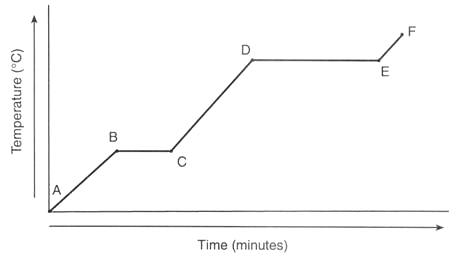
Are the particles moving faster or slower as time goes on?

a)

Faster

b)

Slower

17.

Is the substance gaining or losing energy?

a)

Gaining

b)

Losing

18.

What state/phase is the object likely from points A to B?

a)

Solid

b)

Liquid

c)

Gas

d)

Plasma

19.

What is happening to the particles in the substance between points A and B?

a)

Melting

b)

Freezing

c)

Speeding Up

d)

Slowing Down

20.

Is the substance gaining or losing energy?

a)

Gaining

b)

Losing

21.
Charles' Law States...
a)
As Pressure goes up volume goes down
b)
As Pressure goes up temperature goes up
c)
As Volume goes up temperature goes up 
d)
As Pressure goes down volume goes down 
22.
Directly proportional means that as one value increases ....................
a)
the other stays the same 
b)
the other increases as well
c)
the other decereases
d)
the other goes to zero
23.
Inversely proportional means as one value increases the other............. 
a)
increases 
b)
decreases 
c)
stays the same 
d)
goes to zero
24.
Temperature describes  the ______________ of particles.
a)
volume
b)
mass
c)
motion
d)
conductivity
25.
When a basketball is left outside in the cold it goes flat because the volume of air inside the ball has been reduced. What  gas law does this represent?
a)
Boyle's Law
b)
Charles's Law
26.

A student inflates a balloon with helium then places it in the freezer. The student should expect

a)

the balloon's volume to increase

b)

the balloon's volume to decrease

c)

the balloon's moles to increase

d)

the balloon's moles to decrease

27.

Pressure is

a)

defined as the mass that an object exerts when at rest.

b)

not a measurable in gases.

c)

defined as the number of moles of substance divided by the mass of the substance.

d)

created by the force of the gas particles impacting the walls of the container.

28.
Boyle's law :  The pressure and volume of a gas show a _____ relationship. 
a)
No relationship 
b)
Direct 
c)
Inverse 
d)
Equal
29.
Consider the lab station with the syringe probe. When the volume of air decreased what happened to pressure?
a)
pressure increased due to increased kinetic energy of each gas particle
b)
pressure increased due to the smaller volume and more collisions with the sides of the syringe
c)
molecules collided less due to the pressure decreased due to smaller volume  of molecules
d)
pressure increased because molecules were moving faster due to the increase number of molecules
30.
What would be the effect on the particles if more heat is supplied to the system?
a)
They would slow down
b)
They would stop moving
c)
They would speed up
d)
There would be no effect
31.
The symbol for specific heat is .......
a)
Cp
b)
Q
c)
m
d)
T
32.
A high specific heat means...
a)
It heats up quickly with energy added
b)
It requires more energy to change temperature
33.
You have 20 g of water with specific heat of 4.18 J/gŸ°C.  The temperature changes from 25° C to 20° C.  How much heat energy (Q) moves from the water to the surroundings?
a)
418 Joules
b)
209 J
c)
83 J
d)
4.18 J
34.

Boiling Water

a)

Conduction

b)

Convection

c)

Radiation

35.

Curling Iron

a)

Conduction

b)

Convection

c)

Radiation

36.

How is energy from the Sun transferred?

a)

by radiation

b)

by conduction

c)

by convection

d)

by the force of gravity

37.

How does heat move?

a)

from a warmer to a cooler object

b)

from a cooler to a warmer object

c)

toward a hot object

d)

away from a cold object

38.

__________ is the transfer of heat by the movement of a fluid.

a)

Conduction

b)

Convection

c)

Radiation

39.

When you touch hot sand, heat is transferred by _________ to your skin.

a)

conduction

b)

convection

c)

radiation

40.
Ironing a shirt is an example of...
a)
condensation
b)
conduction
c)
convection
d)
radiation
41.
A chair is several feet from a fireplace. The side of the chair facing the fireplace gets warm due to
a)
conduction
b)
convection
c)
radiation
42.
"Lava lamps" contain colored liquids. These liquids form globs that rise to the top due to
a)
conduction
b)
convection
c)
radiation
43.
What is the density of a substance that has a mass of 30g and a volume of 6 liters?
a)
24 g/l
b)
5 g/l
c)
36 g/l
d)
180 g/l
44.
What is the volume of Object X?
a)
10.0 cm3
b)
15.0 cm3
c)
20.0 cm3
d)
25.0 cm3
45.
What is the volume of 150 grams of lead if it has a density of 11.3 g/cm3?
a)
13.3 g
b)
13.3 cm3
c)
.075 g
d)
1695 cm3
46.
What is the volume of the fish?
a)
18.0 cm3
b)
6.0 cm
c)
38.0 cm3
d)
32.0 mL