
 Worksheets
APES Unit 1 Review
Total questions: 70
Worksheet time: 52mins
The concentration of carbon dioxide in the atmosphere
is increasing in part due to fossil fuel use.
has not significantly changed in the past 200 years.
is increasing in part due to deforestation.
has been decreasing since the 1800’s.
can not be reliably measured
The environment refers to
all conditions surrounding us on Earth.
species interactions that affect human life.
conditions that cause negative effects on our health.
interactions that harm the atmosphere.
the sum of all the conditions surrounding us that influence life.
An experiment is designed to determine if wheat grows better when it is planted alone or with clover. The design calls for 3 pans of each treatment. Pans A, B, and C contain only wheat. Pans D, E, and F contain clover and wheat planted in alternating rows. Each pan contains a total of
100 seeds. All treatments contain the same type of soil, are planted in the same size pan, are exposed to the same amount of sunlight, and are maintained at the same temperature throughout the course of the experiment.
The treatments planted with only wheat are the
sample size.
control.
environmental variable.
null hypothesis.
replication.
A tapeworm lives in the small intestines where it feeds and grows, robbing the human of essential nutrients. This is a _____ type of relationship.
Commensalism
Parasitism
Symbiotic
Mutualism
The cattle egret follows herds of cattle and eat the insects that the cattle stir up as they move through the grassland. The cattle appear to be unaffected by the egrets. This is a _____ type of relationship.
Commensalism
Parasitism
Symbiotic
Mutualism

In which biome would you expect to find an area with an average temperature of 10oC and 200 cm of precipitation annually?
Temperate seasonal forest
Temperate rainforest
Woodland/shrubland
Tropical seasonal forest
In which biome would you expect to find an area with an average temperature of 4oC and 50 cm of precipitation annually?
Tundra
Boreal forest
Temperate grassland/cold desert
Woodland/shrubland
Which biome is characterized by the presence of permafrost?
temperate seasonal forest
woodland/shrubland
tundra
boreal forest
What factors are used to classify a biome?
average temperature
average precipitation
distinctive plants adapted to area
all of these are correct
Terrestrial biomes are defined by ____ and ____ variables.
temperature; precipitation
temperature; animals
precipitation; plants
animals; plants
What is a herbivore?
receives energy from the sun
only eats meat
only eats plants
eats both plants and meat
A keystone species is best defined as
an organism that eats all others
an organism that runs the fastest
an organism that keeps the food web stable
an organism that has the most advantages
Which biome has warm temperatures, high precipitation, and little seasonal variation due to its location near the equator?
Boreal forest
Tropical rainforest
Woodland/shrubland
Subtropical desert
The direction of an arrow in a food chain represents
the flow of energy from organism B to A
the movement of organisms
the directionality of the sun
the flow of energy from organism A to B
All of the following is true about a niche generalist EXCEPT
thrives in multiple environments
feeds on specific food only
lives in various habitats
feeds on various food
What is an omnivore?
receives energy from the sun
only eats meat
only eats plants
eats both plants and meat
Most energy on Earth comes from
volcanoes
the sun
trees
water
fire
Which group of organisms perform photosynthesis?
scavengers
autotrophs
heterotrophs
decomposers
Exemplified by bees consuming nectar and carrying pollen from one flower to another
Commensalism
Parasitism
Mutualism
Predation
Competition

Which environment is characterized by the highest diversity of tree species?
A
B
C
D
E
Which environment is has permafrost as an underlying subsoil?
A
B
C
D
E
This biome is characterized by long dry seasons and is dominated by grasses, shrubs, and grazing animals.
Savanna
Boreal
Tropical Rainforest
Grassland

The location of the greatest remaining natural biodiversity
A
B
C
D
E
This freshwater biome is characterized by fast-flowing water that can originate from underground springs or runoff, which carries sediment and organic material.
Coral Reefs
Rivers
Freshwater Wetlands
Open ocean
This biome is considered to have the lowest primary productivity per square area
Open ocean
Wetlands
Coral Reefs
Rivers
The two major processes involved in the carbon cycle are
weathering and erosion
erosion and deposition
evaporation and transpiration
photosynthesis and respiration
fixation and denitrification
The two major processes involved in the nitrogen cycle are
weathering and erosion
erosion and deposition
evaporation and transpiration
photosynthesis and respiration
fixation and denitrification
Select the choice that best fits each statement.
Plant roots absorb ammonium ions and nitrate ions for use in making molecules such as DNA, amino acids, and proteins.
Denitrification
Assimilation
Ammonification
Nitrogen fixation
What is the main difference between phosphorus and the other major cycles?
Phosphorus exists in elemental form
Phosphorus does not have an atmospheric component
The phosphorus cycle occurs very rapidly
Phosphorus is not needed for life

The process in the hydrologic cycle in which water vapor is released from leaves into the atmosphere is called
Transpiration
Precipitation
Photosynthesis
Condensation
In a given ecosystem, producers convert solar energy into 15,000kcal of chemical energy stored in organic compounds. Which of the following is the most likely amount of energy available to primary consumers?
1.5 Kcal
150 kcal
1,500 kcal
13,500 kcal
Which of the following best describes the net primary productivity of an ecosystem?
Net primary productivity is the amount of energy captured by producers through photosynthesis over time.
Net primary productivity is the amount of energy lost by producers through respiration over time.
Net primary productivity is the amount of energy lost through respiration by producers subtracted from the gross primary productivity of an ecosystem.
The degradation of publicly shared resources is known as ___________
the tragedy of the commons
market failure
an external cost
discounting the future
greenwashing
Which of the below is an example of the tragedy of the commons?
clam beds in public area become depleted below replenishment levels
a large storm smothers a large oyster bed with sand
A company over-harvests its clam farm and devastates the pop
clams taken from the wild for research are later returned to the wild unharmed
a student who does not smoke contracts throat cancer after years of hanging out with her smoker friends


In general, algal blooms occur when
toxins accumulate in shellfish.
nutrients decrease in the water.
nutrients increase in the water.


An organisms special role or position, such as where it lives, how it eats or behaves, and how it interacts with other organisms and the environment.
ecosystem
food web
habitat
niche
An observer notes that the various birds in her yard feed on are using different parts of the tree for nesting sites and food. This is an example of _______________
division of labor
resource conservation
resource partitioning
mutualism
Which of the following ecosystems experiences harsh conditions due to conditions from tides?
Coral reef
Freshwater wetlands
Open ocean
Intertidal zone
What is the effect of deforestation on the carbon cycle?
Increase in the amount of CO2 in the atmosphere
Decrease in the amount of CO2 in the atmosphere
Increase in the amount of photosynthesis
Deforestation has no impact on the carbon cycle
The largest reservoir of nitrogen is the:
Oceans
Rivers
Rock, Lithosphere, & Land
Atmosphere
Nitrogen is added to the atmosphere by:
Denitrification
Fixation
Nitrification
Ammonification
Nitrogen is removed from the atmosphere by:
Denitrification
Fixation
Nitrification
Ammonification
Which of the following best illustrates an abiotic factor affecting a biotic component?
Composting manure is added to agriculture
Phosphorous content in soil affecting plant growth
Plants release oxygen into the atmosphere.
Plants preventing soil erosion
If gross primary productivity in a wetland is 3 kg C/m2/year and respiration is 1.5 kg C/m2/year, what is the net Primary Productivity of the wetland?
1.5 kg C/m2/year
2 kg C/m2/year
3 kg C/m2/year
4.5 kg C/m2/year
The gross primary productivity of an ecosystem is?
the total amount of biomass.
the total energy captured by photosynthesis.
the energy captured after accounting for respiration
the energy available to primary consumers.
If gross primary productivity is 5 gC/m2yr, and the producers need 1.5 gC/m2yr for their own respiration, what is the net primary productivity?
3.5 gC/m2yr
6.5 gC/m2yr
-3.5 gC/m2yr
7.5 gC/m2yr
Place the ecology levels of organization in proper order (smallest to largest)
organism > population > community > ecosystem > biosphere
community > organism > ecosystem > biosphere > population
organism > community > biosphere > population > ecosystem
population > biosphere > ecosystem > community > organism

It refers to the movement/ transfer of contaminant from one trophic level to another.
Bioaccumulation
Biomagnification
Bioremediation
Phytoremediation
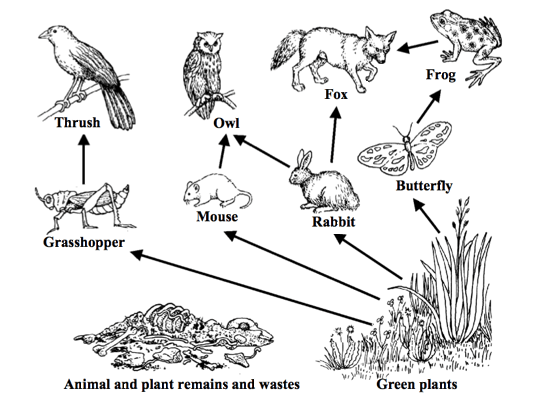
What law best relates to energy loss within an ecosystem?
First law of thermodynamics
Second law of thermodynamics
Third law of thermodynamics
Law of conservation of matter

Analyze and interpret the graph. What pattern do you see between the hare and lynx
As the prey density increases the number of predators increase
As the prey density decreases the number of predators increase
As the prey density increases the number of predators decrease
Both the prey density and predator density stay the same.
None of the above

According to the graph, what is causing the deer population to decrease
They got sick
The wolf population is decreasing
The wolf population increased
They ran out of food

Predator population lags behind prey population because......
Increase in predators leads to decrease in prey
Increase in predators leads to increase in prey
Increase in predators leads to decrease in producers
Increase in producers leads to increase in prey

What happens if a population grows past its carrying capacity?
The population keeps growing
The population starts to die off
The entire species will go extinct
The carrying capacity just increases

