
 Worksheets
Year 11 Summative assessment Part 1 and 2
Total questions: 23
Worksheet time: 8mins

Using the diagram, which letter is the Vas Deferens?
H
I
J
K
What is the function of vas deferens?
A muscular tube that passes upward alongside the testes and transports mature sperm to the urethra.
Sperm storage organ.
Feces holding area.
It produces sugar- rich fluid that provides sperm with a source of energy to help them move.

Which pituitary hormones regulate the human menstrual cycle?
FSH and LH
Progesterone and estrogen
HCG and estrogen
FSH and oxytocin
Which hormone promotes the thickening of the endometrium and also inhibits the hormone that promotes the development of the follicle wall into the corpus luteum?
LH
Progesterone
FSH
Estrogen
Spermatogenesis involves...
Mitosis only
Meiosis only
Mitosis followed by meiosis

The diagram shows oogenesis process. Primary oocyte is repesented by number...
1
2
3
4
5
What are the functions of LH and FSH in the menstrual cycle?
LH- causes ovulation,
FSH- causes menstruation
LH- causes ovulation,
FSH- stimulates an egg to mature in an ovary
LH- stimulates an egg to mature in an ovary, FSH -causes menstruation
LH- stimulates an egg to mature in an ovary, FSH -causes ovulation

The graph shows the concentration in the blood of three of the four hormones FSH, LH, oestrogen and progesterone.
Which hormone is not shown?
FSH
LH
Oestrogen
Progesterone
What is the name of the prenatal test that involves taking a sample of tissue from the membrane that encases the fetus (placenta)
alpha-fetaprotein
amniocentesis
chorionic villus sampling
ultrasound
What is the process of an egg being released by the ovaries called?
Menstruation
Ovulation
Gestation
Conception
What is true about the placenta?
It allows the egg to travel from the ovary to the uterus
It is expelled when a woman menstruates
It determines the baby's genetic traits
It connects the developing baby to the uterus
What is not an example of a birth defect?
Cleft palate
Muscular dystrophy
Amniocentesis
Cerebral palsy
This is the bypass in the fetal heart that allows blood to move directly from the pulmonary artery to the aorta.
foramen ovale
umbilical artery
umbilical vein
ductus arteriosus

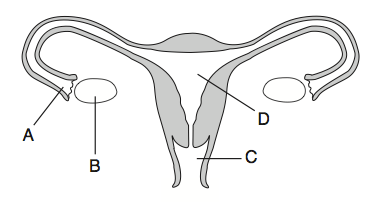
The function of part B is to _______.
produce eggs
produce sperms
allow fertilisation to take place
release the sperm
In what order does sperm travel through the female reproductive system?
Vagina > Uterus > Cervix > Fallopian Tubes
Vagina > Urethra > Cervix > Fallopian Tubes
Cervix > Vagina > Uterus > Fallopian Tubes
Vagina > Cervix > Uterus > Fallopian Tubes
Vagina > Cervix > Urethra > Fallopian Tubes
Muscular contractions of the uterus
Factor that HELP sperm get to the ovum
Factor that PREVENT sperm get to the ovum

