
 Worksheets
Velocity-Time Graph Practice
Total questions: 35
Worksheet time: 24mins

Select the description of motion from A - B.
Slowing down away from the origin
Speeding up away from the origin
Constant velocity away from the origin
Constant velocity towards the origin

What segment of the graph shows no motion, or standing still?
A - B
B - C
C - D
None

True or False: this graph shows several segments ALL with constant velocity.
True
False

Describe motion of C - D.
Constant velocity away from the origin
Slowing down away from the origin
Slowing down away from the origin and then slowing down towards the origin
Slowing down away from the origin and then speeding up towards from the origin

Describe the motion from B - C.
Standing still
Constant velocity of 60 m/min
Constant velocity of 0 m/min
Accelerating
What does a horizontal line (not on the x-axis) mean on a V-T graph?
No movement
Constant velocity
Changing velocity
Change in direction

What is happening at 0 m/min in the middle of segment C - D?
Nothing is happening
Change in speed
Change in position
Change in direction

Which segment shows an object speeding up towards the origin?
A - B above the x-axis
C - D below the x-axis
C-D above the x-axis
D - E

Part D of the graph is from 55s to 95s. During Part D, the velocity values are all negative. What does negative velocity mean?
The object is slowing down.
The object is moving in the opposite direction now.
Part C of the graph is from 35s to 55s. Which of these statements is true about Part C?
The object is at rest.
The object is accelerating (its velocity is increasing)
The object is decelerating (its velocity is decreasing)
The object is moving at a constant velocity.
During section A of the graph (between 0s and 25s), the object is accelerating.
Change in velocity in this time = 3 - 0 = 3m/s
Time taken = 25 - 0 = 25s
What is its acceleration?
Acceleration = Change in velocity x time = 3 x 25 = 75m/s2
Acceleration = Change in velocity / time = 3/25 = 0.12m/s2
The gradient of a velocity-time graph represents (a) .


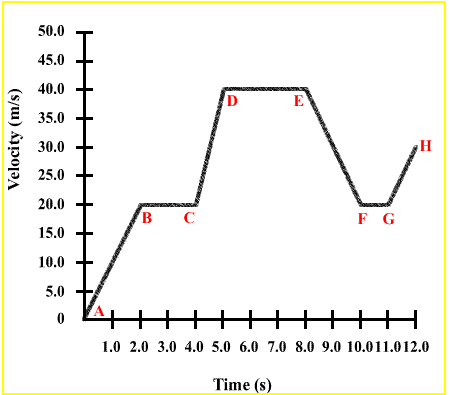
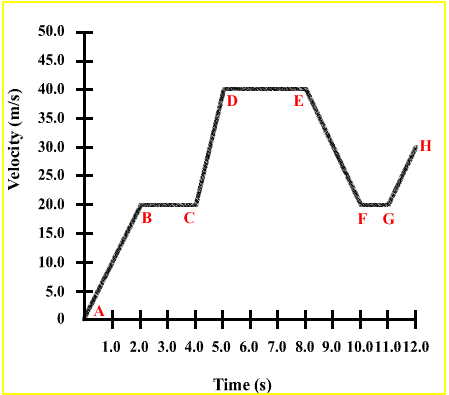


Where is the acceleration the highest?
0-1s
1-3s
3-5s

Explain the motion
Stationary
Constant speed
Constant acceleration
Non-constant acceleration
The acceleration from 0-1s is (a) m/s2.
The acceleration from 3-5s is (a) m/s2.
The deceleration from 5-7s is (a) m/s2.
Calculate the total distance traveled in the first 1s.
(a)
Calculate the total distance traveled in the first 3s.
(a)

