wayground logo

Free Printable Worksheets

NEW

Font size

S
M
L
XL
Worksheets

Electrostatics

Total questions: 30

Worksheet time: 22mins

Name
Class
Date
1.

Two like charges

a)

don't interact

b)

repel

c)

attract

d)

add up to 2

2.

Particles with opposite charges

a)

attract

b)

rebel

c)

repel

d)

attack

3.

A -2C charge and a 4C charge attract each other with 10 N of force. How much will a 2-C charge and an 8-C charge attract each other when placed the same distance apart?

a)

40 N

b)

20 N

c)

10 N

d)

8 N

4.

Sphere A has a positive net charge. Sphere B has a negative net charge. If a neutral sphere was placed between spheres A and B, the charge distribution of the sphere would look like...

a)
b)
c)
d)
5.
What is the name of the particle that is being transferred?
a)
Proton
b)
Neutron
c)
Electron
d)
Positron
6.
What is the overall charge on this balloon? (They are the same so look at either one!)
a)
+3
b)
-6
c)
+6
d)
-3
7.
After you rub a balloon on your hair, the balloon has a negative charge. What charge does your hair have?
a)
Positive
b)
Negative
c)
Neutral
8.
Consider the conduction charging shown. 
a)
Electrons move from the insulating stand into the sphere.
b)
Protons move from the bar into the sphere.
c)
Electrons move from the charged metal bar into the sphere.
d)
Protons move from the sphere into the negatively charged bar.
9.

Two electrically neutral metal spheres, A and B, on insulating stands are placed in contact with each other. A negatively charged rod is brought near, but does not touch the spheres, as shown in the diagram below. How are the spheres now charged?
a)
A is positive and B is positive.
b)
A is negative and B is positive.
c)
A is positive and B is negative.
d)
A is negative and B is negative.
10.
Electrostatic force F exists between two point charges. If the both charges are doubled, the force between the charges will be
a)
F
b)
4F
c)
2F
d)
F/4
11.
A metal sphere having an excess of +5 elementary charges has a net electric charge of
a)
8.0 x 10⁻¹⁹ C
b)
8.0 x 10¹⁹ C
c)
1.6 x 10⁻¹⁹ C
d)
5.0 x 10⁻¹⁹ C
12.
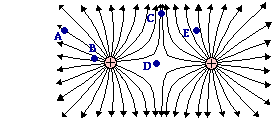
Which of the following labeled points is in the region with the strongest force of electric charge
a)
A
b)
B
c)
C
d)
D
13.
What is the unit of electric charge?
a)
Volts
b)
Amps
c)
Coulombs
d)
Ohms
14.

Which is the field for opposite charges

a)
b)
c)
d)
15.

Two charges are 0.20 m apart and experience a force of 500 N. if the distance between them becomes 0.60 m, what is the new force

a)

4500

b)

540

c)

1500

d)

55.6

16.
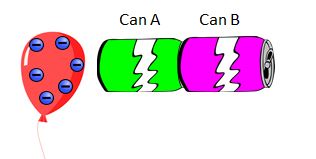
The negatively charged balloon is brought near the two cans. What happens?
a)
The negative charges in Can B move towards the balloon
b)
The negative charges in Can A move away from the balloon
c)
The positive charges in Can B move towards the balloon
d)
The positive charges in Can A move away from the balloon
17.
Which of these is the best definition of polarization?
a)
The object gains a positive or negative charge from another object.
b)
The charges in a neutral object separate due to a nearby charged object.
c)
Charges on a neutral object jump off onto a charged object due to attraction of opposite charges.
d)
Two objects attract each other because they are both charged.
18.

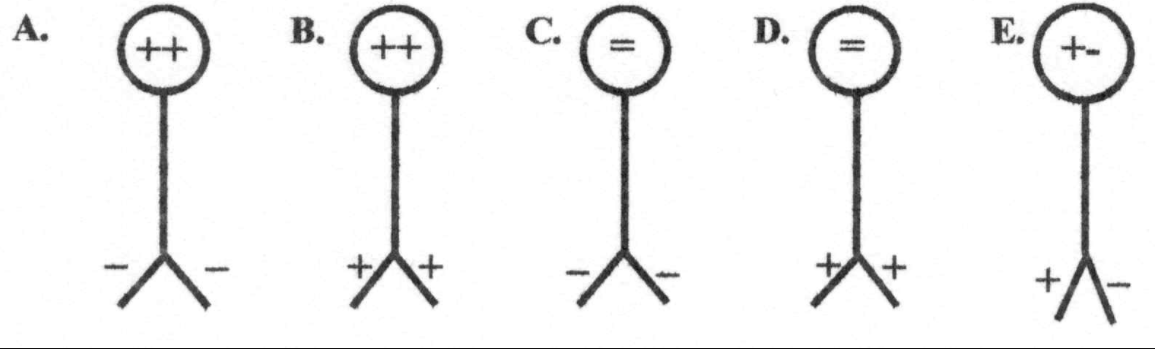
A negatively charged rod is touched to the top of an electroscope. Which shows the resulting charge?

a)

A

b)

B

c)

C

d)

D

e)

E

19.

During induction, grounding is necessary in order for the neutral object to become charged.

a)

true

b)

false

20.

What charge will the metal plate have?

a)

positive; protons attract protons

b)

positive; protons attract electrons

c)

negative; protons attract electrons

d)

negative; protons attract protons

21.

A negatively charged rod is brought close to, but not touching a neutral electroscope. Then the charged rod is moved far away from the electroscope. Which shows the resulting charge?

a)

A

b)

B

c)

C

d)

D

e)

E

22.
As a proton moves in the direction the electric field lines...
a)
it is moving from low potential to high potential and gaining electric potential energy.
b)
it is moving from low potential to high potential and losing electric potential energy.
c)
it is moving from high potential to low potential and gaining electric potential energy.
d)
it is moving from high potential to low potential and losing electric potential energy.
23.

The direction of electric field lines shows the

a)

direction of the force on a test positive charge.

b)

size of the field.

c)

strength of the field.

d)

all of the above

24.
Qand Qare two charges creating an electric field. Based on the electric field lines, we can conclude
a)
Qand Qare both positive
b)
Qand Qare both negative
c)
Qis positive and Qis negative
d)
Qis negative and Qis positive
25.

When work is done on a positive test charge by an external force to move it from one location to another, potential energy _________ (increases, decreases) and electric potential _________ (increases, decreases).

a)

increases, increases

b)

increases, decreases

c)

decreases, increases

d)

decreases, decreases

26.

Is work done on the positive charge to move it from point A to point B?

a)

Yes

b)

No

27.

Electric potential energy is greatest at point...

a)

A

b)

B

28.

Work must be done on a + charge to move it against (i.e., in the opposite direction of) an electric field.

a)

True

b)

False

29.

As a + charge moves in the same direction as an electric field, it gains electric potential.

a)

True

b)

False

30.
A region of space contains a uniform electric field, directed toward the right, as shown in the figure. Which statement about this situation is correct?
a)
The potential at point A is the highest, the potential at point B is the second highest, and the potential at point C is the lowest.
b)
The potential at points A and B are equal, and the potential at point C is lower than the potential at point A.
c)
The potential at all three locations is the same.
d)
The potentials at points A and B are equal, and the potential at point C is higher than the potential at point A.