
 Worksheets
Biomolecules
Total questions: 52
Worksheet time: 22mins
Maya is baking cookies and wants to understand what elements are present in the sugar she is using, which is a carbohydrate. What elements make up carbohydrates?
carbon, hydrogen, oxygen
carbon, nitrogen, hydrogen
carbon, oxygen, sulfur
carbon, hydrogen, nitrogen
Aria is baking cookies and wants to understand what the basic building blocks of carbohydrates are. What is the monomer of carbohydrates?
amino acids
fatty acids
monosaccharides
nucleic acids
Daniel is baking cookies and wants to use the simplest type of sugar possible. He reads that monosaccharides are made of _____ sugars. What number should he write down?
0
1
2
many
Miracle is reading about different types of sugars in her biology class. She learns that lactose is a ________ sugar found in _____. What did Miracle discover?
double; green plants
triple; milk
simple; fruit
double; milk
Abby is preparing for her biology exam and comes across a question: "What type of polysaccharide is starch in plants?" She needs to fill in the blanks: Starch is the _______ polysaccharide in _______.
structural; plants
storage; plants
structural; animals
storage; animals
Nora is learning about different types of sugars in her biology class. She discovers that the simplest sugars are called what?
monosaccharides
disaccharides
polycharides
Abigail is helping her younger sister with a science project about plants. She explains that the strength of plant stems comes from a special material in their cell walls. What is the main component of the cell wall of plant cells that Abigail should mention?
lignin
cellulose
pectin
chitin
After eating a big meal, Anika's body needs to store the extra carbohydrates for later use. In animal cells, how is this excess carbohydrate stored?
starch
glycogen
fats
glucose

Mia is learning about the different sugars found in foods. She wants to know which sugar is found in milk. Which one should she choose?
maltose
galactose
fructose
sucrose
Sophia is learning about healthy eating in her class. Her teacher asks her to identify which foods are sources of carbohydrates. Some carbohydrate foods are ________
fruits
grains
vegetables
all the above
Kai is enjoying a fresh apple and wonders what simple sugar from the fruit gives it its sweet taste. The simple sugar from fruit is called_____.
sucrose
lactose
fructose
maltose

Lily is studying for her biology exam and comes across the following diagram in her textbook. She wonders what type of carbohydrate is shown in the image. What type of carbohydrate is this?
polysaccharide
disaccharide
monosaccharide
it isn't a carbohydrate
Elijah is preparing for a long hike and needs to choose foods that will help him have enough energy throughout the day. Which function of carbohydrates makes them a good choice for Elijah?
Stores energy
Movement
Stores genetic information
Speeds up reactions

Sophia is looking at the structure of a molecule in her biology class, as shown in the image. She wants to know: this is an example of what macromolecule?
disaccharide
fat
monosaccharide
Lipid

Mia is preparing a healthy meal and includes foods like bread, corn, potatoes, pasta, and oats. These are examples of
carbohydrates
lipids
proteins
nucleic acids
Zoe is studying plants in her biology class. She learns that the strength of plant stems comes from a certain polysaccharide in their cell walls. What polysaccharide makes up plant cell walls?
cellulose
glycogen
chitin
starch
Abigail is learning about different types of nutrients in her science class. Her teacher asks her, "What is the common name for carbohydrates?"
sugars/starches
proteins
fats
oils
Emma is studying biology and wants to understand how cells pass on information from one generation to the next. Which of the following best describes the function of nucleic acids in this context?
Perform cell's functions/tasks
Fast energy
Energy storage
Alter other biomolecules
Store genetic information for cells
Bowhead whales can have a specialized layer of blubber up to 30 cm’s thick. This acts as a special insulation that traps the heat their muscles create from movement.
What biomolecule is the blubber primarily made of?
Carbohydrates
Lipids
Proteins
Nucleic Acids
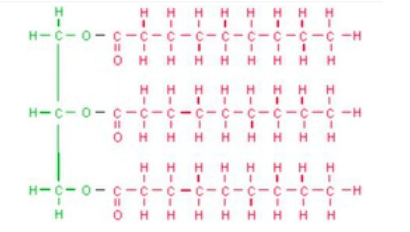
James is studying for his biology exam and comes across the following molecular structure in his textbook. He wonders which type of biomolecule it represents. Which biomolecule is this a picture of?
Protein
Nucleic Acid
Lipid
Carbohydrate

Jack is studying for his biology exam and comes across this picture in his textbook. The hint says it is made of amino acids. Which biomolecule is Jack looking at?
Proteins
Nucleic Acids
Lipids
Carbohydrates
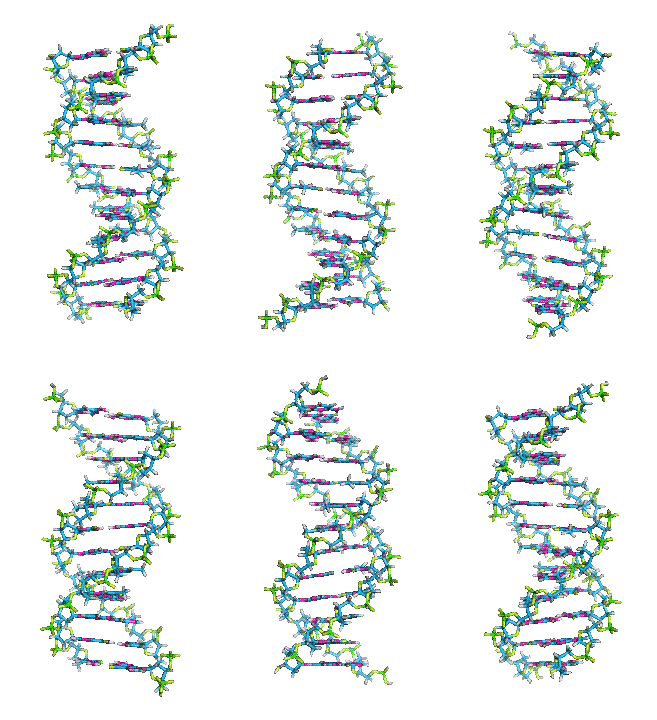
Emma is learning about the molecules that make up living things in her biology class. She discovers that her DNA is made of a biomolecule built from nucleotides, and that this type of molecule carries genetic information. Which biomolecule is Emma studying?
Carbohydrate
Lipids
Protein
Nucleic Acid

Lily is learning about different substances in her kitchen, like butter, cooking oil, and beeswax. She wonders which biomolecule group these fats, oils, and waxes belong to. Which group do they fall under?
Proteins
Nucleic Acid
Lipids
Carbohydrate

Charlotte is building a model of DNA for her biology class. She wants to use the correct building block to represent a nucleic acid. Which of the following should she use?
Monosaccharide
Amino Acid
Nucleotide
Polysaccharide
James is building a long chain using small identical building blocks. In science, ALL such large molecules (polymers) are made up of...
monosaccharides
monomers
proteins
None of these
Charlotte is preparing for her biology exam and is reviewing a list of substances found in living organisms. She comes across the following items: Water, Nucleic Acid, Protein, and Lipid. Which of the following is NOT a biomolecule?
Water
Nucleic Acid
Protein
Lipid
Grace is preparing a biology project about the building blocks of different biomolecules. She is currently focusing on lipids and needs to identify their monomer. Which of the following should Grace choose as the monomer for lipids?
Monosaccarides
glycerol and Fatty Acids
Amino Acids
Nucleotides
Scarlett is baking a cake and wants to understand the building blocks of different nutrients. She wonders, what is the monomer for proteins?
Monosaccarides
Fatty Acids
Amino Acids
Nucleotides

While studying biology, Anna learns that the structure of a cell membrane is crucial for its function. She wonders which type of lipid is primarily responsible for forming the cell membrane. Which type of lipid makes up cell membranes?
Protein
triglyerides
phospholipids
waxes
Martha is learning about what makes up her genetic material in science class. Which biomolecule is responsible for making up her genes?
Carbohydrate
Lipid
Nucleic Acid
Protein
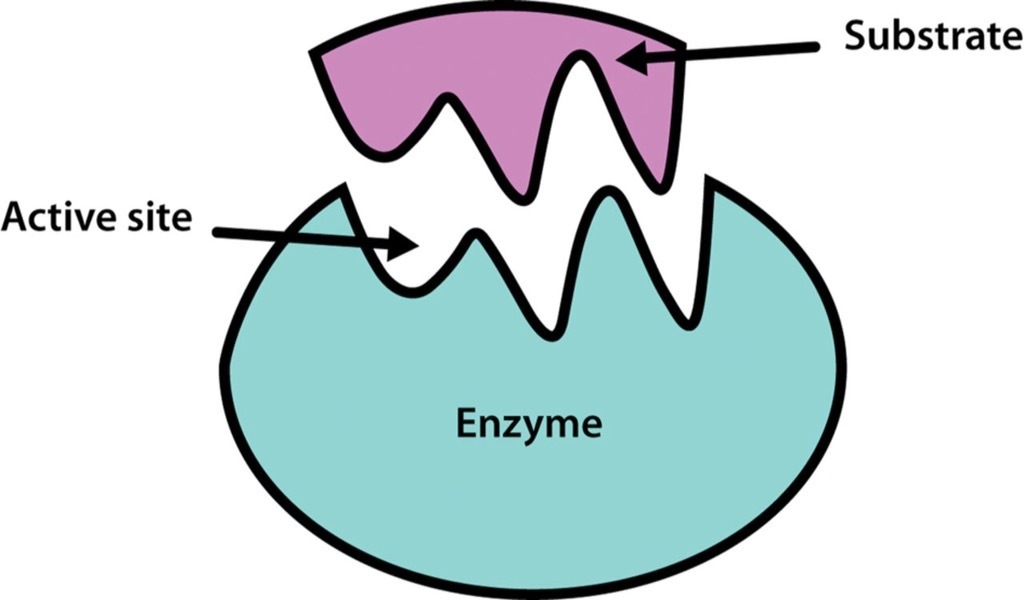
Maya is learning about how the body breaks down food and comes across enzymes. She wonders, what type of biomolecule do enzymes belong to?
Carbohydrate
Lipid
Nucleic Acid
Protein
Priya is baking cookies and adds a special ingredient that helps the dough rise much faster than usual. What is the purpose of this special ingredient, which acts like an enzyme?
give permission for the reaction
raise activation energy
speed up reactions
control how many reactions occur
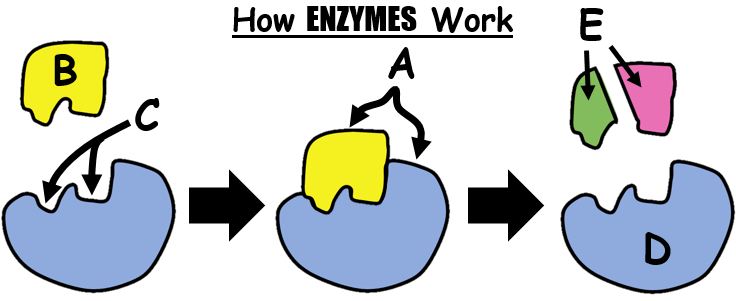
Ethan is baking cookies and uses a special tool to help break down sugar faster. In the diagram, what does letter D represent in this real-world scenario?
enzyme
substrate
enzyme-substrate complex
active site
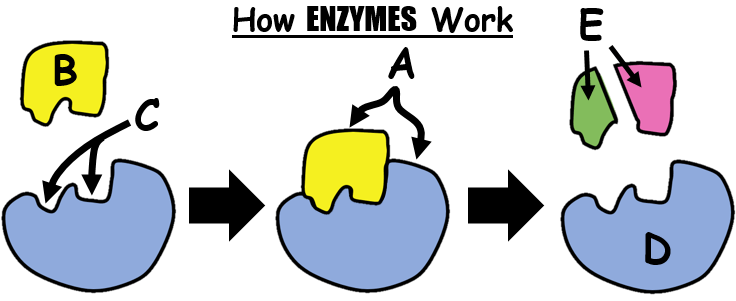
Scarlett is baking cookies and uses a special cookie cutter (the blue shape) to cut dough (the yellow shape) into fun designs. The part of the cookie cutter where the dough fits perfectly is labeled C. What is this part called?
active site
enzymes
substrate
products
Arjun accidentally spills some water on a table. He notices that the water forms droplets and does not spread out on the surface. What term best describes the property of the table's surface?
Hydrophobic
Hydrophilic
Hydroelectric
Hydroloric

Abigail is studying a diagram of a cell membrane in her biology class. She wants to identify which labeled part represents the hydrophobic region of the cell membrane. Can you help her choose the correct label?
E
B
C
A
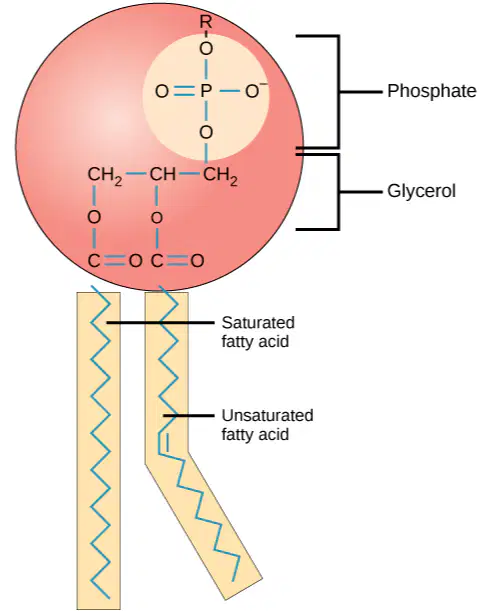
Scarlett is learning about cell membranes in her biology class. Her teacher asks her whether the heads of phospholipids are hydrophobic or hydrophilic. What should Scarlett answer?
Hydrophobic
Hydrophilic
Graham is learning about DNA in her biology class. She discovers that in DNA, Adenine (A) always binds with which of the following?
Adenine
Thymine
Cytosine
Guanine
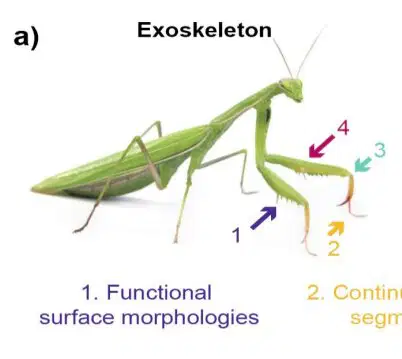
Mary is studying insects and notices that their bodies are covered by a hard outer layer called an exoskeleton. She wonders which polysaccharide is used to build this exoskeleton. Which one is it?
starch
glycogen
cellulose
chitin

Abigail is learning about nutrition and wants to know what type of fat is commonly found in meat and dairy products. What type of fat should she learn about?
sucrose
saturated fats
unsaturated fats
proteins

Harper is looking at diagrams of different biological molecules in her science class. She notices that one of the nucleic acids is single stranded. Which nucleic acid is single stranded?
DNA
lipids
starches
RNA
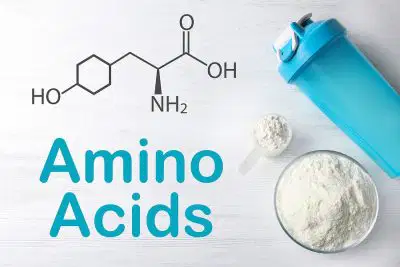
Jackson is learning about proteins in his biology class. His teacher asks him, "How many different amino acids are there that make up proteins in the human body?"
4
20
30
60
Etta is baking cookies and uses a special cookie cutter that only works with dough pieces that are the right size and shape. This is similar to how enzymes are specific. This means that an enzyme only works with molecules that are....
the right size and shape
broken down already
present in water
too big for the body to handle

Ava is learning about how enzymes work in her biology class. She looks at a diagram showing the process and sees that letter D is labeled on one of the shapes. What does letter D represent in the context of enzymes?
enzyme
active site
substrate
products

Benjamin is baking cookies and wants to understand how enzymes work in his dough. He looks at a diagram showing how enzymes interact with other molecules. In the diagram, what does letter B represent?
substrate
active site
enzyme
products

Sophia is learning about how enzymes work in her biology class. She looks at a diagram showing how a specific part of the enzyme fits perfectly with the substrate, allowing the reaction to happen. In the diagram, what does letter C represent?
products
substrate
enzymes
active site
Abigail is cooking an egg and notices that after heating, the egg white changes texture and the proteins inside no longer work the same way. What happens to the enzyme in the egg when it is denatured?
Activation energy is lowered
It becomes stronger
It loses its shape
Activation energy is raised
Jackson is conducting an experiment in his kitchen to learn about enzymes. He notices that when the temperature gets too high, the enzymes seem to stop working. He also reads that extreme pH can affect enzymes, and that enzymes help speed up chemical reactions. Which of these is NOT true about what Jackson is learning?
Enzymes can denature (change shape) when the temperature gets too high.
Enzymes can only be used once in a chemical reaction.
Extreme pH can denature enzymes.
Enzymes speed up chemical reactions.
Luna is conducting an experiment in her biology class. She notices that the enzymes she is studying work best at a certain temperature and pH. Does this mean that every enzyme has an optimal temperature and pH? True or False?
True
False
Imagine Evelyn is trying to park her car in a reserved parking spot, but another car, which looks very similar to hers, quickly takes the spot before she can. What type of regulation is this similar to, where an inhibitor molecule is similar enough to a substrate to bind to the active site and simply block the substrate from binding?
Noncompetitive inhibition
Competitive inhibition
Feedback inhibition
Allosteric regulation
A noncompetitive inhibitor may inhibit binding of a substrate to an enzyme by
binding to the substrate.
binding to the active site.
lowering the activation energy.
increasing the ΔG of the reaction.
changing the shape of the active site.

The structure shown here is ____. It fits into the macromolecule category lipids because
Saturated Fat;
it dissolves in water
Cholesterol; it does not dissolve in water
Unsaturated fat; it has fatty acids tails
Cellulose; it makes up starch

