wayground logo

Free Printable Worksheets

Font size

S
M
L
XL
Worksheets

Review

Total questions: 47

Worksheet time: 28mins

Name
Class
Date
1.

The following features are found only in the plant cell

a)

Lysosome

b)

Cell wall

c)

Chloroplast

d)

Central vacuole

2.

The main function of rough ER is

a)

Fat production

b)

Protein production

c)

Breaking down alcohol and drugs

d)

Delivering proteins to Golgi Body

3.

The nucleus is the

a)

Power house of the cell

b)

Waste collector in the cell

c)

Control center of the cell

d)

protein factory in the cell

4.

It is mainly membrane-enclosed spaces stacked on top of each other

a)

Rough ER

b)

Mitochondria

c)

Smooth ER

d)

Golgi Apparatus

5.

It provides the cell with energy

a)

Vesicle

b)

Nucleus

c)

mitochondria

d)

Vacuole

6.

It is the waste collector and recycler in the animal cell

a)

Ribosome

b)

Vesicle

c)

Central vacuole

d)

Lysosome

7.

Centrosome and centrioles play a major role in

a)

Cell movement

b)

Cell division

c)

Cell contraction

d)

Cell membrane

8.

Movement of anything from an area of high concentration to low concentration.

a)

Passive Transport

b)

Hypotonic

c)

Isotonic

d)

Active Transport

9.
A solution that contains more dissolved substances than the cell it surrounds.  Water leaves the cell. Cell shrinks.
a)
Exocytosis
b)
Osmosis
c)
Hypertonic
d)
Passive transport
10.

Movement of particles into the cell that does require energy. From low to high.

a)

Facilitated Diffusion

b)

Osmosis

c)

Isotonic

d)

Active transport

11.
Movement of water from an area of high concentration to low concentration.  Diffusion of water.
a)
Exocytosis
b)
Osmosis
c)
Hypotonic
d)
Isotonic
12.
Process by which very large particles are brought into the cell by the formation of vacuoles.
a)
Isotonic
b)
Hypotonic
c)
Exocytosis
d)
Endocytosis
13.
Solution that contains the same amount of dissolved substances as the cell it surrounds.  No water movement. Shape stays the same.
a)
Hypotonic
b)
Isotonic
c)
Diffusion
d)
Endocytosis
14.
Solution that contains less dissolved substances than the cell it surrounds.  Water enters the cell. Cell swells up.
a)
Exocytosis
b)
Isotonic
c)
Hypotonic
d)
Active transport
15.
Movement of particles from high to low through a transport protein.  Form of passive transport.
a)
Facilitated diffusion
b)
Active transport
c)
Endocytosis
d)
Hypotonic
16.
Bacteria is frequently used in the ____________system to break down food.
a)
integumentary
b)
digestive
c)
reproductive
d)
muscular
17.
The type of polysaccharide which serves as a strengthening tissue in the cell wall of plants is 
a)
cellulose
b)
glucose
c)
lactose
d)
fructose
18.
Glucose is a _____.
a)
carbohydrate
b)
lipid
c)
protein 
d)
nucleic acid
19.
Proteins are composed of what smaller building blocks?
a)
amino acids
b)
nucleic acids
c)
fatty acids
d)
nucleotides
20.
Which group of organic molecules serve as long-term energy storage and make the cell membrane is?
a)
proteins
b)
carbohydrates
c)
lipids
d)
nucleic acids
21.
The primary purpose the body uses monosaccharides for is?
a)
Building muscles
b)
Helping the Immune System
c)
Immediate Energy
d)
Generating Heat
22.
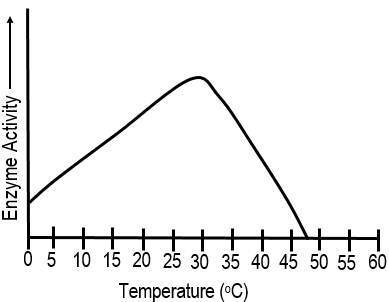
Based on the graph, what temperature does this enzyme work best? 
a)
15 C
b)
40 C
c)
30 C
23.
Which of the following binds to the active site of an enzyme? 
a)
substrate
b)
product
c)
codon
d)
none of the above
24.
What happens when enzymes are heated to a high temperature?
a)
The enzymes die.
b)
The shapes of the enzyme are altered or denatured
c)
The enzymes' amino acid sequence changes.
d)
The enzymes remain the same
25.
Letter D...
a)
active site
b)
enzyme
c)
substrate
d)
products
26.
Letter C...
a)
active site
b)
enzymes
c)
substrate
d)
products
27.
Enzymes are
a)
nucleic acids
b)
proteins
c)
lipids
d)
carbohydrates
28.
Enzymes are _________ that __________ chemical reactions.
a)
proteins, slow down
b)
proteins, speed up
c)
lipids, slow down
d)
lipids, speed up
29.
What do viruses need to reproduce?
a)
they need genetic material
b)
They need a host cell
c)
They need  bacteria
d)
They need insulin
30.
A(n) _____ is a virus that enters a bacterial cell.
a)
endospore
b)
decomposer
c)
plasmid
d)
bacteriophage
31.
When a virus invades a living cell, its _______
takes over the cell's functions.
a)
outer coat
b)
genetic material
c)
core
d)
cytoplasm
32.
What part of the phage is the DNA?
a)
A
b)
B
c)
C
d)
D
33.
When a virus invades a living cell, its _______
takes over the cell's functions.
a)
outer coat
b)
genetic material
c)
core
d)
cytoplasm
34.
Antibiotics kill viruses
a)
True
b)
False
35.
True or False
The flu is caused by a virus.
a)
true
b)
false
36.
What part of a virus is the protein capsule that houses the genetic material (DNA/RNA)?
a)
tail
b)
nucleus
c)
capsid
d)
glycoprotein
37.
The main source of energy for all life comes from ____.
a)
the Earth
b)
the moon
c)
the sun
d)
the food we eat/make
38.
The reactants of photosynthesis are
a)
sugar and water.
b)
sugar and oxygen.
c)
carbon dioxide and water.
d)
carbon dioxide and oxygen.
39.
What are the products of photosynthesis?
a)
Carbon dioxide and water
b)
Carbon dioxide and oxygen
c)
Glucose and oxygen
d)
Glucose and water
40.
What pigment absorbs sunlight for photosynthesis?
a)
chloroplast
b)
thylakoid
c)
grana
d)
chlorophyll
41.
Which of the following is the correct equation for PHOTOSYNTHESIS?
a)
6CO2 + 6H2O --> 6O+ C6H12O6
b)
6CO+ C6H12O6 + 6H2O --> O
c)
6O2 + 6H2O --> 6CO+ C6H12O6
d)
C6H12O6 + 6O2 ---> 6H2O + 6CO2 
42.
What is the purpose of photosynthesis?
a)
make glucose
b)
make ATP
c)
make light
d)
release carbon dioxide
43.
In which organelle (part of the cell) does photosynthesis take place?
a)
mitochondria
b)
chloroplast
c)
nucleus
d)
cell membrane
44.
What are the reactants in the equation for cellular respiration?
a)
oxygen and lactic acid
b)
carbon dioxide and water
c)
glucose and oxygen
d)
water and glucose
45.
What is one of the reactants of cellular respiration?
a)
energy
b)
glucose
c)
carbon dioxide
d)
water
46.
What is the correct equation for cellular respiration?
a)
6O2 + C6H12O6 -> 6CO2 + 6H2O + Energy
b)
6O2 + C6H12O6 + Energy -> 6CO2 + 6H2O
c)
6CO2 + 6H2O -> 6O2 + C6H12O6 + Energy
d)
6CO2 + 6H2O + Energy -> 6O2 + C6H12O6
47.
Where does cellular respiration occur?
a)
Mitochondria
b)
Chloroplast
c)
Nucleus
d)
Vacuole