
 Worksheets
Biology Post Winter Break Review
Total questions: 45
Worksheet time: 2hrs 30mins
Which of the following is an observation?
The secretary is super angry at him
Going shopping makes people happy
It will be super hot out tomorrow
Those bees have black and yellow stripes

Which of the following is an inference from the picture?
a computer is on the table
the duck has a blue shirt
the duck will smash the computer
the computer has a keyboard
What are charged particles that move around an atom’s nucleus?
electrons
protons
ions
neutrons
An organic compound contains an atom(s) of what element?
hydrogen
oxygen
carbon
nitrogen
Which of the following is a characteristic of carbon?
it has three valence electrons
it is the building block of inorganic compounds
its is a metal
it can form, single, double, and triple bonds
Water is _______ which helps give it a _______ surface tension.
polar, low
polar, high
nonpolar, low
nonpolar, high
What is the intermolecular attraction between LIKE molecules known as? For example, the attraction of one water molecule to another water molecule.
cohesion
adhesion
capillary action
density

What property of water allows animals to survive in a pond that has frozen over in the winter?
cohesion
adhesion
capillary action
low density of ice
What are individual monomers of proteins called?
nucleotides
glycerol
monosaccharides
amino acids
Which macromolecule(s) provides short-term energy storage for animals?
carbohydrates
lipids
proteins
nucleic acids
What macromolecule is used for long-term energy storage?
carbohydrates
lipids
proteins
nucleic acids
To which class of macromolecules does enzymes belong?
carbohydrates
lipids
proteins
nucleic acids
What category of macromolecules do hydrophobic fats, oils, waxes, & steroids belong in?
carbohydrates
lipids
proteins
nucleic acids
What category of macromolecules do glycogen, cellulose, glucose, and starch belong to?
carbohydrates
lipids
proteins
nucleic acids
How does an enzyme catalyze a reaction?
by adding energy to the reactants
by increasing the acidity of the environment
by transporting substrates to where they belong
by lowering the activation energy of the reaction

Which enzyme functions in a basic (alkaline) environment?
pepsin
amylase
phophatase
If an enzyme in your body functions within a range of 96.0°F-103.4°F, what best describes how its activity will be at a temperature of 120.3°F?
it will speed up and have much higher activity
it will slow down and have much lower activity
it will denature and have no activity
it will stop moving and have no activity
Which of the following is NOT a characteristic of life?
made up of molecules
made up of cells
maintains homeostasis
responds to stimuli
Homeostasis is one of the eight characteristics of life and it is defined as...
a signal that comes from outside the organism
maintaining a stable internal environment
the life-sustaining chemical reactions in an organism
the molecule that controls an organism's traits
A tulip opens up in the morning at sunrise and closes up
in the evening at sunset. This is an example of what characteristic of life?
reproduction
evolution
growth and development
responsiveness
An adult hydra is producing its offspring asexually through budding. This is an example of what characteristic of life?
reproduction
needs energy
made of cells
genetic code

How would you properly identify this organism?
as unicellular
as multicelluler
as majorcellular
as microcellular
Which of the following is NOT found in a Prokaryotic cell?
Cell membrane
DNA
cytoplasm
Nucleus
Which of the following organelles MUST EVERY cell have?
Mitochondria
Ribosomes
Chloroplasts
Endoplasmic reticulum (ER)

What organelle can be identified as either smooth or rough and moves materials around in the cell?
Cytoplasm
Nucleus
Vacuole
Endoplasmic Reticulum
What is the gel-like material where organelles are located called?
Cytoplasm
Nucleus
Vacuole
Mitochondria

What organelle builds proteins?
Ribosomes
Nucleus
Vacuole
Golgi Body
Which of the following would you find in a plant cell and NOT in an animal cell?
Ribosome
Nucleus
Large Central Vacuole
Rough Endoplasmic Reticulum

A compound consisting of two or more atoms chemically bonded together. (water is an example)
Organelle
Cell
Molecule
Atom
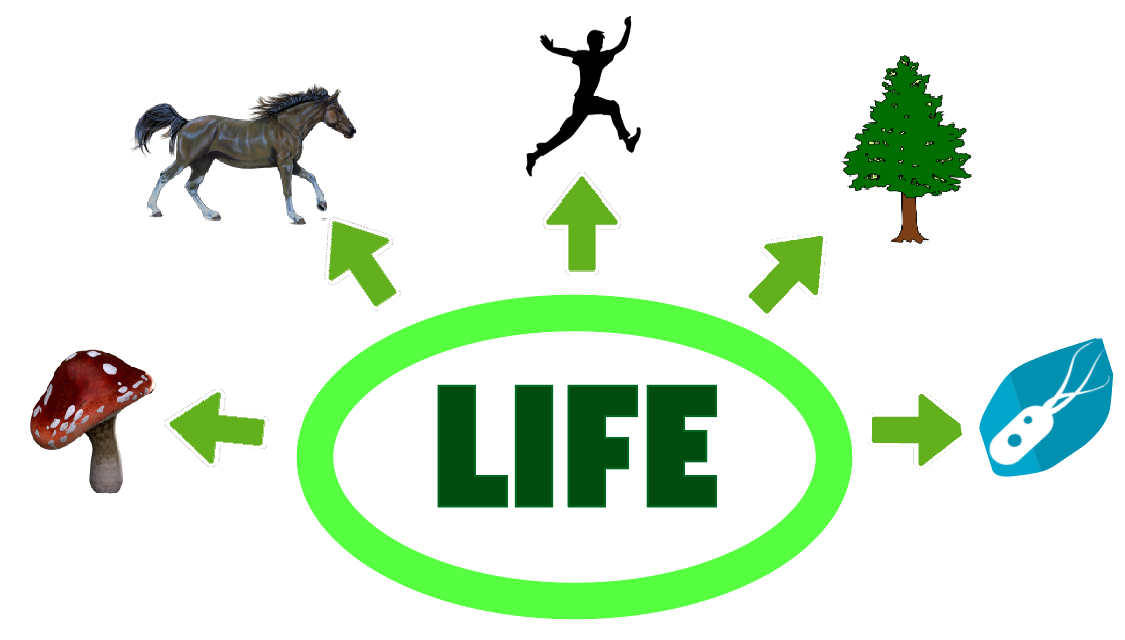
Any single living individual, and can refer to a single human, animal, plant, bacteria, or fungi.
Community
Cell
Population
Organism
A protein in a cell membrane requires energy to transport a molecule across the membrane. Which molecule is most likely used by the protein as an energy source?
ATP
starch
glucose
RNA
If the concentration of a solute is the same throughout a space, the substance
has a large concentration gradient.
is in equilibrium.
will undergo diffusion.
will undergo osmosis.
How does a cell's membrane help an organism maintain homeostasis?
Cell membranes protect the cell organelles from large doses of radiation.
Cell membranes directly control the temperature of the cell.
Cell membranes use a large portion of the cell's energy supply.
Cell membranes control the substances that enter or leave cells.
The movement of water through a selectively permeable membrane is known most specifically as
diffusion
osmosis
endocytosis
equilibrium

What type of solution have the cells in the diagram been placed in?
isotonic
hypertonic
hypotonic
osmotonic
Which of the pictures represents active transport?


Which type of active transport listed below involves the movement of molecules via vesicles?
facilitated diffusion
endocytosis
osmosis
diffusion
If transporting glucose through the cell membrane does NOT require energy, which type of transport could be used by the cell?
osmosis
endocytosis
facilitated diffusion
protein pump
Which is a more accurate image of a cell membrane?


This is an example of positive feedback
This is an example of negative feedback
This is an example of equilibrium
This is an example of diffusion

This image shows osmosis
This image shows facilitated diffusion
This image shows endocytosis
This image shows exocytosis
What does it mean for the cell membrane to be described as a selectively permeable membrane?
it determines the shape of the cell
it determines the flexibility of the cell
it determines the size of the cell
it determines what goes in and out of the cell

Sugar is dissolved in a glass of water. What is the sugar classified as?
solute
solvent
solution
concentration

What is the PROCESS in which molecules in areas of higher concentration move to areas of lower concentration called?
equilibrium
active transport
diffusion
endocytosis

