wayground logo

Free Printable Worksheets

NEW

Font size

S
M
L
XL
Worksheets

Unit 8 Ecology and Evolution Review

Total questions: 50

Worksheet time: 2hrs 34mins

Name
Class
Date
1.

The graph below represents the growth of a population of flies in a car? Which of the following statements best describes the graph?

a)

The fly population did not change.

b)

The fly population decreased, then increased.

c)

The fly population grew following the logistic growth model.

d)

The fly population grew following the exponential growth model.

2.

Which of the following could be a density-independent limiting factor in the desert?

a)

number of prey

b)

food supply

c)

parasitism

d)

rainfall

3.

Which point in this graph represents exponential growth?

a)

Point E

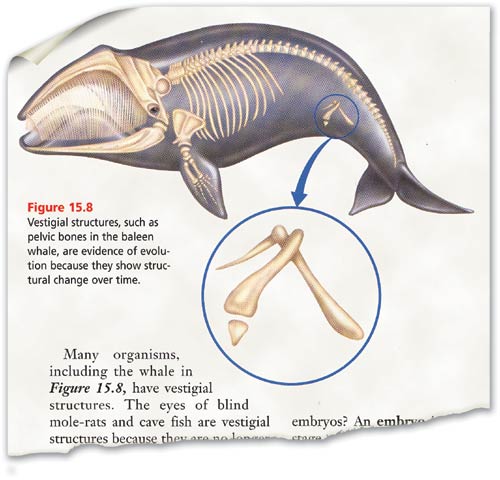
b)

Point A

c)

Point B

d)

Point C

4.

The graph represents _____ of a population.

a)

logistic growth model

b)

exponential growth model

5.

Which point on the graph best represents the carrying capacity?

a)

Letter A

b)

Letter C

c)

Letter E

d)

Letter D

6.

In which month(s) did the Cottontail Rabbits reach their carrying capacity?

a)

January and February

b)

March and May

c)

April and January

d)

April and May

7.

Owls and snakes eat mice and other organisms. What would happen to the mice population if the owl population decreased?

a)

The population would decrease, as the loss of owls as part of their diet is a limiting factor.

b)

The population would decrease, as shelters created by owl nests is a limiting factor.

c)

The population would increase, as competition for food is a limiting factor.

d)

The population would increase, as predation by owls is a limiting factor.

8.

Which of the following is density-independent limiting factor?

a)

disease

b)

competition

c)

earthquake

d)

predation

9.

A population is __________________.

a)

a group of organisms of the same species, in the same place, at the same time.

b)

a group of organisms of the different species, in the same place, at the same time.

c)

an individual organism of the one species, in the same place, at the same time.

d)

a group of organisms of the same species, in the different place, at the same time.
10.
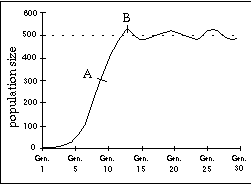
What is the carrying capacity of the graph?
a)
around 500
b)
more than 500
c)
less than 500
d)
around 600
11.
If the death rate of a population is greater than the birthrate, the population shrinks.
a)
True
b)
False
12.
What type of growth model is this?
a)
exponential growth model
b)
logistic growth model
c)
Type I curve
d)
Type III curve
13.
Carrying Capacity is
a)
the capacity of what one person can carry per day 
b)
how many animals you have in your daily bag limit at the end of the year
c)
wildebeest at a watering hole with zebras
d)
the maximum number of individuals that the environment can support
14.
What pattern of growth will a population with limited resources show?
a)
density-dependent
b)
exponential 
c)
logistic
d)
logical 
15.

If the wolf population goes extinct on the island, what is likely outcome

a)

Moose will population will remain stable

b)

The moose population will grow and eat all the vegetation

c)

The other species that rely on the vegetation will take over for the wolves

d)

New predators will begin hunting Moose

16.
If wolves were re-introduced what would happen to the moose population
a)
The moose would go extinct from over hunting
b)
The wolf population would take over the island
c)
The moose population would decline to normal levels
d)
The moose would adapt to other environments
17.

Which of the following factors affect a population's size

a)

Availability of resources

b)

Predator / prey relationships

c)

All of the choices affect population

d)

Reproductive success

18.

We know that population sizes change over time. All statement(s) are true about this change EXCEPT:

a)

When there are more births than deaths the population size will increase.

b)

When there are more deaths than births the population size will decrease.

c)

When there are more deaths than births the population size will increase.

d)

When there are more births than deaths the population size will increase

19.

Review the graph provided. What statements can be made about the significant decline in wolves around 1979?

a)

The wolf decline was a direct result of moose decline.

b)

The is no way to know why the wolf population dropped.

c)

The drop is most likely due to the declining moose population, but more information would be needed to determine that.

d)

The drop is most likely due to the increasing moose population, but more information would be needed to determine that.

e)

The wolf decline was a direct result of the moose increase.

20.

Review the graph provided. What statements can be made about the significant decline in moose in the mid 1990's?

a)

The moose decline was a direct result of wolf decline.

b)

The is no way to know why the moose population dropped.

c)

The drop is most likely due to the declining wolf population, but more information would be needed to determine that.

d)

The drop is most likely due to the increasing wolf population, but more information would be needed to determine that.
21.
A human & a Tape Worm: The tape worm gets a place to live in the intestines of the human and food from the human. The human loses weight and nutrients from the tape worm.
a)
Mutualism
b)
Commensalism
c)
Parasitism
22.
Bird & Tree: A bird builds a nest in a hole in the trunk of the tree. It is protected from the rain and predators. The tree is not harmed or helped by the bird.
a)
Mutualism
b)
Commensalism
c)
Parasitism
23.
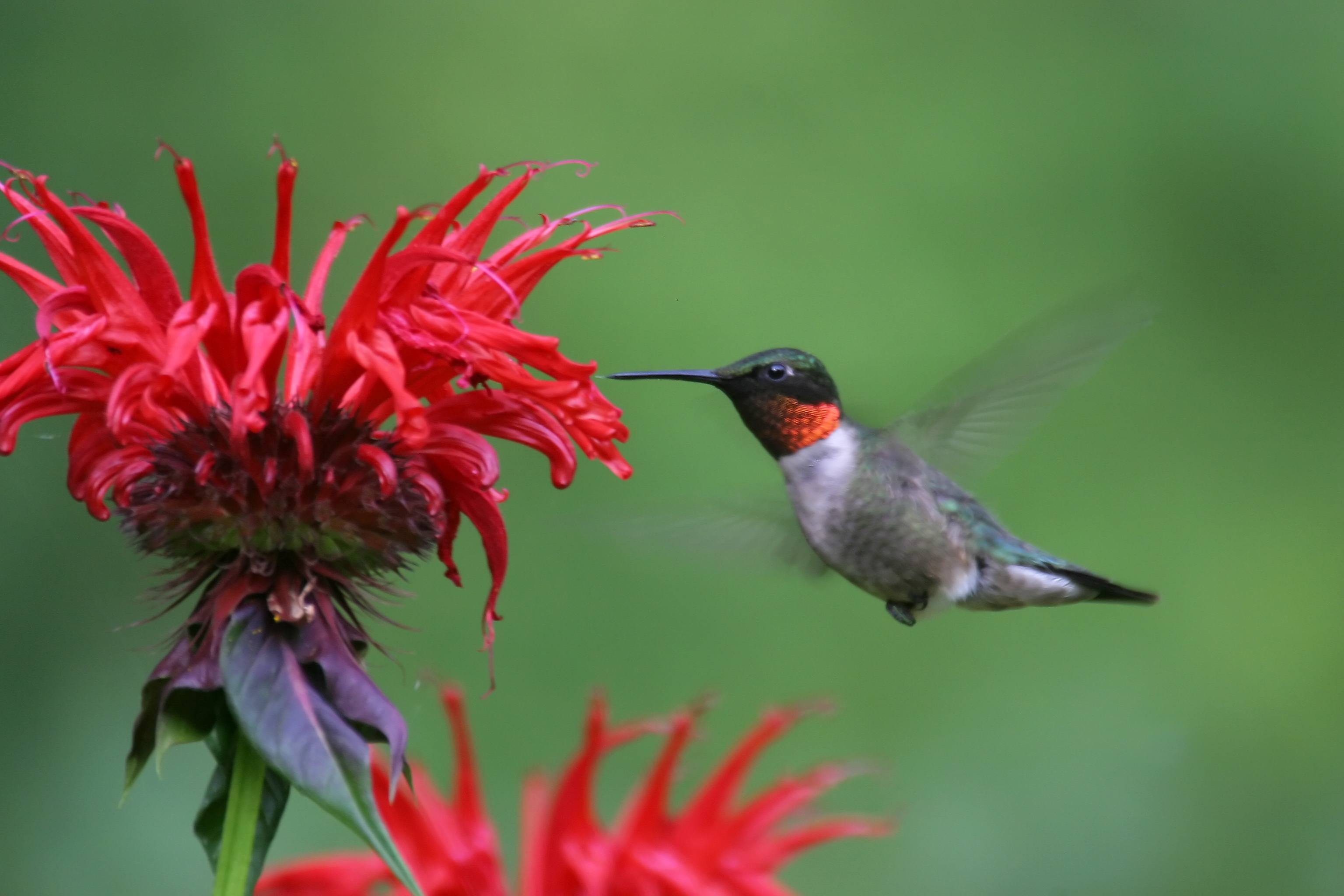
What type of symbiosis?  Hummingbirds feed on nectar from flowers.  The flowers are pollinated by hummingbirds as they move from flower to flower.
a)
commensalism
b)
mutualism
c)
parasitism
d)
predation
24.
Starfish are probably the most important predator in the shallow ecosystem because they eat basically anything that they can come across. Their feeding activities control the whole ecosystem. This is an example of the starfish ___.
a)
habitat
b)
biotic factors
c)
tolerance level
d)
niche
25.
Tree kangaroos live in the upper branches of trees in the rainforests of Queensland, as well as on the island of New Guinea. This is an example of the tree kangaroos ___.
a)
niche
b)
habitat
c)
community
d)
population
26.
What is the name of an animal that is hunted and eaten by other animals?
a)
producer
b)
prey
c)
predator
d)
decomposer
27.
___ states that two species cannot exist together if they compete for the same resources. One will either die out or migrate, or they will adapt to separate resources.
a)
Hardy-Weinberg Principle
b)
Limiting Nutrient Principle
c)
Competitive Exclusion Principle
d)
Tolerance Principle
28.
Remora are small fish with a sucker-like organ that allows them to attach themselves to larger animals like a shark.  By doing this, the remora is able to gain protection from the presence of the shark while helping the shark stay clear from parasites.  This relationship shows _?
a)
 parasitism
b)
mutualism       
c)
commensalism
d)
predation
29.
What factor would cause animals of the same species to begin competing with one another?
a)
increase in precipitation         
b)
the presence of decomposers
c)
the introduction of a new food source
d)
limited supply of resources
30.
In an ecosystem, members of the lizards are observed eating members of the insect population.  In this same ecosystem, birds are also observed using insects as a food source.  The relationship between lizards and birds would best be described as –
a)
predator
b)
 competitive
c)
parasitic
d)
mutualistic
31.
Different species are most likely to compete for resources in an ecosystem if both species attempt to –
a)
occupy the same niche.
b)
successfully reproduce.
c)
live in different habitats.         
d)
find different food sources.   
32.

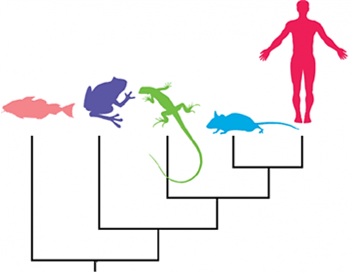
According to this phylogenetic tree, which creature is the least related out of all pictured?

a)

Fish

b)

Frog

c)

Salamander

d)

Human

33.
A biological ____________ is a group of interbreeding populations that is reproductively isolated from other groups.
a)
species
b)
family
c)
phylogeny
d)
hybrid
34.
______ _________ explains how two or more organisms could evolve similar traits even though they are not related to each other.
a)
convergent evolution
b)
reproductive isolation
c)
derived characters
d)
hybrid vigor
35.
__________ characters are similar characteristics that have evolved separately in two unrelated organisms.
a)
analogous
b)
homologous
c)
cladistic
d)
phylogenic
36.
_________ characters may or may not be similar between two organisms but they developed from a common ancestor.
a)
homologous
b)
analogous
c)
cladistic
d)
phylogenic
37.
______________ is the process by which populations change in response to their environment.
a)
natural selection
b)
adaptation
c)
reproductive isolation
d)
divergence
38.
__________ enable an organism to survive in its environment.
a)
adaptations
b)
natural selections
c)
divergence
d)
extinctions
39.
________ structures are reduced in size or function.
a)
vestigial
b)
homologous
c)
cladistic
d)
phylogenic
40.

True or false, evolution happens when an individual organism starts changing itself to adapt to its environment. For example, an adult polar bear might start swimming more so it can handle the melting of the polar ice caps.

a)

false, if it had a cub that could swim better due to longer legs or more buoyant bone structure, this could become a more common trait.

b)

True, evolution happens due to changing individuals

c)

maybe, if it chose to.

d)

I wish I had a pet penguin

41.

Scientists have collected millions of fossils of different organisms, and have developed a timeline of life on Earth. What do we call this?

a)

Mutation

b)

Natural Selection

c)

The theory of evolution

d)

Fossil Record

42.

Sometimes bones in the front limbs of animals are very similar in structure. What do we call similar bone structures that indicate a link to a common ancestor?

a)

Adaptations

b)

Gradualism

c)

Homologous Structures

d)

Extinction

43.

When looking at two birds of the same species, you notice that one has darker feathers than the other one. You also notice that one has a beak that is just a little longer. These slight differences within members of the same species are called.....

a)

Fossils

b)

Extinction

c)

Meiosis

d)

Variations

44.

What is the study of organisms at the early stages of development?

a)

DNA studies

b)

Comparative Embryology

c)

Extinction

d)

Fossil Record

45.
When you compare DNA or proteins to support evolution, you are using what kind of evidence?
a)
anatomical evidence
b)
molecular evidence
c)
fossil evidence
46.
Look at the image, what layer is the second oldest?
a)
Layer L
b)
Layer G
c)
Layer B
d)
Layer J
47.
Which of the following is an example of a vestigial structure?
a)
the wings of a red-tailed hawk
b)
the hind limbs of a house cat
c)
the fins of sharks
d)
the tailbone of a human
48.
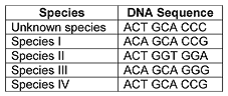
Two organisms that are closely related would have
a)
very similar DNA sequence
b)
exactly the same DNA sequences
c)
no proteins in common
d)
completely different DNA sequence
49.
According to this data, the unknown bacterial species is most closely related to: 
a)
Species I
b)
Species II
c)
Species III
d)
Species IV
50.
Individuals that are well adapted to their environment will survive and produce
a)
better traits
b)
stronger genes
c)
more offspring
d)
fewer mutations