

wayground logo

Free Printable Worksheets

NEW

Font size

S
M
L
XL
Worksheets

[1C EOY Revision] EOY Topics Round 1

Total questions: 20

Worksheet time: 10mins
Name
Class
Date
1.
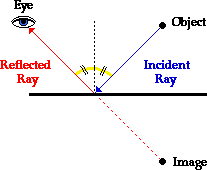
The imaginary line perpendicular to a reflecting surface is called _____.
a)
crooked line
b)
parallel line
c)
angular line
d)
normal line
2.

What is the angle of reflection equal to?

a)

The angle of refraction

b)

The angle of incidence

c)

The angle of absorption

d)

The angle of light

3.

What can you use to see all the different colors in white light?

a)

A flashlight

b)

A shadow

c)

A camera

d)

A prism

4.

When light passes from air to water, what happens to the speed of the light?

a)

speeds up

b)

slows down

c)

stays the same

5.

Why doesn’t the surface of a wooden boat reflect light as the surface of water does?

a)

Because the boat's surface is rough and absorbs more light.

b)

Because the surface of the boat is red, not blue.

c)

Because the boat is not a natural object like the water is.

d)

Because the boat is on top of the water's surface.

6.

The ________ controls the movement of materials into and out of the cell.

a)

cell membrane

b)

nucleus

c)

cytoplasm

d)

cell wall

7.

What is the smallest unit of any organism that is capable of independent function?

a)

tissue

b)

cell

c)

organ

d)

muscle

8.

An individual's "fingerprint" is carried by the _______.

a)

cell membrane

b)

DNA

c)

cell wall

d)

RNA

9.

A cell membrane works to __________________.

a)

store substances moving in and out of the cell

b)

give the cell support

c)

control substances moving in and out of the cell

d)

get rid of waste

10.

What is the correct order of organization?

a)

cells->tissue->organs->organ systems-> organism

b)

tissue->cells->organs->organ systems-> organism

c)

organs->organ systems-> organism->cells->tissue

11.

This diagram represents particles in a ______________ state.

a)

Solid

b)

Liquid

c)

Gas

12.
Which of the following statements about the particle of a gas is true?
a)
Gases can be compressed because their particles are smaller than those of liquids or solids.
b)
Gases can be compressed because there is plenty of space between their particles.
c)
Gases can be compressed because they have low boiling points.
d)
Gases can be compressed because their particles are more elastic than those of liquids or solids.
13.
An inflated balloon is placed in a refrigerator. Which statement describes the movement of the gas particles in the balloon?
a)
The particles move more slowly and become closer together.
b)
The particles move more slowly and become further apart.
c)
The particles move faster and become closer together.
d)
The particles move faster and become further apart. 
14.
The graph below shows part of the cooling curve of a substance. Which row correctly identifies P, Q and R?
a)
P: Gas, Q: Gas and Liquid, R: Liquid
b)
P: Liquid, Q: Gas and Liquid, R: Gas
c)
P: Gas, Q: Liquid, R: Solid
d)
P: Solid, Q: Liquid, R: Gas
15.
A solid compound X was heated steadily for 20 minutes. The graph below shows the change in temperature of X with time. At what temperature did X melt?  
a)
20°C
b)
40°C
c)
90°C
d)
100°C
16.

The symbol of Gold is......

a)

G

b)

Ag

c)

Au

d)

Go

17.
What is the atomic mass of "F"
a)
9
b)
18
c)
17
d)
19
18.
How do you find out the number of neutrons in an atom?
a)
atomic number
b)
atomic mass
c)
charge
d)
atomic mass - atomic number
19.

What is a molecule?

a)

two elements bonded together (sharing electrons)

b)

a mixture of different substances

c)

smallest individual particles

d)

salt mixed in water

20.

Which one of these is a compound?

a)

H2

b)

NaCl

c)

He

d)

O2
