wayground logo

Free Printable Worksheets

NEW

Font size

S
M
L
XL
Worksheets

Unit 1 Review - Government

Total questions: 46

Worksheet time: 23mins

Name
Class
Date
1.

Example: United States; citizens vote for representatives on local, state and national levels who make laws.

a)

Monarchy

b)

Anarchy

c)

Theocracy

d)

Representative Democracy

2.
Government run by religious leader/leaders; no separation of church and state. 
a)
Theocracy
b)
Democracy
c)
Monarchy
d)
Anarchy
3.
Example: Modern day – England – ruler is a symbolic head of state with elected members of Parliament who govern.
a)
Constitutional Monarchy
b)
President
c)
Dictator
d)
Republic
4.
 Self-appointed single person/group rules controlling all aspects of public life (example: freedom of speech) often through military force, intimidation
a)
Dictatorship
b)
Totalitarian
c)
Monarchy
d)
Liberty
5.
Ruler, king/queen/emperor/empress, etc.), inherits power.  Rules by divine right- given power to rule by God.
a)
Theocracy
b)
Democracy
c)
Republic
d)
Monarchy
6.
Government which controls every aspect of public and private life. 
a)
Republic
b)
Totalitarian
c)
Theocracy
d)
Democracy
7.
Example: Saddam Hussein
a)
Supreme Leader
b)
Pope
c)
Dictator
d)
Monarch
8.
Example: Puritan leaders helped govern the colony of Massachusetts in the early colonial era.
a)
Republic
b)
Theocracy
c)
Dictator
d)
Governor
9.
Why was King John forced to sign the Magna Carta?
a)
to increase the power of the monarchy
b)
to end taxation in England
c)
to force the monarchy to give up power
d)
to weaken the power of nobles
10.
Which king was "forced" to sign the Magna Carta in 1215?`
a)
King James
b)
King John
c)
King Louis
d)
King Henry
11.
The Magna Carta of 1215 started the path to which form of government in modern day England?
a)
communism
b)
absolute monarchy
c)
oligarchy
d)
parliamentary democracy
12.
In England, which branch of government would the Great Council eventually become after the signing of the Magna Carta?
a)
Senate
b)
Parliament
c)
House of Representatives
d)
Supreme Court
13.

The English Bill of Rights

a)

Created separation of powers

b)

Enhanced the democratic election

c)

Limited the powers of the king and queen

d)

All the answers are correct

14.

The English Bill of Rights was passed by the

a)

Parliament of England

b)

The 13 American Colonies

c)

The Pope

d)

Scotland

15.
The Mayflower Compact was the first agreement for self - government to be created and enforced in america  
a)
true
b)
fasle
16.
 Why did the Pilgrims create the Mayflower Compact?
a)
 to show that they opposed representative government.
b)
to establish an orderly community
c)
 to reinforce the laws of England in the new colony
d)
 to guarantee universal religious tolerance in the colony
17.
The Mayflower Compact foreshadows the U.S. Constitution in which of the following ways
a)
 It places the source of government power in the people rather than in God or a King.
b)
It ensures both the right to free speech and the separation of church and state
c)
it establishes three branches of government in order to create a system of checks and balances.
d)
It grants equal rights to all residents regardless of race or gender.
18.
The House of Burgesses is important in history because it was the 
a)
the first time a council advised the Virginia Company
b)
only legislative body in England
c)
first election of women as leaders
d)
first elective legislative body in America
19.
The House of Burgesses gave the colonists in Virginia the opportunity to control _______________
a)
their own government
b)
the First Americans
c)
the Royal Governor
d)
the King of England
20.
What does legislative mean?
a)
to elect governors
b)
to judge the laws
c)
to create laws (law-making)
d)
to create new settlements
21.

What are unalienable rights?

a)

Rights that government cannot take away

b)

Rights that government takes away

c)

rights for aliens

d)

Government is needed to promote equality

22.
From whom did the signers of the Declaration of Independence receive their authority to declare independence? 
a)
From the King of England
b)
From the European nations. 
c)
From the people of the American colonies.
d)
They needed no authority.
23.

The Declaration of Independence is most like a what?

a)

Love Letter

b)

Treaty

c)

Break-up letter

d)

Constitution

24.
Under the Articles of Confederation, the government consisted of _______________ branch of government.
a)
3
b)
2
c)
1
d)
4
25.
Under the Articles of Confederation Congress could only pass a law if ____________ out 13 states agreed. 
a)
13
b)
8
c)
9
d)
10
26.
One weakness of the Articles of the Confederation was ____________. 
a)
The ability of Congress to tax.
b)
The inability of Congress to tax.
c)
The ability of Congress to declare war.
d)
The ability of Congress to create courts.
27.
In order to change (amend) the Articles of Confederation,  __________ out of 13 states had to agree. 
a)
9
b)
10
c)
13
d)
15
28.
Under the Articles of Confederation, Congress could regulate trade between the states.
a)
true
b)
false
29.
Membership into Congress was based upon a state's population. 
a)
true
b)
false
30.
Under the Articles of Confederation, each state got __________ vote. 
a)
b)
2
c)
1
d)
5
31.
The Articles of Confederation created a _________________ type of government.
a)
strong
b)
average
c)
weak
d)
federal
32.
Which branch of government existed when the Articles of Confederation was created?
a)
Legislative (congress)
b)
Judicial (Supreme court)
c)
Executive (President)
d)
Legislative, Executive, and Judicial
33.
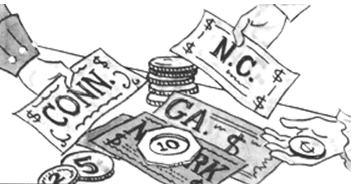
Which of the following weaknesses  in the Articles of Confederation does  this picture represent?
a)
no common currency (money)
b)
no executive branch
c)
no power to tax
d)
one vote for each state
34.
Which of the following is an example of a weakness in the Articles of Confederation?
a)
Congress couldn't collect taxes
b)
Weak national government
c)
Provided no common currency/money for all 13 states
d)
All of the  above
35.
What is the name of the first written plan of government for the newly independent U.S.A.?
a)
Constitution
b)
Treaty of Paris
c)
Declaration of Independence
d)
Articles of Confederation
36.

Political philosopher who believed a social contract existed between political leaders and the people they governed

a)

John Locke

b)

John Lincoln

c)

Joseph Locke

d)

Lincoln Locke

37.

Vast region that included present day Illinois, Indiana, Michigan, Ohio, and Wisconsin

a)

New England

b)

Northeast Territory

c)

Louisiana Territory

d)

Northwest Territory

38.

Act passed by Congress that created a system of limited self government for the settlers living in the Northwest Territory

a)

Northwest Territory

b)

Land Ordinance of 1785

c)

Northwest Ordinance of 1787

d)

Articles of Confederation

39.

Set of basic principles and laws that determine the powers and duties of government

a)

constitution

b)

ratification

c)

suffrage

d)

republic

40.
Who had more power under the Articles of Confederation?
a)
Federal Government
b)
State Governments
c)
Individual people
d)
States with larger populations
41.
What did Shays' Rebellion help Americans realize they needed?
a)
A strong national government
b)
A stronger militia
c)
A common currency
d)
The ability to sign peace treaties
42.

Where did Shay's Rebellion take place?

a)

Vermont

b)

Delaware

c)

Massachuestes

d)

New York

43.

Which of the following was NOT a lead up to Shay's Rebellion

a)

Declaration of Indepndence

b)

Creating the U.S Constitution

c)

Articles of Confederation

d)

American Revolution

44.
Shays' Rebellion was made up of which group of people?
a)
farmers and merchants
b)
bankers
c)
government leaders
d)
basketball players
45.

In the Northwest Territory, what was not allowed? However, it was allowed in the original 13 states.

a)

farming

b)

house building

c)

slavery

d)

Native Americans

46.
The Northwest Ordinance of 1787 _____
a)
allowed slavery in the northwest territory
b)
established a method for admitting new states to the Union
c)
made people move to the northwest
d)
did nothing