wayground logo

Free Printable Worksheets

NEW

Font size

S
M
L
XL
Worksheets

Chem/Bio Exam Anatomy

Total questions: 48

Worksheet time: 41mins

Name
Class
Date
1.
the central region of an atom where its neutrons and protons are is its 
a)
nucleus 
b)
electron cloud
c)
core 
d)
center 
2.
A particle that moves around the nucleus is a(n)...
a)
Proton
b)
Neutron
c)
Electron
d)
Quark
3.

What is the charge of an electron?

a)

Positive

b)

Negative

c)

Neutral

4.

What is the charge of an proton?

a)

Positive

b)

Negative

c)

Neutral

5.

What is the charge of an neutron?

a)

Positive

b)

Negative

c)

Neutral

6.

Which of the following elements are the basis of organic, living organisms?

a)

Iron

b)

Nitrogen

c)

Carbon

d)

Hydrogen

7.

Which of the following statements best describes a covalent bond?

a)

A bond where nitrogen is bonded to everything.

b)

A bond where electrons are shared.

c)

A bond where electrons are donated from one atom to another.

8.
Protein molecules are composed of long chains of __________ .
a)
ribosomes
b)
RNA
c)
amino acids
d)
DNA
9.
The major macromolecules of life are:
a)
lipids, proteins, carbohydrates, nucleic acids
b)
nucleic acid and water
c)
lipids and fats
d)
DNA
10.
Which has a pH below 7?
a)
Acid
b)
Base
11.
What is the pH of water?
a)
0
b)
4
c)
7
d)
14
12.
What is the pH range of a base?
a)
0-6.9
b)
7.1-14
c)
0-14
d)
7
13.

What is the main biological function of carbohydrates?

a)

Quick energy

b)

Contain genetic information

c)

Make up enzymes

d)

Make you fat

14.
What carries no charge 
a)
Neutrons
b)
Electrons
c)
Protons
15.

Speed up chemical reactions

a)

catalysts

b)

hormones

c)

salts

d)

acids

16.
How are ionic bonds formed?
a)
Transfer of electrons
b)
Sharing of electrons
17.
DNA and RNA are examples of 
a)
Carbohydrates
b)
Lipids
c)
Proteins
d)
Nucleic Acids
18.
Nucleotides are monomers of
a)
Carbohydrates
b)
Lipids
c)
Proteins
d)
Nucleic Acids
19.
Monosaccharides are monomers of
a)
Carbohydrates
b)
Lipids
c)
Proteins
d)
Nucleic Acids
20.
Waxes, oils and fats are examples of
a)
Carbohydrates
b)
Lipids
c)
Proteins
d)
Nucleic Acids
21.
Which macromolecule is shown?
 View Figure 1 (if not visible)
a)
lipid
b)
protein
c)
nucleic acid
d)
carbohydrate
22.
What is the function of nucleic acids?
a)
store genetic information
b)
store energy (long-term)
c)
store energy (short-term)
d)
build skin, hair, nails, muscles
23.
Which of the following organic compounds is the main source of energy for living things?
a)
carbohydrates
b)
lipids
c)
nucleic acids
d)
proteins
24.
Lipids can be digested into what smaller subunits?
a)
nucleic acids
b)
amino acids
c)
fatty acids
d)
glucose
25.
Which group of biomolecules provide quick energy to organisms?
a)
proteins
b)
carbohydrates
c)
lipids
d)
nucleic acids
26.
Enzymes are..
a)
nucleic acids 
b)
carbohydrates 
c)
lipids 
d)
proteins 
27.
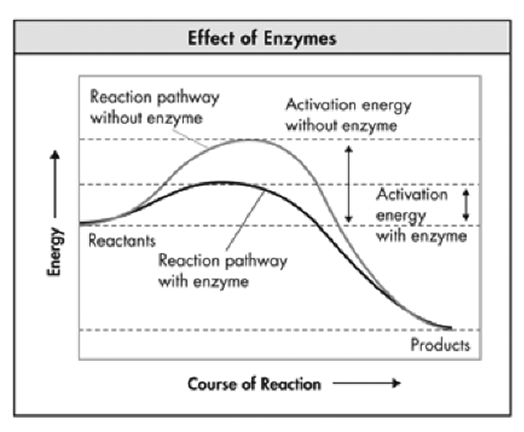
The graph shows how enzymes affect reactions in cells. Which statement best summarizes the information shown in the graph?
a)
Enzymes increase the energy of the reactants.
b)
Enzymes decrease the energy level of the products.
c)
Enzyme decrease the activation energy of the reaction.
d)
Enzymes reverse the direction of the reaction.
28.
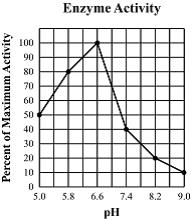
Which of the following conclusions can be drawn from this graph?
a)
The optimum pH of the enzyme is 6.6.
b)
The optimum pH of the enzyme is 5.8
c)
The enzyme’s activity increases as pH increases 5.0 to 9.0
d)
The enzyme’s activity is greater around pH of 8.0 .
29.
Any substance that is acted upon by an enzyme is called a(n)?
a)
Coenzyme
b)
Substrate
c)
Vitamin
d)
Polypeptide
30.
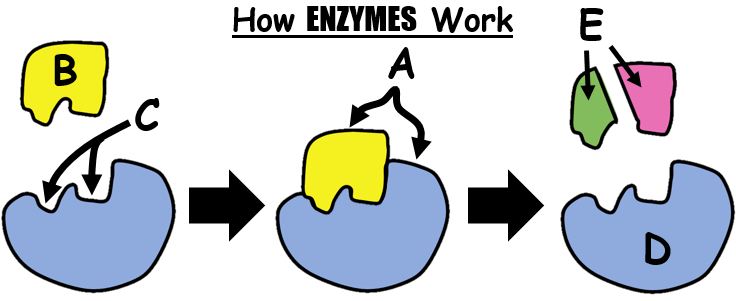
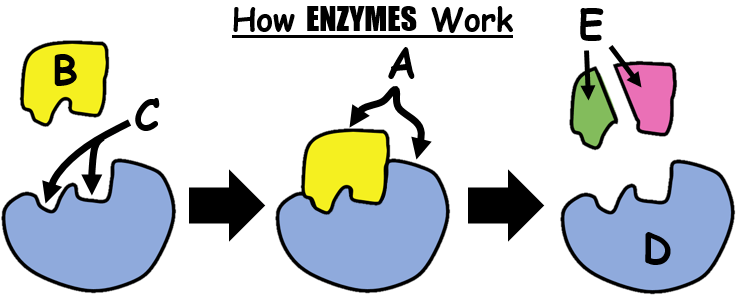
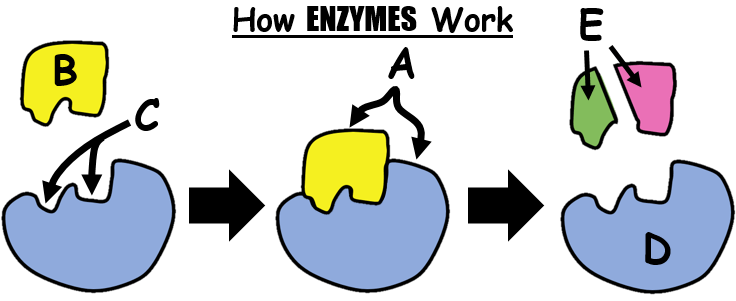
In the diagram, what is letter A? 
a)
product
b)
substrate
c)
enzyme-substrate complex
d)
active site
31.
What happens when enzymes are heated to a high temperature?
a)
The enzymes die.
b)
The shapes of the enzyme are altered denature
c)
The enzymes' amino acid sequence changes.
d)
The enzymes remain the same
32.
Letter D...
a)
active site
b)
enzyme
c)
substrate
d)
products
33.
Letter B...
a)
active site
b)
enzyme
c)
substrate
d)
products
34.
Which enzyme is most efficient in a basic solution?
a)
A
b)
B
35.

What elements (monomers) make up a protein?

a)

C, H, O

b)

C, H, O, N

c)

C, H, O, N, P

36.

Match the protein with the correct picture.

a)
b)
c)
d)
37.

Identify the lipid:

a)
b)
c)
d)
38.
the starting materials in a chemical reaction
a)
Products
b)
Reactants
c)
Starters
d)
Enders
39.
a substance that is formed as the result of a chemical reaction
a)
Product 
b)
Reactant
c)
Starters
d)
Enders
40.
an atom or molecule which has gained or lost one or more of its valence electrons
a)
Covalent Bond
b)
Chemical Formula
c)
Ion
d)
Compound
41.
The left side of the equation below is called
a)
Products
b)
Reactants
42.
The right side of the equation below is called the
a)
products
b)
reactants
43.

What type of bonding does this picture show?

a)

Ionic

b)

Covalent

44.

What type of bonding does this picture show?

a)

Ionic

b)

Covalent

45.

The chemical bond between a non-metal and another non-metal will be a ________ bond.

a)

metal

b)

ionic

c)

covalent

d)

polar

46.

The chemical bond between a metal and a non-metal will be a _____ bond.

a)

metal

b)

ionic

c)

covalent

d)

polar

47.

What is the pH in the stomach?

a)

1-3

b)

4-6

c)

7

d)

8-11

e)

12-14

48.

Antacids are __________ substances.

a)

acidic

b)

neutral

c)

basic