
 Worksheets
Matter and Change Chapter Review
Total questions: 46
Worksheet time: 26mins
Which of the following is NOT an example of matter?
Sunglasses
Beach Towel
Sunlight
Water
The study of matter and its changes is called
Biology
Chemistry
Physics
None of the above
The smallest unit of an element that retains the properties of that element is called a(n)
Element
Compound
Atom
Molecule
Solids, liquids, and gases are three phases of matter that
Have mass
Take up space
Are made up of atoms
All of the above
Which of the following is NOT a pure substance?
Element
Compound
Mixture
Molecule
Which property of a substance is not affected by a physical change?
Reactivity
Size
Position
Shape
The different substances in a mixture
keep their physical properties
form new molecules
cannot be separated
combine chemically
Which of the following is NOT a potential sign of chemical change?
Change in odor
Boiling
Fizzing
Change in color
Which of the following causes a chemical change?
Moving
Melting
Burning
Shattering
Unlike a mixture, a pure substance has
Atoms
Molecules
A specific size
A fixed composition
Which of the following is an example of a chemical change?
Ice melting
Paint fading
Pounding gold into a coin
A puddle evaporating
An _____ is a pure substance that cannot be broken down into simpler, stable substances and is made of one type of atom.
Atom
Element
Matter
Particle
A _____ is a substance that can be broken down into simple stable, substances.
Atom
Particle
Compound
Element

Water has a constant boiling point of 100oC. Boiling points are examples of _____ which do not depend on the amount of matter in a sample.
Extensive properties
Intensive properties
Chemical properties
physical properties
A friend asks you to you help lift a box. He points you over to the large box with 100 kg printed on the side. You know that that is a HEAVY box. The mass of this box is an example of _____ which depends on the amount of matter.
Extensive properties
Intensive properties
Chemical properties
Physical properties
A student is observing a new substance. He notices that the substance is a white crystal with a mass of about 2 grams. What type of properties did you observe?
Extensive property
Intensive property
Physical property
Chemical property
A student observes that a white crystal substance will start bubbling with added to acetic acid. This reaction is an example of what type of property?
Extensive property
Intensive property
Physical property
Chemical property
A chemical is observed to melt at 0oC and boil at 100oC. These phase changes are a type of _____.
Physical change
Chemical change
Chemical reaction
Physical reaction
A mixture is a blend of 2 or more kinds of matter which can be physically separated. If the 2 types of matter are not evenly distributed, the mixture is said to be _____.
heterogeneous
homogeneous
Part of your lab instructions might be to add a salt to a sample of water. The salt dissolves in the water, but you would still taste it. What type of mixture did you make?
a homogeneous solution
a heterogeneous sol
a heterogeneous suspension
a homogeneous gel
The boiling point of water is 1000 C. This is an example of a(n) ___________ property.
intensive
extensive
(a) is a measure of the space occupied by an object.
(a) is a measure of the amount of matter an object contains.
_________ is an example of a physical change.
ice melting
burning a log
dying hair
popping popcorn
_________ is an example of a chemical change
cutting hair
boiling water
cooking an egg
tearing paper
The state of matter where particles are very spread out and moving quickly.
gas
liquid
solid
Helium
The phase change when a solid becomes a liquid.
freezing
sublimation
melting
condensation
As heat energy increases, temperature...
increases
decreases
remains the same
varies
The phase change when a gas becomes a liquid.
condensation
evaporation
deposition
sublimation
The phase change when a liquid becomes a gas.
melting
boiling
sublimation
evaporation


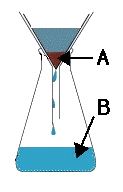
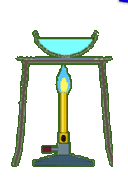
No matter what you do, sand will not dissolve in water, because sand is _________.
dissolved
soluble
insoluble
aqueous
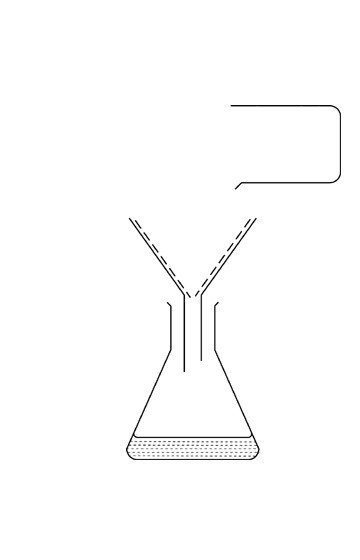
What is the name of this separation technique?
distillation
filtration
evaporation
chromatography
Dyes in water soluble markers may be separated by means of
Simple distillation
Crystallisation
Chromatography
Filtration
What is decantation?
Decantation is used to separate insoluble solids from liquids. Two immiscible liquids are also separated by this process.
Decantation is a process of separating insoluble solids from liquids.
Decantation is the process of separating miscible liquids
The process of settling down of particles of a solid in a liquid is
Decantation
Filtration
Sedimentation
Sublimation
The liquid that passes through the filter paper during the process of ____ is called ______
Filtrate
Filtration
Sedimentation
Find the odd one out
Sedimentation
Decantation
Loading
Distillation

