
 Worksheets
Meiosis
Total questions: 24
Worksheet time: 24mins
Name
Class
Date
1.
If the diploid number of carrots is 18, the haploid number is
a)
18
b)
9
c)
27
d)
36
2.

A human body (somatic) cell usually has how many chromosomes?
a)
6
b)
22
c)
4
d)
46
3.
Why do we need meiosis?
a)
To double the number of chromosomes going into sex cells
b)
To halve the number of chromosomes going into sex cells
c)
To triple the number of chromosomes going into sex cells
d)
To not change the number of chromosomes going into sex cells
4.
The result of meiosis is:
a)
two diploid cells
b)
two haploid cells
c)
four diploid cells
d)
four haploid cells
5.
The chromosomes that pair up during meiosis, are called __________ chromosomes.
a)
heterozygous
b)
haploid
c)
homologous
d)
diploid
6.

Meiosis makes sperm and egg cells. In humans, sperm and egg cells each have _____ chromosomes. Therefore a fertilized human egg cell (sperm and egg cell combined) would create a cell with _____ chromosomes.
a)
23, 46
b)
46, 23
c)
2, 4
d)
50, 100
7.
How many daughter cells are produced from meiosis ?
a)
10
b)
6
c)
4
d)
2
8.
The products of meiosis are genetically...
a)
different.
b)
identical.
9.
Human eggs and sperm are _____, and each has ____ chromosomes.
a)
diploid, 23
b)
diploid, 46
c)
haploid, 23
d)
haploid, 46
10.
Identify a purpose of meiosis. Select all that apply.
a)
Produce gametes for reproduction.
b)
Repair damaged or dead cells.
c)
Reduce the chromosome number.
d)
Growth of organisms from birth to adulthood.
11.
What are homologous chromosomes?
a)
Pairs of chromosomes with different genes on each.
b)
Pairs of chromosomes with the same genes on each.
c)
Pairs of chromosomes with no genes.
d)
Pairs of chromosomes with the wrong genes on each.
12.

What phase is shown in the picture?
a)
anaphase 1
b)
anaphase 2
c)
metaphase 1
d)
telophase 1
13.
The process of crossing over occurs in what phase of meiosis?
a)
anaphase 1
b)
prophase 1
c)
prophase 2
d)
telophase 1
14.
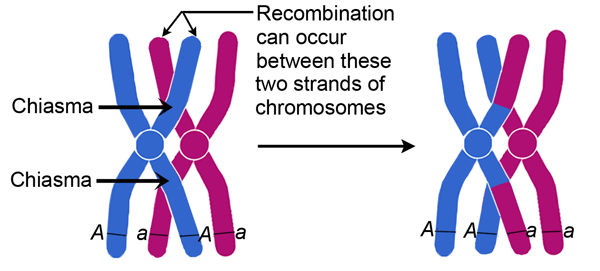
This image shows chromosomes during Prophase 1. Which of the following correctly describes the process shown?
a)
segregation of sister chromatids
b)
condensation and segregation of alleles
c)
mutationin which the DNA content of the gene is altered
d)
crossing - over in which alleles are exchanged
15.
The nuclear membrane dissolves during
a)
Prophase
b)
Metaphase
c)
Anaphase
d)
Telophase
16.

What phase is shown here?
a)
Prophase II
b)
Metaphase I
c)
Metaphase II
d)
Anaphase I
17.

What phase is shown here?
a)
Metaphase II
b)
Telophase I
c)
Telophase II
d)
Metaphase I
18.

What phases is shown here?
a)
Prophase II
b)
Prophase I
c)
Anaphase II
d)
Interphase I
19.

What phase is shown here?
a)
Anaphase I
b)
Prophase I
c)
Metaphase II
d)
Metaphase I
20.

What phase is shown here?
a)
Telophase I
b)
Metaphase II
c)
Telophase II
d)
Anaphase I
21.

A human usually has ______ chromosomes in their body cells.
a)
6
b)
22
c)
4
d)
46
22.
How many chromosomes are in the new cells of meiosis?
a)
46
b)
23
23.
Before mitosis or meiosis can begin, DNA must go through Interphase. This is when...
a)
DNA replicates
b)
DNA splits
c)
DNA forms chromosomes
d)
Chromosomes cross over
24.

What is one of the advantages, of reproducing sexually versus asexually?
a)
survival of the fittest
b)
overproduction
c)
genetic variation
d)
cloning
100 %

