
 Worksheets
Unit 2A Mock Test
Total questions: 20
Worksheet time: 44mins

Compare the function, f(x), below to the graph, g(x), pictured. Which has a lower y-intercept?
f(x) is lower than g(x)
g(x) is lower than f(x)
f(x) and g(x) have the same y-intercept
Can not be determined from the given information
Fireworks are fired from the roof of a 100-foot building. The equation h(t)=−16t2+84t+100 models the height, h, of the fireworks at any given time, t. What is the max height of the fireworks?
2.625
6.25
100
210.25
Which pair of systems of equations has no solutions?


Which statement is true about the quadratic functions g(x), shown in the table, and the function f(x)?
f(x)=−x2+7xThey have the same vertex
They share a zero in common
They are both minimums
They have the same y-intercepts
Which of the following functions has the highest minimum?
g(x)=x2+4x+5
f(x)=(x+4)(x−1)


A fish jumping out of the water can be modeled by the function h(t) = -16t2 + 43t - 6 where h(t) represents the height of the fish after t seconds. An eagle nearby spots the fish and dives to catch it; its flight path is modeled by the function h(t) = 27 - 13t. After how many seconds does the eagle catch the fish and at what height above the water?
0.75 seconds & 17.25 feet above the water
1.34 seconds & 22.89 feet above the water
2.75 seconds & 8.75 feet above the water
The eagle doesn't catch the fish.

Find the solutions to the system shown. Which is the smallest x-value in the solution set?
0
4
3
7
Which function below is a quadratic function that has been vertically stretched by 3, shifts right 7, and shifts up 9.
y=3(x−7)2+9
y=31(x−7)2+9
y=3(x+7)2+9
y=3(x+7)2−9
What is the horizontal difference between the graph of y = x2 - 4 and the graph of y = (x + 5)2 - 4?
y = (x + 5)2 - 4 would shift up 5 units
y = (x + 5)2 - 4 would shift down 5 units
y = (x + 5)2 - 4 would shift right 5 units
y = (x + 5)2 - 4 would shift left 5 units

The coordinate plane shows the graphs of Function A and Function B. Which of the translations below map Function A onto Function B?
Function A has a horizontal translation 7 units right and a vertical translation 3 units up.
Function A has a horizontal translation 7 units left and a vertical translation 3 units down.
Function A has a horizontal translation 3 units left and a vertical translation 7 units down.
Function A has a horizontal translation 3 units right and a vertical translation 7 units up.

Determine the curve of best fit.
y=−2.7x+7.4
y=0.95x2−2.08x−0.75
y=−.05x−3.26
y=0.95x2+2.08x+0.75
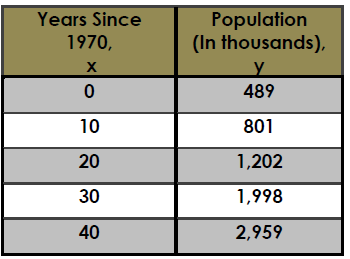
If the population in the town modeled by the table continued to grow, how many people (in thousands) would live there now, approximately 50 years later?
6,230
5,731
4,177
489

Given the quadratic in table form, what is the axis of symmetry?
x = -1
x = 6
x = -2
x = 0
Which is the interval of increasing for the function y=−(x+3)(x−1) ?
x > −1
x < −1
x < 4
x > 4

Describe the end behavior of the graph.
x → −∞, y → −∞
x → ∞, y → −∞
x → −∞, y → ∞
x → −∞, y → 3
x → −∞, y → ∞
Given the coordinates A(-2, -3), B(0, 4), and C(2, 4), find the image points under the transformation f(x,y)=(y−2, x−1) .
A'(-5, -3), B'(2, -1), and C'(2, 1)
A'(1, -3), B'(3, 7), and C'(5, 4)
A'(-2, -6), B'(0, 1), and C'(2, 1)
A'(-4, -4), B'(-2, 3), and C'(0, 3)


For the figure below, state the angle of rotation and the number of lines of symmetry.
angle of rotation: 45°; lines of symmetry: 8
angle of rotation: 45°; lines of symmetry: 4
angle of rotation: 72°; lines of symmetry: 4
angle of rotation: 72°; lines of symmetry: 8
What geometric form do rotations move points along?
rays
parallel lines
perpendicular lines
circular arcs
Which rigid motion transformation moves an image perpendicular to its pre-image?
translation
reflection
rotation
dilation

