
 Worksheets
Plate tectonics
Total questions: 20
Worksheet time: 10mins
Name
Class
Date
1.
A ______ is a section of the lithosphere that slowly moves over the asthenosphere, carrying large slabs of continental and oceanic crust.
a)
wedge
b)
plate
c)
chunk
d)
fault
2.
What is the name of the single landmass that began to break apart 200 million years ago?
a)
Panthalassa
b)
Laurasia
c)
Gondwanna
d)
Pangaea
3.
The movement of fluid, caused by differences in temperature, that transfers heat from one part of the fluid to another is _____________.
a)
Convection current
b)
Seismic waves
c)
Sea-floor spreading
d)
Conduction current
4.
The process by which molten material adds new oceanic crust to the ocean floor is called ___________.
a)
Divergent boundary
b)
Sea-floor spreading
c)
Convergent boundary
d)
Renovating
5.
What is an undersea mountain chain where new ocean floor is produced?
a)
Rift valley
b)
Deep-ocean trench
c)
Mid-ocean ridge
d)
Transform bounda
6.
A __________ is a deep valley along the ocean floor beneath which oceanic crust slowly sinks toward the mantle.
a)
deep-ocean trench
b)
rift valley
c)
sea-floor spreading
d)
mid-ocean ridge
7.
What is the process by which oceanic crust sinks beneath a deep-ocean trench and back into the mantle at a convergent plate boundary?
a)
Subduction
b)
Induction
c)
Abduction
d)
Reduction
8.
_____________ is a plate boundary where two plates move away from each other.
a)
Convergent boundary
b)
Transform boundary
c)
Divergent boundary
d)
Insurgent boundary
9.
_____________ is when two plates move toward each other.
a)
Convergent boundary
b)
Allegiant boundary
c)
Transform boundary
d)
Sliding boundary
10.
A _____________ is when two plates move past each other in opposite directions.
a)
emergent boundary
b)
divergent boundary
c)
transform boundary
d)
convergent boundary
11.
___________ is the theory that pieces of Earth's lithosphere are in constant motion, driven by convection currents in the mantle.
a)
Seismic waves
b)
Convection current
c)
Divergent boundary
d)
Plate tectonics
12.
Which of these explains that Earth's outer layer is broken into large slowly moving pieces?
a)
Plate Tectonic Theory
b)
Continental Drift
13.
What is the difference between the lithosphere and asthenosphere that makes up the mantle?
a)
The lithosphere is ismade of dense solid meal whle the asthenosphere is made of liquid molten metal
b)
The lithosphere is a mixture of gasses while the asthenosphere is made of solid rock
c)
The lithosphere is molten rock that moves while the asthenosphere is ridid and thin
d)
The lithosphere is made of solid rock while the asthenosphere is more flexible hot rock that moves.
14.
Convergent Plate Movement can create
a)
Rifts
b)
Mountains
c)
Ocean Ridges
d)
Radiation
15.
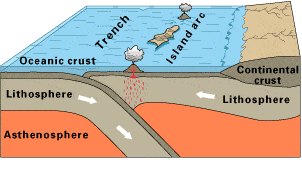
Observe this diagram of a plate boundary. One statement BEST describes what is happening. It is that
a)
the oceanic crust is melting.
b)
the denser ceanic crust is subducting under the less dense oceanic crust
c)
volcanic islands are forming.
d)
the tectonic plates are moving away from each other.
16.
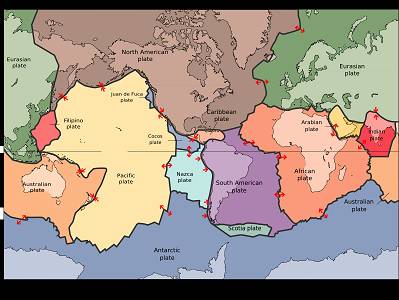
Geologists have long recognized that earthquakes are not randomly distributed on Earth but occur in concentrated areas that coincide with __________ and provide evidence for the theory of ___________ .
a)
mountain ranges; fault zones.
b)
continental borders; supercontinents.
c)
plate boundaries; plate tectonics
d)
areas of liquid magma; sea floor spreading.
17.
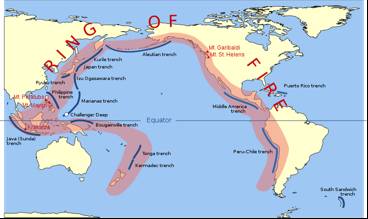
The image shows the Pacific Ring of Fire, a region of high tectonic activity. What evidence supports the theory that the tectonic activity of the region is due to the subduction of tectonic plates?
a)
The region is bound by many oceanic trenches.
b)
North America seems to be colliding with Asia at the north of the ring.
c)
The Asia-Pacific region is dotted by many small and large islands
d)
The landmasses look like they would fit together like the pieces of a jigsaw puzzle.
18.

How is it possible for new crust to be formed without increasing the surface area of the Earth?
a)
Crust is destroyed at the same time it is created
b)
New crust is underwater where it sinks
c)
New crust breaks more easily than old crust
19.

Wegener’s proposal of a supercontinent was supported by:
a)
earthquake data
b)
seafloor magnetism
c)
rock, fossil, and climate data.
d)
convection currents in the mantle.
20.
Where are the youngest rocks on Earth found?
a)
Along mid-ocean ridges
b)
Along transform boundaries
c)
On the edges of the continents
d)
Near ocean trenches
100 %

