
Font size
 Worksheets
Revision Quiz: Particulate Nature of Matter
Total questions: 25
Worksheet time: 19mins
Particles of all matter are in constant random motion.
Which statements describe the arrangement or movement of particles in solids?
particles are moving in all directions
Particles are arranged in an orderly manner
particles can slide over one another.
particles vibrate about their fixed positions
Which statement about liquids is correct?
They have a fixed shape and a fixed volume.
They have a fixed shape but not a fixed volume.
They have no fixed shape but they do have a fixed volume.
They have no fixed shape and no fixed volume.
The particles of solids ________________
vibrate about their fixed postions
are able to slide over each other
move about freely at high speeds and in random direction
do not move
The particles of liquids ________________
vibrate about their fixed postions
are able to slide over each other
move about freely at high speeds and in random direction
do not move
The particles of gases ________________
vibrate about their fixed postions
are able to slide over each other
move about freely at high speeds and in random direction
do not move
These particles are held together by very strong forces of attraction
Solid
Liquid
Gas
Plasma

The diagram represent the arrangement of particles in ____________.
gas
liquid
solid

The three states of matter are represented by diagrams X, Y and Z. Which change occurs during condensation?
X to Y
X to Z
Y to X
Z to X
Which statement best describes the fact that gases can be compressed?
The particles in a gas do not have a fixed volume.
The particles in a gas are very far apart.
The particles in a gas have no force of attraction (bonds) between them.
The particles in a gas are constantly moving very rapidly.
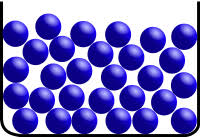
Which description best matches this particle model?
Closely packed and vibrate about a fixed position.
Particles are rather close together but can slide past each other.
Particles have lots of energy and can move around.
When a liquid becomes a solid, what are the changes in the behaviour of the particles? Select all that apply.
Particles lose energy
Forces of attraction are weakened/ overcome
Particles move closer together
Particles become smaller

How many changes of state occur in this graph?
1
2
3
1.Which of the following processes causes the distance between the particles to increase the most?
Melting
Freezing
Sublimation
condensation
Which statement best describes the fact that gases can be compressed?
The particles in a gas do not have a fixed volume.
The particles in a gas are very far apart.
The particles in a gas have no force of attraction (bonds) between them.
The particles in a gas are constantly moving very rapidly.
Which statement about liquids is correct?
They have a fixed shape and a fixed volume.
They have a fixed shape but not a fixed volume.
They have no fixed shape but they do have a fixed volume.
They have no fixed shape and no fixed volume.

Why solids and liquids cannot be compressed?
The particles are closely packed together and there are no empty spaces.
The particles are far apart from one another and there are empty spaces.
The particles are arranged in an orderly manner.
The particles are not arranged in an orderly manner.
A substance has a boiling point of 90°C. What changes occur when it is heated from 50°C to 120°C?
energy of particles increase; attractive forces between particles decrease
energy of particles decrease; attractive forces between particles increase
energy of particles increase; attractive forces between particles increase
energy of particles decrease; attractive forces between particles decrease
What happens to the kinetic energy of particles in a solid as it begins to melt?
It fluctuates randomly.
It decreases significantly.
It remains constant.
It increases.
During the melting process, what occurs to the arrangement of particles in a solid?
They become more ordered.
They remain in a fixed position.
They start to move more freely and become less ordered.
They completely disperse into the air.
In a heating curve, what does a plateau represent?
A decrease in energy of the particles.
A change in temperature without a change in state.
A change in state without a change in temperature.
A constant temperature throughout the heating process.

What is the freezing point of the substance?
0oC
60oC
120oC
180oC

In which region(s) of the heating curve would water be a liquid and a gas at the same time?
A
B
C
D
E

Describe the substance at letter A.
Solid
Liquid
Melting
Evaporating

What is the phenomenon called when smoke particles in air move constantly and randomly as observed under a microscope?
Brownian motion
Newtonian motion
Circular motion
Linear motion

