wayground logo

Free Printable Worksheets

Font size

S
M
L
XL
Worksheets

Population ecology

Total questions: 22

Worksheet time: 16mins

Name
Class
Date
1.

The resource partitioning where they feed at different times

a)

Temporary partitioning

b)

Tempor partitioning

c)

Tempered partitioning

d)

Temporal partitioning

2.
If the number of births in a population is the same as the number of deaths in a population, what will happen to the growth of the population?
a)
It will increase.
b)
It will decrease.
c)
It will stay the same.
d)
It will fluctuate.
3.
Largest number of individuals of a population that the environment can support...  
a)
carrying capacity
b)
population crash
c)
lag phase
d)
mutualism
4.
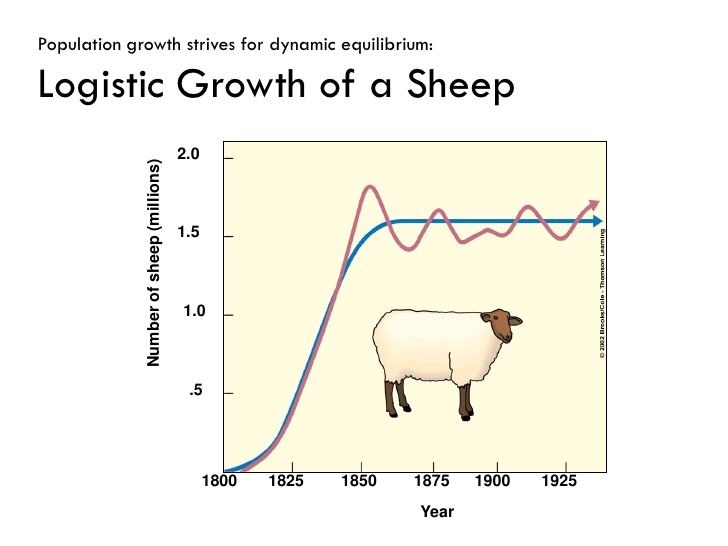
What is the carrying capacity for this sheep population?
a)
1.8 million
b)
1.25 million
c)
1.6 million
d)
1.o million
5.
When a population grows past the ecosystem's carrying capacity, what happens to the population?
a)
Continues to grow
b)
The population starts to die off to return to carrying capcity
c)
The population will go extinct due to lack of resources
d)
The population grows then finds a new carrying capacity
6.
Food, water, sunlight, shelter, and space are resources that are often __________.
a)
limiting factors
b)
wet
c)
messy
d)
found in rocks
7.
In a forest ecosystem, which of the following is the best example of a limiting factor for a rabbit population?
a)
Squirrel Population
b)
Sunlight
c)
Grass available
8.
When organisms move out of the population, this is known as
a)
emigration
b)
abandonment
c)
immigration
d)
succession
9.
which statement sounds accurate based on the graph data. 
a)
The zebra and lions do not affect each other
b)
when lions population increases, so does the zebra population
c)
When the zebra population increases, it causes the lion population to also increase
d)
when zebra populations go down, the zebra population goes up. 
10.
Which kind of growth does the human population follow? It is described as a J-shaped curve.
a)
Exponential Growth
b)
Logistic Growth
c)
Outstanding Growth
d)
Minimal Growth
11.
A population is...
a)
A group of one species in one area
b)
Multiple species that live in one area
c)
All of the living and nonliving things in an area
d)
None of these
12.
What type of growth is represented behind?
a)
exponential
b)
logistics
c)
a good kind
d)
representative
13.
What point on the graph represents the carrying capacity?
a)
A
b)
B
c)
C
d)
D
14.

Which of the following are density dependent factors?

a)

competition for resources

b)

predation

c)

disease

d)

natural disasters

15.

Which of the following are examples of a density independent factors?

a)

forest fire

b)

seasonal cycles

c)

storms

d)

disease

16.

A population’s emigration in one month totaled 2 individuals. During the same period, immigration was 12 individuals. Natality (births) was 8, and mortality was 15 due to a parasite infection. What was the net effect on the population size?

a)

+5

b)

+3

c)

0

d)

-4

17.

Factors like predation can have a positive benefit to the population of prey organisms because predators tend to keep prey populations below their ___________.

a)

carrying capacity

b)

sustainibility number

c)

exponential growth point

d)

competition level

18.

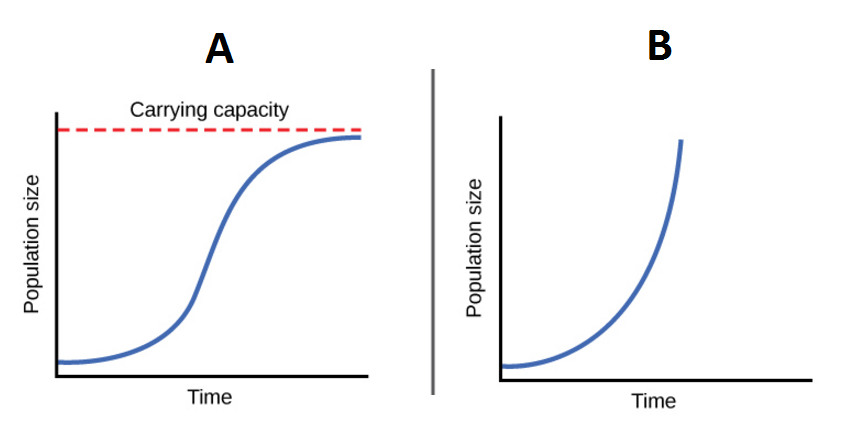
What type of growth model is shown in image A?

a)

Exponential

b)

Logistic

19.

At carrying capacity, a population __________.

a)

increases rapidly

b)

increases slowly

c)

decreases slowly

d)

is in dynamic equilibrium

20.

Which of the following populations is most likely to go extinct?

a)

a very small population in an unstable environment

b)

a moderate-sized population of r strategists

c)

a large population with lots of genetic variability

d)

all would be equally likely to go extinct

21.

Which population growth model most closely describes the human population in the modern age?

a)

logistic growth

b)

exponential growth

c)

upward growth

d)

tumor growth

22.

What causes the carrying capacity to fluctuate?

a)

Birth rate

b)

environmental resistance

c)

lag phase

d)

decelerating phase