
 Worksheets
Reflection-light
Total questions: 25
Worksheet time: 14mins
Magnification produced by a rear view mirror fitted in vehicles
is less than one
is more than one
is equal to one
can be more than or less than one depending upon the position of the object in front of it.
The mirror having reflection surface curved outward
plane mirror
concave mirror
convex mirror
cylindrical mirror
When light falls on a surface and bounces back to the medium, the phenomena is called ……………..
(a)
……………. is ratio of height of image to height of object.
(a)
A spherical mirror produces an image with magnification, m=+0.60
What can we say about the size of the image?
The image is point-sized.
The image is the same size as the object.
The image is diminished in size.
The image is magnified in size.
The magnification ,m -produced by a spherical mirror is measured to be m=+3.6
What can we say about the nature of the image?
The image is real and inverted.
The image is virtual and erect.
The image is real and erect.
The image is virtual and inverted.

Diagram shows a phenomenon occurs when the spotlight is directed onto a mirror surface. What is the principle of light shown in the situation?
Light travels in a straight line
Refraction of light
Reflection of light
Light travels in parallel
Which of the following is NOT a use of a concave mirror?
car lights
torches
security mirrors
mirrors used by dentist
Image behind the mirror is
virtual
real
upside down
upright
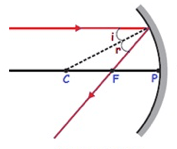
This ray diagram is for which mirror?
concave
convex
plane
window

what is A on the diagram?
center of curviture
focal length
reflected ray
focal point
Rob wants to design a solar furnace that will focus sunlight at one spot to heat water.
Which of the following mirrors should Rob use in the solar furnace?
Note: The smooth side is the reflecting part of the mirror, and the dotted side is the back.


inverted and enlarged
inverted and diminished
erect and enlarged
erect and diminished
Which statement is true for the reflection of light?
The reflected light is less bright than the incident light.
The angle of incidence and reflection are equal.
The sum of angle of incidence and reflection is always greater than 900.
The beams of incident light after reflection diverge at unequal angles.

The image shows the path of incident rays to a concave mirror.
Where would the reflected rays meet for the image formation to take place?
behind the mirror
between F and O
between C and F
beyond C
An image of an object produced on a screen which is about 36 cm using a convex lens.
The image produced is about 3 times the size of the object. What is the size of the object?
12 cm
24 cm
36 cm
6 cm
A student conducts an activity using a concave mirror with focal length of 10 cm. He placed the object 15 cm from the mirror. Where is the image likely to form?
at 6 cm behind the mirror
at 30 cm behind the mirror
at 6 cm in front of the mirror
at 30 cm in front of the mirror
A student conducts an activity using a flask of height 15 cm and a concave mirror. He finds that the image formed is 45 cm in height. What is the magnification of the image?
-3 times
-1/ 3 times
1/ 3 times
3 times
Focal length of plane mirror is
At infinity
Zero
Negative
None
Image formed by plane mirror is
Real and erect
Real and inverted
Virtual and erect
Virtual and inverted
A concave mirror gives real, inverted and same size image if the object is placed
At F
At infinity
At C
Beyond C

What is 'u' ?
image distance
object distance
focal distance
None

Fill in the blank.
Enlarged
Point sized
Highly magnified
Diminished

Fill in the blank.
Diminished
Magnified
Same size
Enlarged

