
NEW
Font size
S
M
L
XL
 Worksheets
Thermal Energy and Chemical Reactions
Total questions: 23
Worksheet time: 25mins
Name
Class
Date
1.
What does temperature measure?
a)
Heat of Molecules
b)
ºC
c)
Average Kinetic Energy of Molecules
d)
Thermal Energy
2.

What would be the effect on the particles if more heat is supplied to the system?
a)
They would slow down
b)
They would stop moving
c)
They would speed up
d)
There would be no effect
3.
How does heat flow?
a)
Always from cold to warm
b)
Always from warm to cold
c)
Both warm to cold & cold to warm
d)
It depends on the temperature
4.
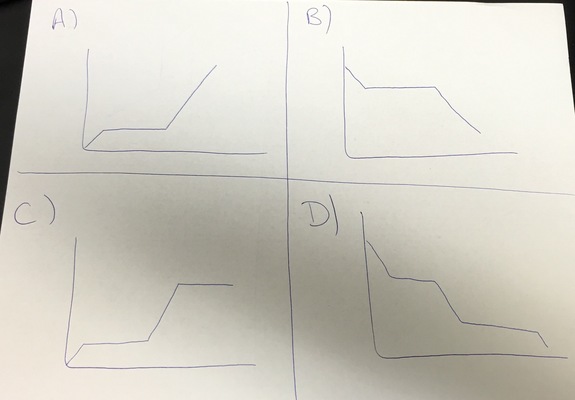
Which of the following shows a tray of water being put in the freezer?
a)
A
b)
B
c)
C
d)
D
5.
What is the equation to measure change in Thermal (Heat) Energy?
a)
Q=mc∆t
b)
Q=mc
c)
Q= ∆mct
d)
m=QC
6.
What is the symbol for Thermal (Heat) Energy in the specific heat formula?
a)
Q
b)
t
c)
m
d)
C
7.
What unit do you use to measure Thermal Energy?
a)
J/Kg ºC
b)
Kg
c)
ºC
d)
J
8.

There are four cups of hot cocoa. The cup sizes are shown. The temperature of the cocoa in each cup is 25 degrees celsius. Which cup has the MOST thermal energy?
a)
Large cup (Trenta)
b)
Small cup (Tall)
c)
Venti
d)
All three are the same temperature so they have same thermal energy
9.
Specific heat is....
a)
The measure of kinetic energy of an objects particles
b)
A measure of the energy needed to increase the average kinetic energy of the particles
c)
The heating caused by the motion of flluid due to temperature difference
d)
The transfer of energy by electromagnetic radiation
10.
A high specific heat means...
a)
It requires less energy to change temperature
b)
It requires more energy to change temperature
c)
It heats up very quickly
11.
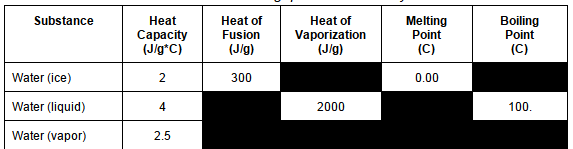
How many Joules of energy are required to change 10 gram of ice at -2 C to water at 20 C?
a)
440 J
b)
880 J
c)
10,140 J
d)
66,000 J
12.
The specific heat of aluminum is 0.21 cal/g°C. How much heat(Q) is released when a 10 g piece of aluminum foil is taken out of the oven and cools from 100° to 50°?
a)
105 J
b)
10.5 J
c)
1.05 J
d)
50 J
13.
A sample of iron receives 50.J of heat energy that raises the temperature of the iron 25.0°C. If iron has a specific heat of 0.10 J/g°C, what is the mass of the iron sample?
a)
25 g
b)
30 g
c)
20 g
d)
50 g
14.
When a piece of aluminum foil is taken out of the oven and cools from 100° C to 50°C, What is the change in temperature?
a)
50°
b)
0°
c)
100°
d)
150°
15.
What is the standard Unit for temperature?
a)
Joules (J)
b)
Degrees Celsius (°C)
c)
Grams (g)
d)
Joules per Grams Degrees Celsius (J/g°C)
16.
Define 'Enthalpy'
a)
a) Energy stored in the movement of molecules in a substance
b)
b) The opposite of temperature
c)
c) The temperature of a molecule
d)
d) Energy stored in the chemical bonds in a substance
17.
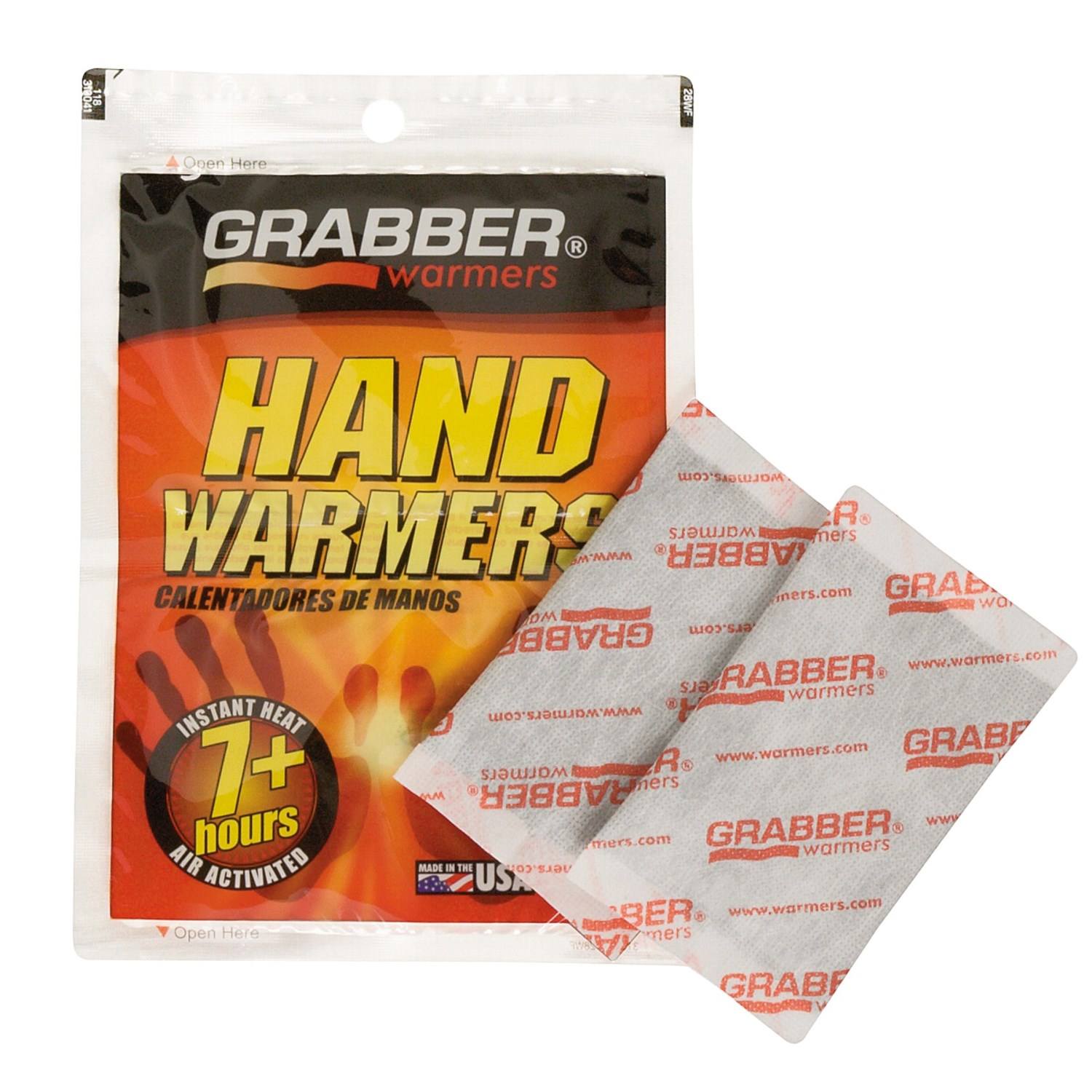
What type of reaction occurs in a hand warmer
a)
exothermic
b)
endothermic
18.

Exothermic reactions...
a)
Absorb energy
b)
Release energy
c)
Release Color
d)
Absorb Color
19.
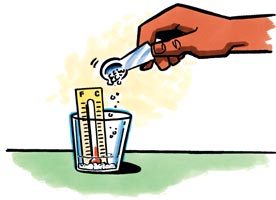
In an endothermic reaction, heat is ...
a)
taken in or absorbed
b)
given out or released
20.
If they energy required to break the bonds is greater than the energy given out by making new bonds the reaction is
a)
Exothermic
b)
Endothermic
c)
Neutralisation
21.
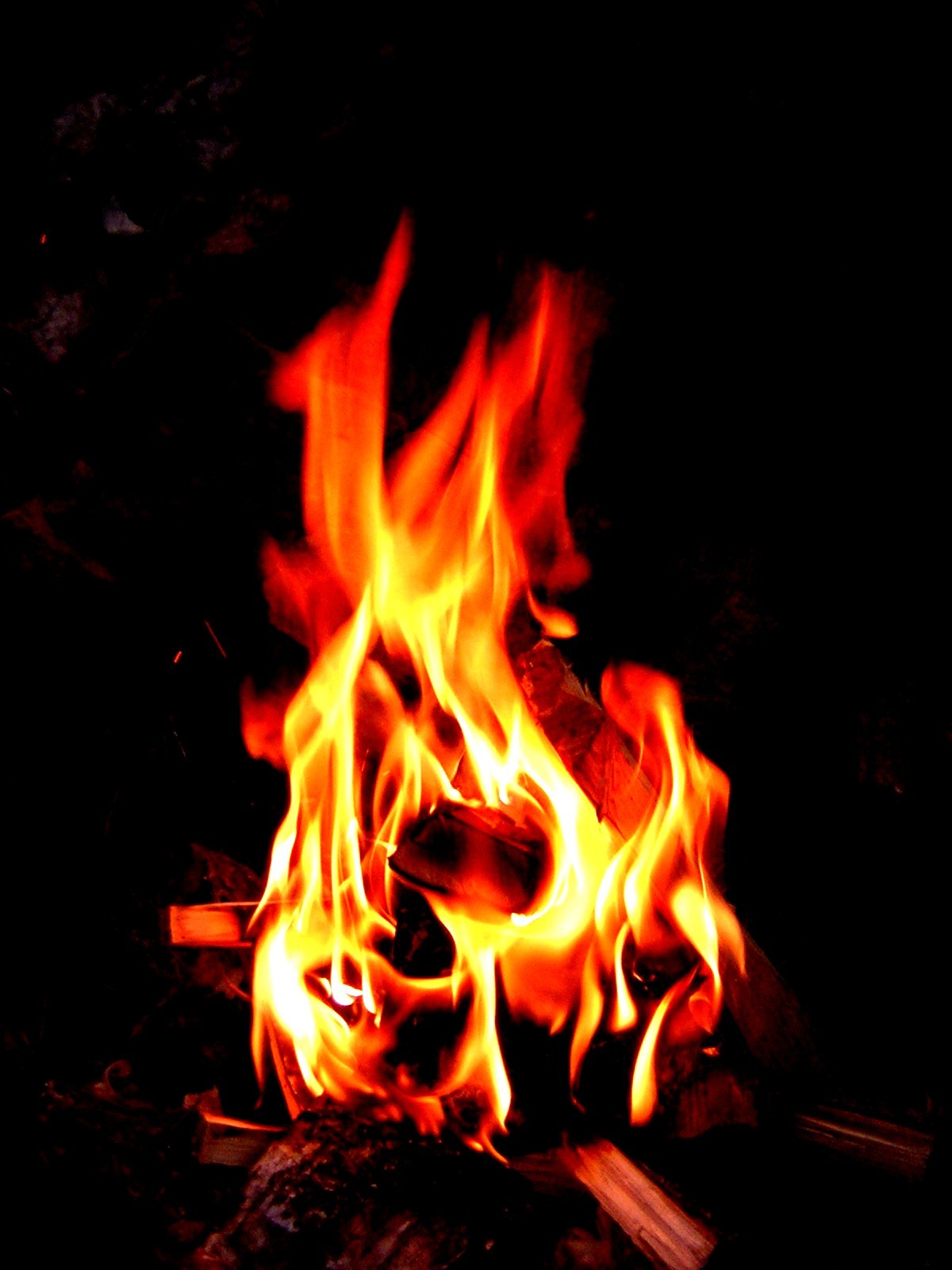
_____ reactions usually feel hot!
a)
endothermic
b)
exothermic
22.
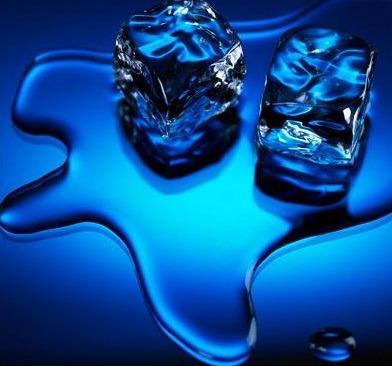
____ reactions usually feel cold.
a)
endothermic
b)
exothermic
23.
If they energy required to break the bonds is less than the energy given out by making new bonds the reaction is
a)
Exothermic
b)
Endothermic
c)
Neutralisation
Reset

