
 Worksheets
Enzyme Quiz I
Total questions: 20
Worksheet time: 16mins

Which of the following describes reactions which turn large molecules into smaller ones?
Anabolic reactions
Catabolic reactions
Metabolic reactions
Enzymes

Enzymes need certain environmental conditions in order to function properly. What happens when enzymes are heated to a high temperature?
they die
they denature
they change their amino acid sequence
they work better

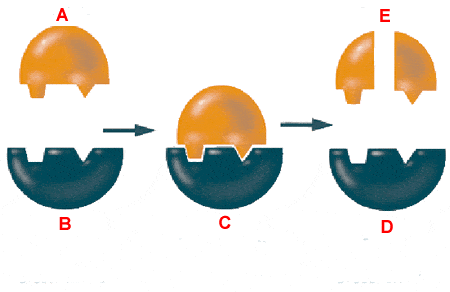
Where do substrates bind on an enzyme?
voltage-gated channels
surface receptor
calcium channels
active site

What 3 letters do enzymes typically end in?
-ose
-ase
-ese
-tic

Which of the following tasks listed below is most associated with enzymes?
catalyze chemical reactions
store genetic information
store chemical energy in the cell
dissolve nutrients and minerals

What are signs that a chemical reaction has taken place?
Color change
Gas bubbles
Solid forming
All of the above

In an Exergonic reaction, heat is ________.
Absorbed
Created
Destroyed
Released

In an Endergonic reaction, heat is ________.
Released
Absorbed
Created
Destroyed
organism referred to?

What is the energy needed to start an chemical reaction referred to?
Cascading Energy
Potential Energy
Kinetic Energy
Activation energy

The enzyme known as ‘catalase’ is involved in the breakdown of hydrogen peroxide molecules into separate water and oxygen molecules. During this reaction, what happens to the ‘catalase’?
The enzyme would become products: O2 and H20
The enzyme would be fully used up and discarded.
The enzyme would remain unchanged in any way.
The enzyme would become a new type of enzyme.

REVIEW: Which of the following best describes the function of nucleic acids?
Nucleic acids are used as the building blocks of proteins.
Nucleic acids inhibit and stop the flow of biochemical reactions.
Nucleic acids contain the genetic code for protein synthesis.
Nucleic acids transmit signals that begin biochemical processes.

REVIEW: A scientist analyzing an unknown substance has determined that it consists of carbon, hydrogen and oxygen. During experimentation, she determines that the substance is soluble in oil but not in water. Which of the following macromolecules is the unknown substance most likely to be?
carbohydrate
nucleic acid
lipid
protein

REVIEW: Which of the four major biological macromolecules can be easily identified by the nitrogen base found in its structure?
Carbohydrate
Protein
Lipid
Nucleic Acid

What is the purpose of an enzyme?
give permission for the reaction
raise activation energy
speed up reactions
control how many reactions occur

Where do substrates bind on an enzyme?
voltage-gated channels
surface receptor
calcium channels
active site

What happens to an enzyme when it is denatured?
Activation energy is lowered.
It becomes stronger.
It loses its shape.
Activation energy is raised.

Which factors can change the shape of an enzyme and thus denatures a enzyme?
Excessive heat and changes in pH
Nothing can
Exposure to light and sound
Exposure to bacteria and Amoebas

What will most likely happen if an appropriate enzyme is added to a chemical reaction?
The reaction rate will increase.
The equilibrium of the reaction will be maintained.
The reaction rate will decrease.
The reaction will stop.

