
NEW
Font size
 Worksheets
Ecosystem
Total questions: 20
Worksheet time: 13mins

What is an ecosystem?
A community of non-interacting organisms and their physical environment.
A biological community of interacting organisms and their chemical environment.
A biological community of interacting organisms and their physical environment.
A community of non-interacting organisms and their chemical environment.

What is a biotic factor?
Any non-living component that affects the population of another organism, or the environment.
Any living component that has a population.
Any living component that affects the population of another country.
Any living component that affects the population of another organism, or the environment.

What is a food web?
A system of intraconnecting chains linked together to show the feeding relationships of organisms in an ecosystem.
A system of interconnecting chains linked together to show the feeding relationships of organisms in an ecosystem.
A system of interlocking chains that show a relationship between non-living things.
A system on intralocking chains that show a relationship between non-living things.

What is an abiotic factor?
A living condition or thing, that influences or affects an ecosystem and the organisms in it.
A non-living condition or thing, that does not affect an ecosystem and the organisms in it.
A non-living condition or thing, that influences or affects an ecosystem and the organisms in it.
A living condition or thing, that does not affect an ecosystem and the organisms in it.
An animal that hunts and eats other animals for energy.
prey
predator
decomposer
consumer
Choose the producer.
rock
tree
cow
bird
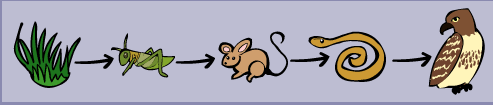
Explain the flow of energy in this food chain (who passes energy to who).
The hawk gives energy to the snake. The snake gives energy to the mouse. The mouse gives energy to the grasshopper who gives energy to the grass.
The mouse gives energy to the hawk. The snake gives energy to the grasshopper. The grass gives energy to the snake.
The grass gives energy to the grasshopper. The grasshopper gives energy to the mouse. The mouse gives energy to the snake who gives energy to the hawk.
The grass gives energy to the grasshopper. The mouse gives energy to the grasshopper. The mouse gives energy to the snake and to the hawk.

Which of the following acts as secondary consumer?
Grass
Grasshopper
Mouse
Owl
In a meadow ecosystem, a population of rabbits increases. What populations are most likely to increase as a result?
foxes, hawks, and other predators of the rabbits
leafy plants that rabbits eat
rabbits that live elsewhere
worms that live in the meadow soil
Number of births each year per 1,000 people
birth rate
population growth
population density
migration
In order for population to grow
death rate must be higher than birth rate
heart rate must be lower than death rate
birth rate must equal death rate
birth rate must be higher than death rate


