Wayground logo

Free Printable Worksheets

Font size

S
M
L
XL
Worksheets

Waves

Total questions: 25

Worksheet time: 1hrs 23mins
Name
Class
Date
1.
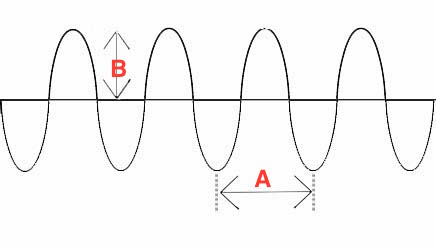
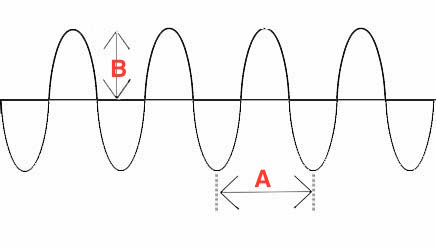
What property of this wave is represented by the letter "A"
a)
amplitude
b)
crest
c)
trough
d)
wavelength
2.
What property of the wave is represented by the letter "B"?
a)
amplitude
b)
crest
c)
trough
d)
wavelength
3.
The highest point on a wave is:
a)
the crest
b)
the trough
c)
the top
d)
the coast 
4.
The lowest point on a wave is the:
a)
Amplitude
b)
Crest
c)
Trough
d)
Wavelength
5.
The number of wavelengths that pass a point each per second is:
a)
frequency
b)
period
c)
longitudinal 
d)
transverse wave 
6.
When the frequency of a wave increases, what happens to the wavelength?
a)
The wavelength is not directly affected by the frequency of a wave.
b)
The wavelength increases.
c)
The wavelength decreases.
d)
More specific information is needed to form a conclusion about the wavelength.
7.
Which is the correct equation for calculating the speed of a wave?
a)
T = 1/f
b)
Speed= Wavelength x Period
c)
Speed = Wavelength/Frequency
d)
Speed= Wavelength x Frequency
8.
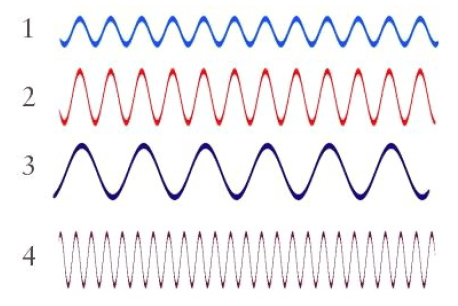
Which wave in the diagram has the greatest frequency?
a)
1
b)
2
c)
3
d)
4
9.
Which wave in the diagram has the greatest wavelength?
a)
1
b)
2
c)
3
d)
4
10.
1.  A wave has frequency of 50 Hz and a wavelength of 10 m. What is the speed of the wave?
a)
500 m/s
b)
50 m/s
c)
5 m/s
d)
0.5 m/s
11.
1.  A wave has frequency of 5 Hz and a speed of 25 m/s. What is the wavelength of the wave?
a)
25 m
b)
125 m
c)
5 m
d)
25 m/s
12.
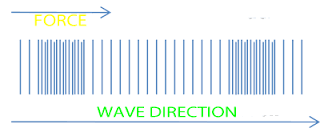
What type of waves have compressions and rarefactions?
a)
longitudinal
b)
transverse
13.
Which part of a longitudinal wave is where particles are packed closely together?
a)
compression
b)
rarefaction
c)
crest 
d)
amplitude
14.
the maximum distance that the particles of the medium carrying the wave  move away from their rest position
a)
frequency
b)
wavelength
c)
hertz
d)
amplitude
15.

A system is oscillated at a frequency equivalent to its natural frequency by an external force.

This phenomenon is called

a)

Damping

b)

Resonance

c)

Rectification

d)

Pitching

16.

Diagram below shows a graph of an oscillation system experiences damping.

Which of the following quantity does not change?

a)

Size of oscillation

b)

Period of oscillation

c)

Energy of oscillation

d)

Amplitude of oscillation

17.

Diagram below shows the displacement-time graph of an oscillating spring.

The oscillating spring undergoes …

a)

damping

b)

resonance

c)

interference

d)

forced oscillation

18.

When the amplitude of a wave increases, its

a)

wavelength will increase

b)

frequency will decrease

c)

energy will increase

d)

period will decrease

19.

Diagram below shows an oscillating system.

Which graph shows the correct relationship between displacement and time for the oscillating system?

a)
b)
c)
d)
20.
What occurs when vibrations traveling through an object match the object's natural frequency?
a)
reflection
b)
diffraction
c)
resonance
d)
refraction
21.
True or False: Every object has at least one natural frequency.
a)
True
b)
False
22.
When two objects vibrate at the same frequency it is called.....
a)
Diffraction
b)
Reflection
c)
Refraction
d)
Resonance
23.

A guitar string is plucked and set into oscillation. Over time the amplitude of oscillation of the string decreases. The oscillation of the string is said to be ...

a)

damped

b)

forced

c)

natural

d)

resonant

24.

When a forced oscillation is damped, the amplitude

a)

builds up quite slowly

b)

constantly rises and falls

c)

is always small

d)

is reduced

25.
What occurs when vibrations traveling through an object match the object's natural frequency?
a)
reflection
b)
diffraction
c)
resonance
d)
refraction