wayground logo

Free Printable Worksheets

Font size

S
M
L
XL
Worksheets

Review 21-22

Total questions: 140

Worksheet time: 4hrs 1mins

Name
Class
Date
1.

What is rule #1?

a)

Follow directions quickly

b)

Raise your hand for permission to speak.

c)

Raise your hand for permission to leave your seat.

d)

Keep your dear teacher happy.

2.

What is rule number 2?

a)

follow directions quickly.

b)

Raise your hand for permission to speak

c)

Raise your hand for permission to leave your seat.

d)

Make smart choices.

3.

What is rule #3?

a)

Follow directions quickly

b)

Raise your hand for permission to speak.

c)

Raise your hand for permission to leave your seat.

d)

Keep your dear teacher happy.

4.

What is rule number 4?

a)

follow directions quickly.

b)

Raise your hand for permission to speak

c)

Raise your hand for permission to leave your seat.

d)

Make smart choices.

5.

What is rule #5?

a)

Raise your hand for permission to leave your seat.

b)

Make smart choices.

c)

Keep your dear teacher happy.

d)

Keep your eyes on the target.

6.

What is rule #6?

a)

Raise your hand for permission to leave your seat.

b)

Make smart choices.

c)

Keep your dear teacher happy.

d)

Keep your eyes on the target.

7.
The Fertile Crescent soil is...
a)
dry
b)
rich
c)
rocky
d)
unproductive
8.
City-states offered protection to their citizens with...
a)
irrigation systems
b)
strong armies
c)
good record keeping
d)
walls around the city
9.
Mesopotamia lies between these two rivers...
a)
Indus and Ganges
b)
Fox and Wolf
c)
Ural and Yanghtzee
d)
Tigris and Euphrates
10.
Because of its rich farmland, Mesopotamia is also known as...
a)
The Fertile Crescent
b)
The Farm Factory
c)
The Fertile Farmland
d)
The Agricultural Crescent
11.

What is the place value of the underlined digit?

26,732

a)

Ones

b)

Tens

c)

Hundreds

d)

Thousands

12.

What is the value of the underlined digit?

376,893

a)

8

b)

80

c)

8,000

d)

800

13.

2,361 ______ 2,561

a)

>

b)

<

c)

=

14.

754,987 ______ 754,987

a)

<

b)

>

c)

=

15.

Which is 2,876 in word form.

a)

2,000 + 800 + 70 + 6

b)

2,376

c)

Two thousand, eight hundred seventy-six

16.

Every city in Mesopotamia had a temple called a

a)

Ziggurat

b)

Ziggumouse

c)

pyramid

d)

church

17.

Mesopotamian inventions:

a)

sewers, wheel, plow, checkers, sailboat, irrigation system

b)

sewers, wheel, plow, chess,sailboat, irrigation system

c)

sewers, wheel, plow, checkers, sailboat, immigration system

d)

sewers, wheel, plot, checkers, sailboat, irrigation system

18.

The world's oldest recorded story

a)

The Epic of Gilgamesh

b)

The Epic of Hambabah

c)

The Epic of Uruk

d)

The Epic of Enkidu

19.

Solve using rounding 769 + 825

a)

800 + 800 = 1600

b)

700 + 800 = 1500

c)

700 + 900 = 1600

d)

800 + 900 = 1700

20.
Cuneiform symbols were made with wedge shaped marks on clay tablets
a)
True
b)
False
21.

To preserve their Cuneiform writings, Sumerians

a)

Dried the tablets using natural winds

b)

Put the tablets under water

c)

Baked the clay tablets in the sun

d)

Baked the tablets in the oven

22.
Cuneiform was?
a)
A special agreement
b)
writing system
c)
a temple
23.

The tool used to write cuneiform on clay was called a

a)

Pencil

b)

Pen

c)

Stylus

d)

Stick

24.

Who developed one of the earliest systems of writing?

a)

Babylonians

b)

Sumerians

25.

What is 20 x 500?

a)

10000

b)

1000

c)

100

d)

100000

26.

What is 20 x 500?

a)

10000

b)

1000

c)

100

d)

100000

27.

What was the Code of Hammurabi?

a)

A way of coding secret messages

b)

A written set of laws

c)

A type of architecture that allowed for tall pyramids to be constructed

28.

Who was Hammurabi?

a)

The last king of the Assyrian Empire

b)

The first king of the Babylonian Empire

c)

A great scribe who recorded the history of Mesopotamia

29.

What types of laws were included in the code?

a)

Religious

b)

Business

c)

Laws about slavery

d)

All of the above

e)

None of the above

30.

Around how many laws were included in the code of Hammurabi?

a)

52

b)

122

c)

282

31.

What was the punishment for a son who hit his father?

a)

His hands would be cut off

b)

He was spanked three times

c)

He was sent to timeout for 30 minutes

32.

What language was the Code of Hammurabi written in?

a)

Babylonian

b)

Latin

c)

Greek

d)

Akkadian

33.

The Code of Hammurabi is important because it tells us a lot about the way the people of Babylon lived.

a)

True

b)

False

34.

Which is the best estimate for 49 x 27?

a)

1,500

b)

150

c)

1,000

d)

100

35.

Isabelle has 6 ant farms. Each ant farm has 89 ants. Which of the following shows a reasonable estimate of how many ants Isabelle has?

a)

7x125=875

b)

8x110=880

c)

6x90=540

d)

10x100=100

36.
Which shows the best estimate to use for estimating 37 × 63?
a)
40 × 70 = 2,800
b)
50 × 60 =  3,000
c)
40 × 60 =  2,400
d)
30 × 60 =  1,800
37.

Assyrians were excellent in war tactics.

a)

False

b)

True

38.

The Assyrians were a cruel empire.

a)

True

b)

False

39.

After conquering an area it was not uncommon for the Assyrians to...

a)

force the entire population to move to a completely new place

b)

make the entire population slaves

c)

kill the entire populatoin

40.

To defend their land, the Assyrians built a large ______.

a)

navy

b)

air force

c)

army

d)

coast guard

41.

The Assyrians were a fearsome and mighty force and were the first large army to use ______weapons.

a)

automatic

b)

iron

c)

atomic

d)

steel

42.

Assyria’s cruel treatment of people led to many _____.

a)

tears

b)

suicides

c)

all the answers are correct

d)

rebellions

43.

What were the names of the ancient rulers of Babylon and Sumer?

a)

King Tut

b)

Hammurabi

c)

Nabopolassar

d)

Chugamonga

e)

Nebuchadnezzar

44.

What is an empire?

a)

A group of many lands united under one ruler.

b)

One land with a king.

c)

Two lands with two kings.

d)

A group of many lands with many rulers.

45.

Why did the Assyrians take conquered people from their lands and move them to unfamiliar places?

a)

They had better homes for them in the new places.

b)

They wanted them to live in better land.

c)

They wanted them to be less able to organize and rebel.

d)

They wanted them to be more able to organize and rebel.

46.

Hammurabi was a __________________ king.

a)

Akkadian

b)

Babylonian

c)

Assyrian

d)

Neo-Babylonian

47.

Who built the first Bais Hamikdash?

a)

Shlomo Hamelech

b)

Dovid Hamelech

c)

Betzalel

d)

The Mesopotamians

48.

Which came first? Chanukah or Purim?

a)

Chanukah

b)

Purim

c)

They both happened the same year

49.

Choose all the PRIME numbers

a)

1

b)

2

c)

3

d)

5

50.

A COMPOSITE number has:-

a)

Exactly 2 factors

b)

Less than 2 factors

c)

More than 2 factors

d)

No factors

51.

List the first (4) multiples of 8

a)

1, 2, 4, 8

b)

8, 16, 24, 32

52.
Which is a NOT a factor of 9?
a)
0
b)
1
c)
3
d)
9
53.
Joe has listed the first 4 multiples of 7 as: 
7   14    22     28
Which one is incorrect?
a)
7
b)
14
c)
22
d)
28
54.

Which are factors of 20?

a)

2,10,5,4,1,20

b)

3,5,7,9

c)

40,80,100

d)

15,25,35

55.
Which number is a factor of 6?
a)
12
b)
2
c)
8
d)
10
56.
Which is a factor of 12?
a)
24
b)
5
c)
3
d)
0.3
57.
List the first 5 multiples of 8
a)
1, 2, 4, 8
b)
8, 16, 25, 32, 40
c)
8, 16, 24, 32, 40
d)
8, 16, 24, 31, 40
58.
Which are the factors of both 6 and 15?
a)
9
b)
5
c)
6
d)
3
59.
How often did the Nile flood?
a)
Once
b)
Twice
c)
Once a Year
d)
Twice a Year
60.
Which land feature is located at the mouth of the Nile?
a)
Cataracts
b)
Deltas
c)
Deserts
d)
Mountains
61.
Which is the longest river in the world?
a)
Nile River
b)
Yellow River
c)
Mississippi River
d)
Amazon River
62.
Which important event provided rich soil year after year around the Nile River?
a)
Giant flocks of birds coming from the south.
b)
Huge storms came during the rainy seasons.
c)
The river flooded its banks.
d)
None of these events.
63.
What did Egyptians consider the Gift of the Nile?
a)
The fish they were able to catch for food.
b)
The fresh water they could use for drinking.
c)
The breeze that help them travel upstream.
d)
The rich black soil from the Nile flooding.
64.

Boats on the Nile River were the main way of traveling and shipping goods in Ancient Egypt.

a)

True

b)

False

65.

Why was it important to ancient Egyptians?

a)

Food, water and transport

b)

crocodiles

c)

moses

d)

pyramids

66.

The River Nile controlled the way ancient Egyptians split their calendar into:

a)

ONE season

b)

TWO seasons

c)

THREE seasons

d)

FOUR seasons

67.

When the inundation waters receded they left behind:

a)

disaster and mayhem

b)

great poverty

c)

homeless people

d)

a fertile, black mud

68.

Inundation levels were measured by:

a)

a waterproof measuring tape

b)

a nilometre

c)

farmers

d)

pharaohs

69.

The Shaduf was:

a)

used by masons to carry blocks of stone

b)

used by scribes to make papyrus

c)

used by farmers to irrigate the land

d)

used by craftsmen to produce good pottery

70.

Name the unshaded fraction.

a)

1/4

b)

2/8

c)

4/8

d)

3/4

71.
The number on the top of a fraction is called what?
a)
numerator
b)
denominator
72.

Name the denominator in the fraction.

a)

5

b)

1

c)

8

d)

6

73.

Name the numerator in the fraction.

a)

1

b)

3

c)

6

d)

5

74.
What fraction is represented at point G?
a)
3/4
b)
2/3
c)
2/1
d)
1/5
75.
Which fraction equals one whole?
a)
3/4
b)
4/5
c)
5/6
d)
4/4
76.
Which letter represents 2/6?
a)
X
b)
G
c)
C
d)
B
77.
What fraction of the m and m's are yellow?
a)
1/4
b)
1/5
c)
5/1
d)
4/5
78.
a)
1
b)
3
c)
9
d)
8
79.
Are the fractions equivalent?
a)
Yes
b)
No
80.
a)
<
b)
>
c)
=
81.
What does the picture represent?
a)
improper fraction
b)
proper fraction
c)
mixed number
d)
unit fraction
82.
Choose the correct mixed number.
a)
1/4
b)
2
c)
2 9/4
d)
2 1/4
83.
What does the picture represent?
a)
mixed number
b)
unit fraction
c)
improper fraction
d)
proper fraction
84.
Change the improper fraction into a mixed number.
a)
1 1/4
b)
1 2/4
c)
3 3/5
d)
4 3/5
85.
Change the mixed number into an improper fraction.
a)
3/2
b)
4/1
c)
4/2
d)
3/5
86.
Change the mixed number into an improper fraction.
a)
4/3
b)
3/4
c)
1/2
d)
3/2
87.

The Nile River would flood every year, bringing silt to farmer's fields. Silt is:

a)

A type of insect

b)

Water

c)

A mixture of fertile sand, dirt, and minerals

d)

A type of plant

88.

What was papyrus used for?

a)

Building

b)

Sail boating

c)

Fishing

d)

Writing paper

89.

How did the Nile River benefit Egyptians? (select all that apply)

a)

fresh drinking water

b)

floods destroyed homes and crops

c)

floods provided silt

d)

papyrus grew near the river

e)

a waterway for transportation

90.

How did Egyptians get water to their crops?

a)

Plow

b)

Chariot

c)

Wagon

d)

Irrigation

91.

The Great Pyramid was built for which pharaoh?

a)

King Tut

b)

Djoser

c)

Akhenaten

d)

Khufu

92.

Which reason best describes why the pyramids were built?

a)

To celebrate the royal family

b)

To store the royal family's stuff

c)

To help the pharaoh reach the afterlife

d)

To help desert travelers find Egypt

93.

True or False: All ancient Egyptian pharaohs were buried in pyramids

a)

False

b)

True

94.

Why did later pharaohs decide to be buried in tombs instead of pyramids?

a)

Tombs took less time to build

b)

Tombs made it easier to reach the afterlife

c)

Tombs were harder to spot by tomb raiders

d)

Tombs were more impressive

95.

The Sphinx is a mythical creature with the head of a human and the body of what animal?

a)

dog

b)

zebra

c)

monkey

d)

lion

96.

Historians believe which group is responsible for building the pyramids?

a)

Aliens

b)

Farmers

c)

Slaves

97.

What does the word "Hieroglyphics" mean?

a)

Scary Writing

b)

Sacred Drawings

c)

Sacred Writings

d)

I love writing

98.

What is a Cartouche?

a)

A sarcophagus.

b)

A religious painting.

c)

A government document.

d)

A name plate.

99.

What type of writing did they use to write a Cartouche?

a)

Hieroglyphics.

b)

Demotic.

c)

Cuneiform.

100.
What is a HIEROGLYPH?
a)
pictures representing objects, sounds or letters
b)
the ancient Mesopotamian form of writing
c)
giant structures that were shaped like a pyramid
d)
the kings and queens of ancient Egypt
101.
These were the people who specialized in learning and writing Hieroglyphics in ancient Egypt.
a)
Pharaohs
b)
Scribes
c)
Mummies
d)
Soldiers
102.
Which of the following is NOT true about Scribes?
a)
they were well paid
b)
they were highly respected
c)
they never became Pharaohs
d)
they knew other things besides reading and writing
103.
This discovery in 1799 CE finally allowed modern scholars to translate ancient Egyptian Hieroglyphics.
a)
The Bible
b)
The Book of the Dead
c)
The Great Sphinx
d)
The Rosetta Stone
104.

Jean Francois Champollion, a French Egyptologist, _______________ the hieroglyphic and hieratic texts by comparing them with the known Greek text.

a)

copied

b)

erased

c)

presented

d)

deciphered

105.
What was one of the few ways that a peasant boy could rise to a higher social class?
a)
store a lot of grain
b)
attend scribe school
c)
help build a pyramid
d)
take care of a temple
106.
Name the decimal that is shown in the picture:
a)
5.0
b)
0.05
c)
0.50
d)
0.55
107.
Compare the following decimals: 
6.81 ____ 6.87
a)
<
b)
>
c)
=
d)
+
108.
Name the decimal that is pictured: 
a)
0.86
b)
0.87
c)
0.85
d)
0.94
109.
Compare the following decimals: 
6.32 ____ 6.5
a)
<
b)
>
c)
+
d)
=
110.
Name the decimal that is pictured: 
a)
0.4
b)
0.06
c)
0.04
d)
0.6
111.
Compare the following decimals: 
5.5 _____ 5.05
a)
<
b)
>
c)
+
d)
=
112.
Name the decimal that is pictured: 
a)
1.0
b)
0.01
c)
0.1
d)
0.001
113.
Place the following events in sequence:
A. A body is washed in Natron
B. A body is wrapped up in bandages.
C. A body's internal organs are removed.
a)
A, B, C
b)
C, B, A
c)
B, C, A
d)
A, C, B
114.
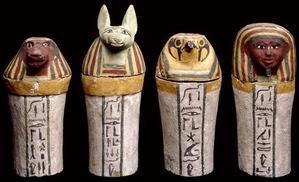
What might you find in canopic jars?
a)
A mummy's ka
b)
A mummy's internal organs
c)
A mummy's posessions
d)
A mummy's limbs
115.
After the mummification process was complete, the mummy was placed in an elaborately decorated sarcophagus.  What was a sarcophagus?
a)
a grave
b)
a pyramid
c)
a jar
d)
a coffin
116.
What can you conclude from the fact that the Egyptians painted the walls of the mummies' tombs with pictures of servants, food and animals?
a)
They wanted to liven up the dull brick walls.
b)
They believe the dead needed these things in the afterlife.
c)
They wanted to protect the dead against grave robbers.
d)
They believe these images warded off evil spirits.
117.
Egyptians believe in mummifying bodies for the afterlife; however, different organs were more important than others.  Which organ was NOT considered important?
a)
Heart
b)
Brain
c)
Lungs
d)
Liver
118.
This organ was always left inside the body because it contained the spirit or Ka.
a)
Heart
b)
Brain
c)
Lungs
d)
Liver
119.
To prevent the body from smelling, salt was used to preserve and dry out the body.  This salt was called
a)
Ether
b)
Smelling Salt
c)
Natron
d)
Epson Salt
120.

Mummification rituals were performed by:

a)

Farmers

b)

Nobleman

c)

Pharaohs

d)

Priests

121.

What is 24 hundredths written as a decimal?

a)

0.024

b)

2.4

c)

0.24

d)

0.204

122.

What is two and six hundredths written as a decimal?

a)

2.06

b)

2.60

c)

0.206

d)

0.26

123.

What is 2/10 + 15/100 written as a fraction?

a)

25/100

b)

17/100

c)

215/100

d)

35/100

124.

How is 5 25/100 written as a decimal?

a)

.525

b)

5 25/10

c)

5 25/100

d)

5.25

125.

Which lists the places in the correct order?

a)

tens ones . tenths hundredths

b)

hundredths tenths . tens ones

c)

ones . tens tenths hundredths

d)

tenths hundredths . ones tens

126.
TRUE OR FALSE: Greece had lots of fertile valleys and rich soil.
a)
True
b)
False
127.
The geography of Greece was dominated by...
a)
rugged ocean coasts
b)
rich, fertile valleys
c)
mountains and seas
d)
vast desert plateaus
128.
Many communities in ancient Greece were separated by mountains and valleys which
resulted in...
a)
the development of many different languages
b)
the development of fiercely independent states
c)
the construction of an advanced system of roads
d)
alliances formed for group protection
129.
Which of the following is a  government where a few wealthy people rule?
a)
Monarchy
b)
Oligarchy
c)
Democracy 
d)
Communism
130.
What is a person who seizes power in an illegal way called?
a)
King
b)
Savage
c)
Tyrant
d)
Aristocrat
131.
What was the raised, fortified area that was the highest place in the city called?
a)
Agora
b)
Acropolis
c)
Oligarchy
d)
Parthenon
132.
What was the large open area where city life was centered around called?
a)
Agora
b)
Acropolis
c)
Democracy
d)
Mall
133.
Which of the following types of government did Athens have FIRST?
a)
Oligarchy
b)
Democracy 
c)
Tyranny
d)
Monarchy
134.
Who could participate in the Athenian democracy?
a)
All adult male citizens and slaves
b)
All free men and women
c)
All free, adult male citizens
d)
Anyone who lived in Athens
135.
a)

Parallel

b)

Perpendicular

c)

Intersecting

136.
a)

Parallel

b)

Perpendicular

c)

Intersecting

137.

Choose the most precise answer: This Sawali or bamboo wall is

a)

parallel lines

b)

perpendicular lines

c)

intersecting lines

138.

Choose the most precise answer: This road in Tanay Rizal is

a)

Intersecting

b)

Perpendicular

c)

Parallel

139.

Choose the most precise answer: This post is

a)

Parallel

b)

Perpendicular

c)

Intersecting

140.

Which of the picture is a PARALLEL Line?

a)
b)
c)