
 Worksheets
Binding Energy Elements
Total questions: 50
Worksheet time: 25mins
As the binding energy of a nucleus increases, the
energy required to separate the nucleus into
nucleons _____.
decreases
increases
stays the same
becomes negative to positive

Which graph best represents the relationship
between energy and mass when matter is converted
into energy?
A
B
C
D
Mass defect is
∑mnucleons – mnucleus
∑mnucleons – matoms
∑mnucleus – mnucleons
∑matoms – mnucleons
Number of neutrons can be found by
mass number - protons
mass number minues neutrons
mass number minus electrons
mass number plus protons
The energy of the mass defect is equivalent to
Binding Energy
Binding Energy per Nucleon
Energy decay
Mass of the decay
Binding Energy is present in ...
the nucleus
in the electrons
nucleus and electrons
neutrons
Binding Energy is
Mass defect * c2
BE/A * c2
BE/A
Mass defect / A
Binding energy is
to completely separate nucleons
to completely separate neutrons
to completely join the nucleons
to completely join the neutrons

These elements are most likely to undergo a fission reaction.
Greater than A=20
Greater than A=62
Less than A=62
Less than A=20
_______ is when a large nucleus is split into smaller nuclei releasing large amounts of energy.
fusion
fission
radioactive decay
gamma radiation
_______ is when two small nuclei collide and join together to form a larger nucleus releasing large amounts of energy.
fission
beta decay
alpha decay
fusion
When hydrogen is "fused" together on the Sun, what new element is created?
Helium
Carbon Dioxide
Oxygen
Light
The process of fusion happens in a star's
Corona
Convection Zone
Radiative Zone
Core
The largest element that any "star" can create is.
Helium
Carbon
Iron
Uranium
Any element larger than Iron on the periodic table is created by a/an
Supernova
Super Giant Star
Main Sequence star
Alchemists
Fusion and fission are both able to create energy due to the fact that they -
release mass.
provide radiation.
destroy nuclei.
create particles.
Nuclear fission occurs when a nucleus -
gains mass and loses energy.
transforms into two elements.
splits and releases energy.
loses mass and loses energy.
The concept of mass defect and E=mc2 for nuclear reactions describes how -
energy is created during any phase change.
a small amount of mass can generate a lot of energy.
energy in motion can not be easily controlled.
mass and energy are destroyed at the same rate.
Large amounts of energy from supernovae are need to make elements greater than Iron. Why do nuclei need to absorb a neutron before undergoing nuclear fission?
Because nuclear fission rarely occurs spontaneously; absorbing a neutron makes the nucleus unstable, causing fission to occur.
Because nuclei require an external force to split apart, provided by absorbing a neutron.
Because neutrons are required to initiate the fission process by bombarding the nucleus.
Because nuclei need to reach a critical mass before undergoing fission.
In nuclear fission, the daughter nuclei are _______ stable than the parent nuclide.
more
less
equally
unpredictably
The conversion of _______ into _______ results in the liberation of a lot of energy in a fission reaction.
mass, energy
energy, mass
protons, neutrons
neutrons, protons

Elements to the right of Iron will undergo
Fusion to become more stable
Fission to become more stable
Elements to the left of Iron will undergo
Fusion to become more stable
Fission to become more stable
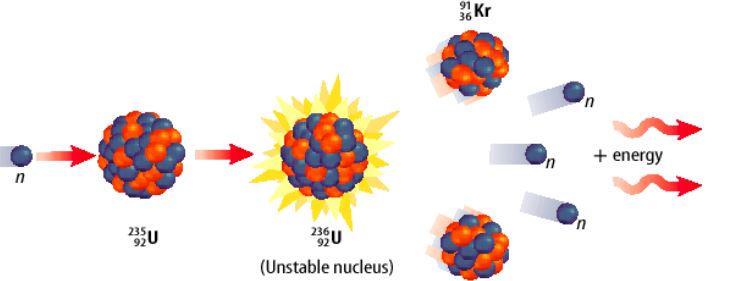
is an example of
nuclear fission
radioactive decay
nuclear fusion
artificial transmutation
Nuclear binding energy is
the energy required to overcome the electrostatic force between the protons in the nucleus
energy equivalent of the mass of the protons in the nucleus
the energy equivalent of the mass of all the nucleons in the nucleus
the energy equivalent of the difference between the total mass of the individual nucleons and their mass when they are contained in the nucleus
What type of protective clothing is recommended for medical professionals working with radiation-emitting devices?
Protective suit
Apron
Hat
Standard uniform
What type of warning signs are used at the entrance of a radiation protection area in a health care facility?
Biohazard sign
High voltage sign
Radioactive sign
Infrared sign
What is the most common form of ionizing radiation in a health care facility?
Gamma
Alpha
X-Ray
Beta
As you go down stairs towards a basement, you are exposed to more radiation from _______
rocks
cosmic ray
x-ray
food
As you go to higher altitude, you are exposed to more radiation from ________
cosmic ray
radon gas
building material
nuclear power station
The example of artificial radiation
x-ray
building material
cosmic ray
food
The example of natural radiation
radon
x-ray
nuclear power station
nuclear weapon test
A small amount of radiation around us all the time because of radioactive materials in the environment is called _________
background radiation
natural radiation
artificial radiation
material radiation
This radiation contribute the most to our body's exposure from radiation
food
radon gas
rock
medical source
How many helium need to fuse together to create carbon in stars?
2
3
4
6
How many helium need to fuse together to create oxygen in stars?
8
10
5
4
How many hydrogens need to fuse together to create helium in stars?
8
10
5
4
Which of the following is NOT one of the methods to decrease your radiation exposure from a source?
Limit exposure time
Increase distance
Decrease distance
Use shielding
Stars glow because of the electromagnetic radiation that they emit. This energy is generated by nuclear fusion in the core of the star. Which best describes how energy is generated in a star?
Bonds between helium atoms break, releasing energy.
Bonds form between hydrogen atoms, releasing energy.
Hydrogen atoms combine, forming helium atoms and releasing energy.
Helium atoms split apart, forming hydrogen atoms and releasing energy.
The three types of nuclear radiation in increasing order of low to high penetrating power are ____.
alpha, beta, x-ray, gamma
X ray, beta, gamma, alpha
alpha, x-ray, gamma, beta
X ray, gamma, beta, alpha
What equation represents how to calculate binding energy?
E=mc2
l*w*h
E2= C2+B2
OG Mass - PT Mass
In oder to create atoms larger than Iron the process REQUIRES large amounts of energy. This energy comes from....
planetary collisions
black holes
a star exploding
nuclera fusion in the core of a star

