Wayground logo

Free Printable Worksheets

Font size

S
M
L
XL
Worksheets

Air around us

Total questions: 65

Worksheet time: 53mins

Name
Class
Date
1.

___________ gas is necessary for burning

a)

Oxygen

b)

Nitrogen

c)

Carbon dioxide

2.

__________ gas occupies the major part of composition of air.

a)

Nitrogen

b)

Oxygen

c)

Carbon dioxide

3.

The burning of fuel produces ______.

a)

Dew

b)

Wind

c)

Smoke

4.

Earth is surrounded by an envelope of gases called the _____________.

a)

Hydrosphere

b)

Solar system

c)

Atmosphere

d)

Cloud bubble

5.
What do dust, smoke, salt, and chemicals have in common?
a)
They are gases in the air.
b)
They make up water vapor in the air.
c)
They are particles in the air.
d)
They are only found in pure air.
6.
Which of these makes up about 21 percent of the atmosphere?
a)
argon
b)
carbon dioxide
c)
nitrogen
d)
oxygen
7.
What are the percentages of the main gases on Earth?
a)
78% oxygen, 21% nitrogen and 1% other
b)
78% other, 21% oxygen and 1% nitrogen
c)
78% nitrogen, 21% oxygen and 1% other
d)
95% carbon dioxide and 5% oxygen
8.

Which gas is released into the atmosphere by plants following photosynthesis?

a)

Oxygen

b)

Argon

c)

Carbon dioxide

d)

Nitrogen

9.

What layer protects us from the sun's harmful rays?

a)

Protection layer

b)

Ozone layer

c)

Atmospheric layer

10.

How to prevent air pollution?

a)

To plant trees

b)

To use bicycles or public transport instead of using private vehicles.

c)

All of the mentioned.

d)

To share the seat in car or bike to other person or the friend who is coming or going to the same destination or place where we are going to go to

11.

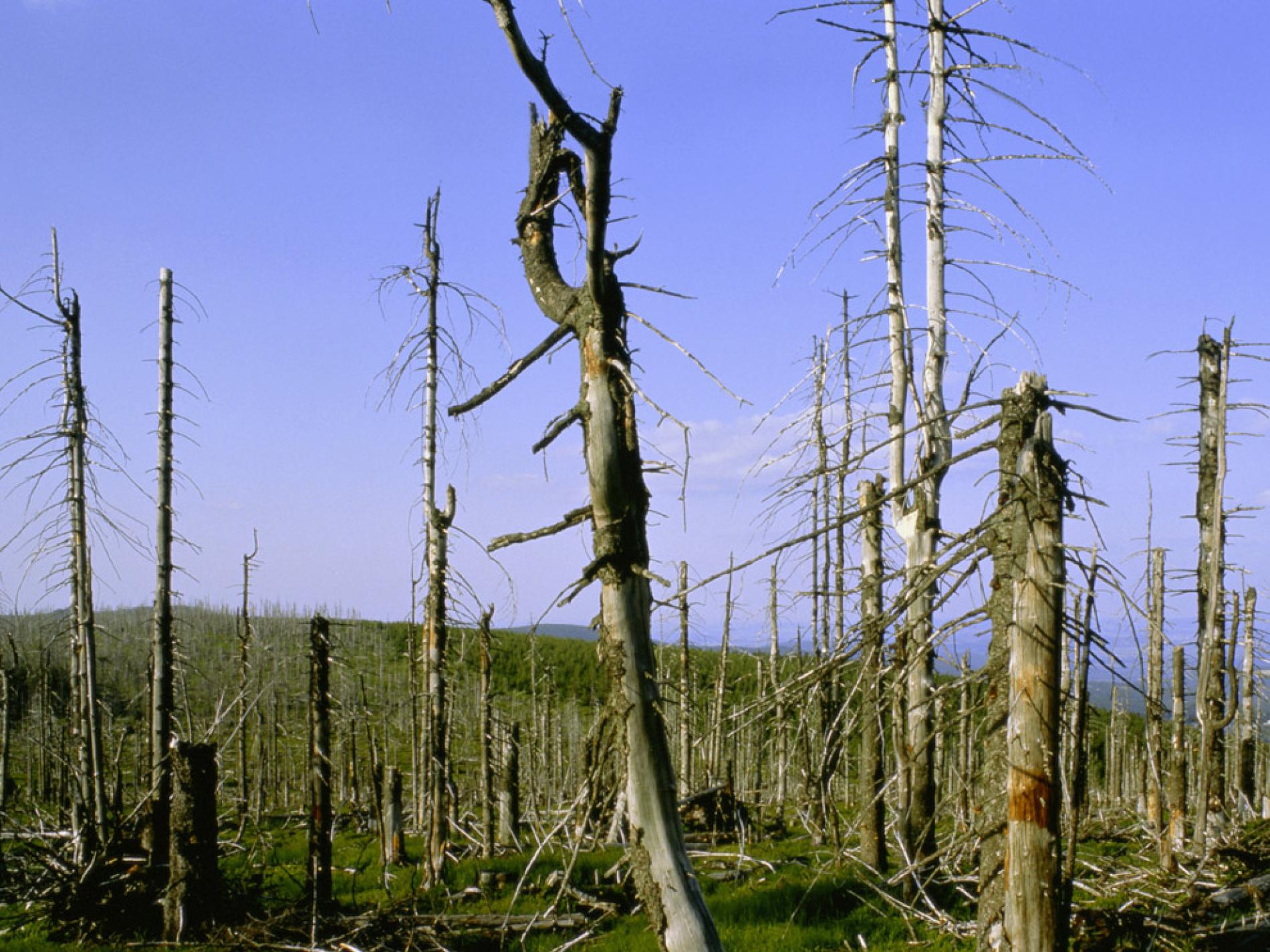
Look at the photo. This is an example of _____ pollution.

a)

Water

b)

Air

c)

Land

12.

What is air?

a)

Air is found everywhere. We cannot see air, but we can feel it.

b)

Air in motion is called wind.

Air occupies space.

Air is present in water and soil.

c)

Known as atmosphere.

d)

Air is resent everywhere

13.

The component of air used by green plants to make their food, is ___________.

a)

Ozone layer

b)

Carbon di-oxide

c)

Hydrogen

d)

Argon

14.

Air takes up __________

a)

Water

b)

Weight

c)

Space

15.

We can ______ the air.

a)

Feel

b)

Touch

c)

Smell

16.

______ from cars makes the air dirty.

a)

Smell

b)

Smoke

c)

Smoge

17.

which gases have 0.01%

a)

argon, ozone, carbon di-oxide and hydrogen

b)

nitrogen

c)

oxygen

d)

air pollution

18.

The component of air used by green plants to make their food, is ___________.

a)

ozone layer

b)

carbon di-oxide

c)

hydrogen

d)

argon

19.
Oxygen is a living element that humans and animals require to live. 
a)
True 
b)
False
20.

________________ could increase the amount of oxygen in the air.

a)

Building more houses

b)

Burning more oil

c)

Paving more streets

d)

Planting more trees

21.
Plants use _____________ to make their own food during photosynthesis.
a)
water
b)
energy from the Sun
c)
CO2
d)
water, energy from Sun, CO2
22.
What goes up but never goes down?
a)
Ruler
b)
Stairs
c)
Your height
d)
Your age
23.
Animals use oxygen for _____________.
a)
breathing
b)
creating food
c)
making glucose
d)
transpiration
24.
Which statement is an example of how plants and animals depend on each other?
a)
animals provide food for plants
b)
animals provide water for plants
c)
animals provide oxygen for plants
d)
animals provide carbon dioxide for plants
25.

What is the process of plants taking in carbon dioxide and releasing oxygen called?

a)

Respiration

b)

Produce

c)

Photosynthesis

d)

Breathing

26.

A gas produced by animals during respiration that plants use for photosynthesis.

a)

Oxygen

b)

Toots

c)

Carbon dioxide

d)

Water vapor

27.

Plants and animals are interdependent of each other.

a)

True

b)

False

28.
Plants use _____________ to make their own food during photosynthesis.
a)
water
b)
energy from the Sun
c)
CO2
d)
water, energy from Sun, CO2
29.
What does an "exchange of gases" mean?
a)
It means that gases are apart of everything. 
b)
It means that orange juice is an upside down milkshake with a missing tail.
c)
It means that humans and plants trade gases back and forth.
d)
It means that carbon in apart of all living things. 
30.
Which type of organism gets its energy directly from the Sun?
a)
producer
b)
consumer
c)
composer
d)
decomposer
31.
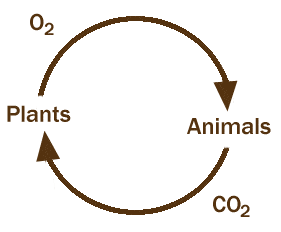
Which statement is true about the carbon dioxide-oxygen cycle?
a)
animals breathe in nitrogen and release oxygen which is used by plants
b)
animals breathe in oxygen and release carbon dioxide which is used by plants
c)
animals breathe in nitrogen and release carbon dioxide which is used by plants
d)
animals breathe in carbon dioxide and release oxygen which is used by plants
32.
Animals and plants use substances that cycle through the environment.  Which substance is needed by plants to survive and is released into the environment by animals?
a)
oxygen
b)
sugar
c)
salt
d)
carbon dioxide
33.
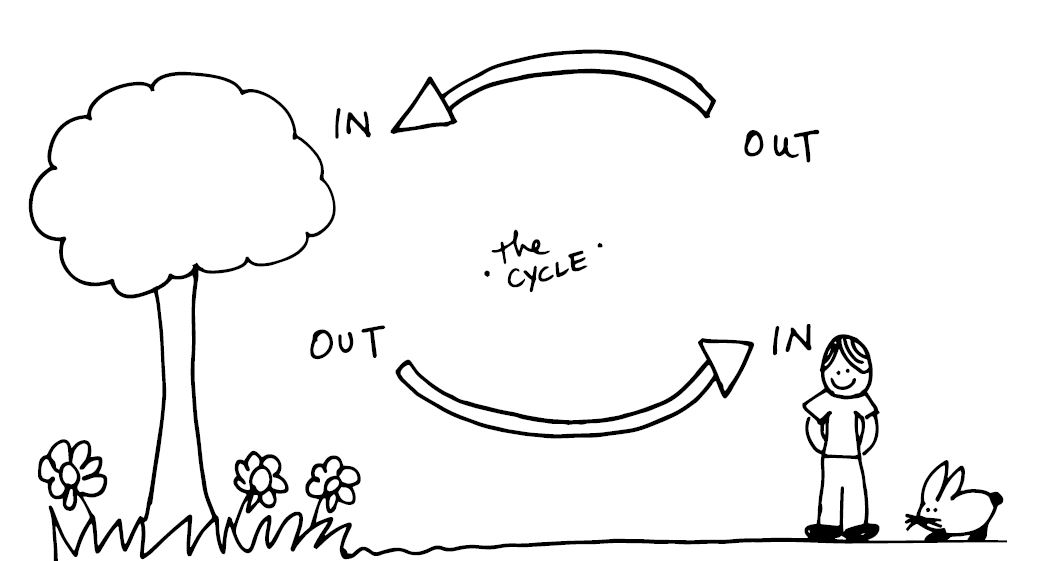
The CO2/O cycle is important to animals because it provides
a)
a gas they take in when breathing
b)
chemicals that build bones
c)
energy they need to move
d)
fresh water for their survival
34.
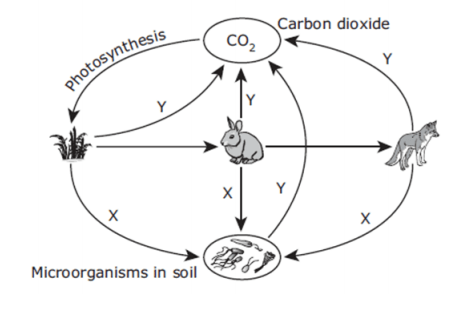
The diagram shows the flow of organic molecules through an ecosystem. What two processes are identified by the labels X and Y?
a)
X : Respiration
Y : Predation
b)
X : Adaptation
Y : Decomposition
c)
X : Fermentation
Y : Nitrogen Fixation
d)
X : Decomposition
Y : Respiration
35.
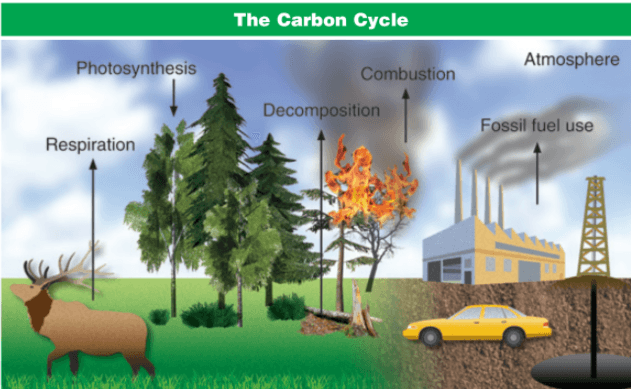
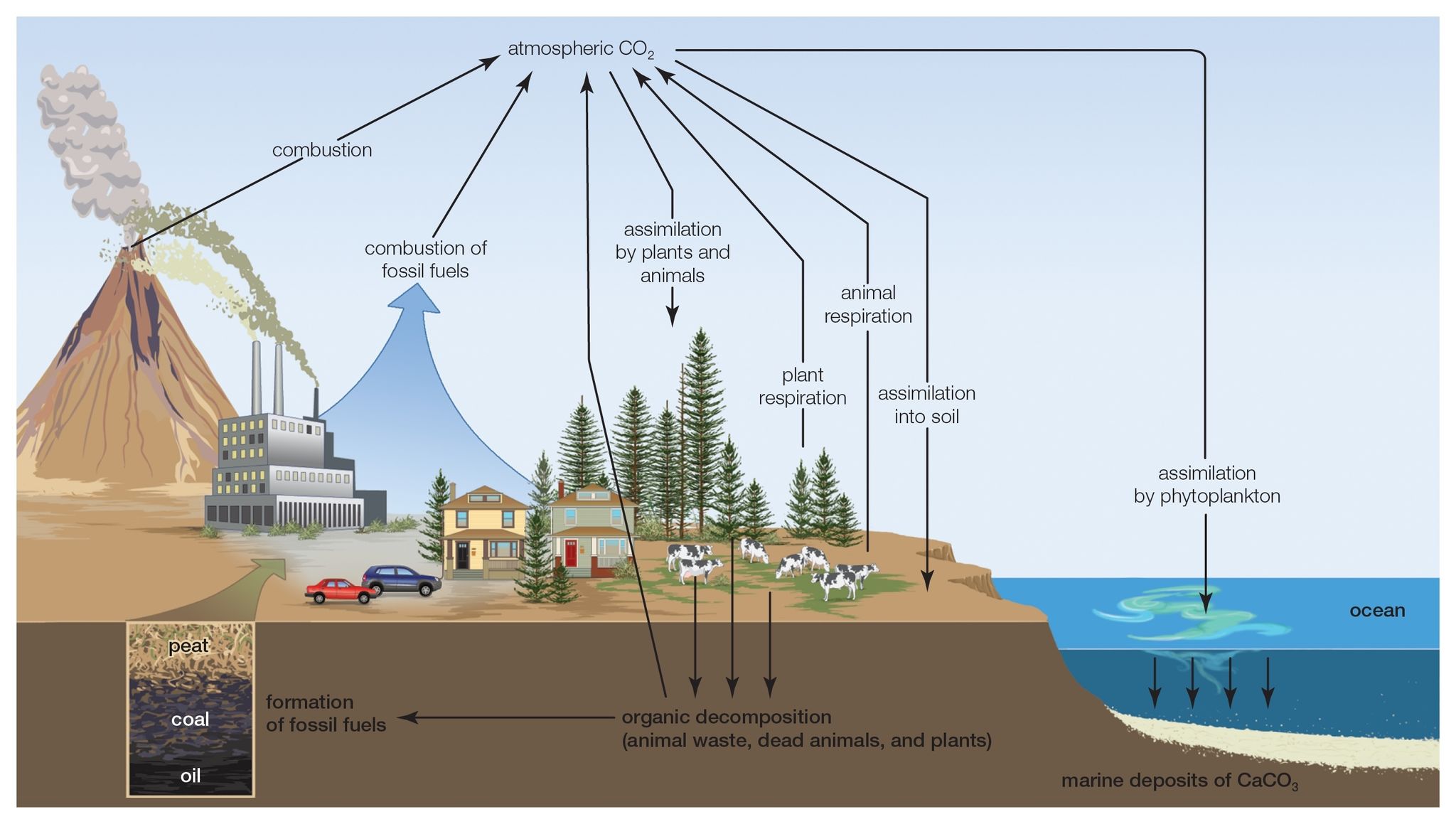
Burning fossil fuel has which effect in the carbon cycle?
a)
It removes carbon dioxide from the atmosphere.
b)
It puts carbon dioxide under the ground.
c)
It adds carbon dioxide to the atmosphere.
d)
It has no effect in the carbon cycle.
36.
Which of the following add carbon dioxide to the atmosphere?
a)
volcanoes
b)
combustion of fossil fuels
c)
animal and plant respiration
d)
all of these
37.
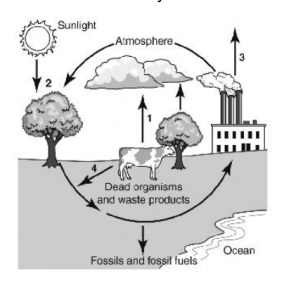
What is happening at 1?
a)
respiration: releasing CO2
b)
decomposing CO2 in the soil
c)
photosynthesis: absorbing CO2
d)
turning CO2 from the atmosphere into organic molecules
38.

What is happening at 2?

a)

respiration: releasing CO2

b)

decomposing CO2 in the soil

c)

photosynthesis: absorbing CO2

d)

turning CO2 from the atmosphere into organic molecules

39.

What is happening at 4?

a)

respiration: releasing CO2

b)

decomposing CO2 in the soil

c)

photosynthesis: absorbing CO2

d)

turning CO2 from the atmosphere into organic molecules

40.
Which type of fire extinguisher should be used on a fire involving flammable liquids such as grease or oil?
a)
Water
b)
Carbon Dioxide 
c)
Dry Chemical
d)
Foam
41.
Water is not used to control fires involving electrical appliances.
a)
False
b)
True
42.
Which is not combustible substance
a)
Wood
b)
Cow dung cake
c)
stone
d)
paper
43.
The condition which are required for combustion to take place are:
a)
fuel
b)
ignition temperature
c)
oxygen
d)
all of these
44.
Another term for burning is
a)
Fire triangle
b)
Magnesium oxide
c)
Combustion
d)
Bustion
45.

What is the best defense against fire?

a)

Water

b)

Call the firefighters

c)

Use fire extinguisher

d)

Run

46.

What is an appropriate place to keep fire extinguisher?

a)

Near a stove or oven

b)

Each floor of your home

c)

The kitchen

47.

Do fire extinguishers expire?

a)

Yes

b)

No

48.

What should you do when your clothes catch on fire?

a)

Panic, run and scream

b)

Stop, drop and roll

c)

Run towards a fireman

d)

Scream hysterically

49.
What are the pollutants known to cause acid rain?
a)
nitrogen oxides and sulfur dioxide (sulfur compounds)
b)
Low pH and Acid
c)
Lemon Juice and Battery Acid
d)
Particulate Matter and Carbon Dioxide
50.
What can humans do to reduce the effects of acid rain?
a)
Develop Alternate Energy Sources (Solar Power, Wind Energy)
b)
Use Less Energy
c)
Stop Burning Fossil Fuels
d)
All of the Answers are Correct
51.
CFC's cause harm to our 
a)
Troposphere
b)
Inversion Layer
c)
Ozone Layer
d)
Carbon Dioxide
52.

When the Ozone Layer loses Ozone what happens to organisms on the earth's surface?

a)

They are exposed to Smog

b)

Nothing happens

c)

They are exposed to Acid Rain

d)

They are exposed to Ultraviolet B Radiation

53.
Humans cause long and short term harm to their environment.
a)
true
b)
false
54.
These are two ways people can reduce air pollution.
a)
Drive vehicles that get low gas mileage / Burn trash at home
b)
Burn less fossil fuels / walk and ride bikes
c)
Create major forest fires / Use CFC's
d)
Burn styrofoam at landfills / Use more chlorine
55.
Select the natural form of air pollution.
a)
CFC's
b)
Burning Fossil Fuels
c)
Forest Fires
d)
Paints and Solvents
56.

Which pair below are the two main sources of air pollution in urban (populated) areas?

a)

vehicles, volcanoes

b)

vehicles, industries

c)

Industries, agriculture

d)

All of the above

57.
Acid rain can damage
a)
Drinking water sources
b)
Aquatic life
c)
Architecture/buildings
d)
All options are correct
58.
Global warming is due to 
a)
Greenhouse gases
b)
Nitric and sulfuric acids
c)
CFCs
d)
Ozone depletion
59.
Greenhouse gases, in moderate amounts, keep the Earth's temperature stable
a)
True
b)
False
60.
What is air pollution?
a)
Any harmful substance that builds up in the air 
b)
pollen, dust, gases
c)
industrial pollution
d)
chemicals in the water
61.
Which of these problems can be caused by air pollution?
a)
Respiratory problems
b)
Reduced food sources for humans
c)
Increased disease for humans
d)
Decrease in global temperatures
62.
The ozone layer is damaged by
a)
CFCs
b)
Increase in greenhouse gases
c)
Increased global temperatures
d)
Sulfuric and nitric acids
63.
A metallic element that can cause brain damage
a)
Lead
b)
Particulate matter
c)
Ground-level ozone
d)
Nitrogen oxides
64.

An experiment released a colourless gas which rekindles glowing wooden splinter. The gas released is........

a)

Carbon dioxide

b)

Hydrogen

c)

Nitrogen

d)

Oxygen

65.

A reaction between solution A and substance B produce a colourless gas. The gas release turns the lime water into cloudy. The gas is ........

a)

nitrogen dioxide

b)

carbon monoxide

c)

sulphur dioxide

d)

carbon dioxide