Wayground logo

Free Printable Worksheets

Font size

S
M
L
XL
Worksheets

Cell Transport

Total questions: 28

Worksheet time: 46mins

Name
Class
Date
1.

The movement of molecules like gases from an area of high concentration to an area of low concentration through the phospholipid bilayer

a)
Osmosis
b)
Respiration
c)
Diffusion
d)
Active Transport
2.

The movement of molecules from an area of high concentration to an area of low concentration through a protein channel in the phospholipid bilayer

a)
Osmosis
b)

Simple Diffusion

c)

Facilitated Diffusion

d)
Active Transport
3.
Cells use energy to move materials across a membrane (low to high concentration).
a)
Active transport
b)
Passive transport
c)
Diffusion
d)
Osmosis
4.
a)
Passive Transport
b)
Active Transport
5.
This picture represents what type of cell transport?
a)
endocytosis
b)
exocytosis
c)
osmosis
d)
passive transport
6.
Cells transport material across a cell membrane without using energy (high to low concentration)
a)
Passive transport
b)
Concentration
c)
Endocytosis
d)
Active Transport
7.
Which of the following is an example of osmosis?
a)
Oxygen exiting leaves after photosynthesis
b)
A raisin swelling in a cup of water
c)
Water changing from a liquid to a gas
d)
Oxygen moving into an animal cell
8.
Which part of this phospholipid is hydrophobic?
a)

tail

b)
head
c)
all of it is hydrophobic
d)
none of it is hydrophobic
9.
Cell membrane surrounds a particle and encloses it (for large particles)
a)
Endocytosis
b)
Exocytosis
c)
Permeable
d)
In high concentration
10.
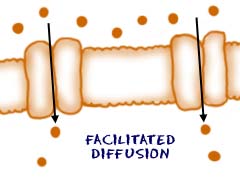
What type of transport is this?
a)
facilitated diffusion
b)
active transport
c)

simple diffusion

d)
osmosis
11.
The process where only water is allowed to pass through the cell membrane from a high to low concentration.
a)
meiosis
b)
respiration
c)
diffusion
d)
osmosis
12.

Choose all that are true about active transport?

a)
It requires energy
b)
it does not require energy
c)

It moves material from low to high concentration

d)
it moves material from high to low concentration
13.

Which direction will the water go in the picture?

a)

The water will not move.

b)

The water will move out of the cell.

c)

The water will move in both directions in and out of the cell

d)

The water will move into the cell

14.
This cellular structure helps organisms maintain homeostasis by controlling what substances may enter or leave cells.
a)
vacuole
b)
nucleus
c)
cell membrane
d)
cell wall
15.

When something repels water, it is -

a)
Hydrophobic
b)
Hydrophilic 
c)
Hydroelectric 
d)
Hydrochloric
16.
What are two types of passive transport?
a)

endocytosis and exocytosis 

b)

hypertonic and isotonic

c)
hydrophobic and hydrophillic 
d)
osmosis and diffusion
17.

The energy molecule used in active transport is called -

a)

adenine

triphosphorous

b)

alkaline tripotassium

c)

adenosine triphosphate

d)

argon tellurium phosphorous

18.

When something is attracted to water, it is -

a)
Hydrophobic
b)
Hydrophilic 
c)
Hydroelectric 
d)
Hydroloric
19.
In which direction will these molecules diffuse?
a)
from right to left
b)
from left to right
c)
they will not move at all
d)
they will move in both directions equally
20.

The abbreviation for the energy molecule in active transport is -

a)

AZP

b)

ATP

c)

ADP

d)

ACP

21.

Which is not active transport?

a)

endocytosis

b)

osmosis

c)

exocytosis

d)

movement with a Sodium Potassium pump

22.

Which part of this phospholipid is hydrophillic?

a)

tail

b)
head
c)

all of it is hydrophillic

d)

none of it is hydrophillic

23.

Which direction will the water go in the picture?

a)

The water will not move.

b)

The water will move out of the cell.

c)

The water will move in both directions in and out of the cell

d)

The water will move into the cell

24.

A large molecule like sugar would pass through the cell membrane through -

a)

the phospholipid bilayer

b)

an aquaporin

c)

a protein pump

d)

A molecule like sugar cannot pass through the cell membrane; it is too big.

25.

The type of cell transport is ___; it is ___ transport.

a)

endocytosis, passive

b)

endocytosis, active

c)

exocytosis, passive

d)

exocytosis, active

26.

What type of cellular transport is pictured?

a)

osmosis

b)

endocytosis

c)

protein pump

d)

protein channel

e)

exocytosis

27.

The type of cellular transport pictured is _.

a)

simple diffusion

b)

facilitated diffusion

c)

exocytosis

d)

endocytosis

28.

The type of cellular transport pictured here is _.

a)

exocytosis

b)

endocytosis

c)

protein pump

d)

osmosis

e)

hydrosis