
 Worksheets
Chapter 10: Mechanical Waves (C1 & C2)
Total questions: 35
Worksheet time: 45mins


A string is clamped at both ends and plucked so it produces a standing wave as shown above. How many nodes and antinodes are there?
2 nodes, 3 antinodes
3 nodes, 2 antinodes
4 nodes, 3 antinodes
3 nodes, 4 antinodes
The ___________________ of waves change when the waves move from one medium to another.
frequency
amplitude
speed
compression
The ____________________________ are produced by
the superposition of two progressive waves of
equal in amplitude and frequency, traveling in
opposite direction.
stationary wave
progressive wave
sound wave
heat
What is Node?
Zero displacement
Back and forth displacement
Maximum displacement
Linear displacement
What is two factors that influence sound intensity?
node and antinode
amplitude and distance
The equation of a progressive wave is given by y = 0.1 sin (3x + 10t) where y and x are in meters and t in second. The direction of the wave is
leftwards
rightwards
upwards
downwards
Which property of wave motion distinguish a progressive wave from standing wave:
amplitude
frequency of vibration
propagation of energy
direction of vibration

What is the Doppler Effect?
A change in frequency due to the relative motion of a wave source and an observer
When a wave overlaps with another wave
When a wave bounces off of another object
When a wave bends due to traveling through a different medium



You are driving in a car and honk the horn at a person standing in the street. As you approach the person, what happens to the pitch of the horn according to you in the car?
It increases
It decreases
It stays the same because you are in the car moving with the sound.
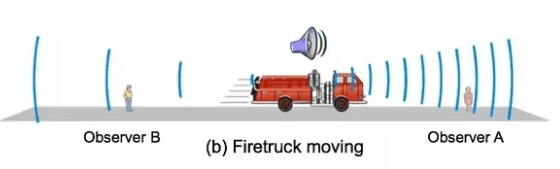
Look at the picture. Who is experiencing a higher pitched sound?
Observer A
Observer B
There's no difference
the doppler effect causes a shift in...
pitch
wavelength
frequency
All of the above

Standing waves created in strings, pipes and closed pipes have specific wavelengths that fit into the length of those instruments
True
False

A pipe, opened at both ends (40 cm long) makes a tone travelling at 330 m/s. Calculate the frequency of the fundamental wave.
4.125 Hz
264 Hz
26400 Hz
412.5 Hz
Even numbered harmonics (multiples of fundamental frequency) do not form in a closed pipe because
the pipe “fits” only an odd number of quarter wavelengths
the pipe “fits” only an even number of quarter wavelengths
the pipe cannot put an anti-node at the open end
the pipe cannot get enough air to vibrate in the pipe at these lengths

The pipe length of A is 0.18 m. Sound travels at 343 ms-1 Calculate the frequency of the sound produced.
686 Hz
1905.56 Hz
343 Hz
1429.17 Hz
The pipe length of D is 0.65 m. The frequency of the sound produced is 1200 Hz. Calculate the wave velocity.
120 m/s
600 m/s
343 m/s
780 m/s

The figure shows several modes of vibration of a string fixed at both ends. The mode of vibration that represents the fifth harmonic is
1
2
3
4
None of these is correct.

The figure represents a string of length L, fixed at both ends, vibrating in several harmonics. Which string shows the 3rd harmonic?
A
B
C
D
E

A stretched string is fixed at points 1 and 5. When it is vibrating at the second harmonic frequency, the nodes of the standing wave are at points
1 and 5.
1, 3, and 5.
1 and 3.
2 and 4.
1, 2, 3, 4, and 5.

The figure shows a standing wave in a pipe that is closed at one end. The frequency associated with this wave pattern is called the
first harmonic.
second harmonic.
third harmonic.
fourth harmonic.
fifth harmonic.

