Wayground logo

Free Printable Worksheets

Font size

S
M
L
XL
Worksheets

Atomic Structure

Total questions: 51

Worksheet time: 26mins

Name
Class
Date
1.
Sodium has an atomic number of 11, how many protons does this atom have?
a)
22
b)
11
c)
12
d)
2
2.
Protons are equal to:
a)
Atomic Mass
b)
Number of neutrons
c)
Atomic Number
d)
All of the subatomic particles
3.
A proton is a _____ charged particle.
a)
Negatively
b)
Positively
4.
The atoms of any given element ____ have the same number of protons.
a)
sometimes
b)
always
c)
never
5.

How many protons are in Neon

a)

10

b)

20

c)

21

d)

30

6.

In a neutral atom, the atomic number is equal to...

a)
neutrons
b)
electrons
c)
atomic mass
d)

electrons or protons

7.

What are valence electrons?

a)

The total number of electrons in an atom

b)

The number of electrons in the outermost shell

c)

The number of electrons in the second shell

d)

The number of protons in the outermost shell
8.

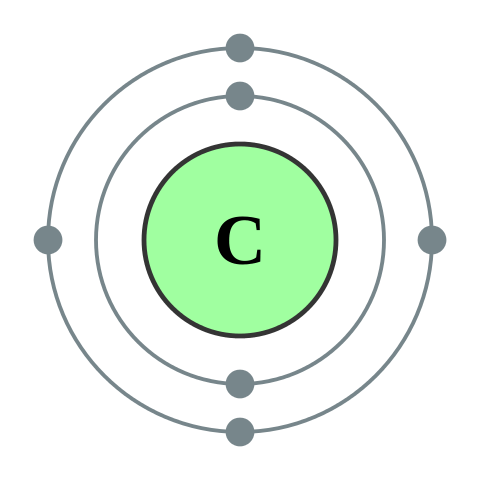
How many valence electrons does carbon have?

a)

4

b)

5

c)

6

d)

7

9.
How many valence electrons are found in atoms of group 1?
a)
7
b)
6
c)
4
d)
1
10.
How many valence electrons are found in atoms of group 14?
a)
4
b)
3
c)
14
d)
16
11.

How many neutrons are in Gold

a)

118

b)

79

c)

197

d)

276

12.

How many neutrons are in Potassium

a)

19

b)

20

c)

39

d)

58

13.
Which two particles make up the nucleus of an atom?
a)
Protons and Electrons
b)
Protons and Neutrons
c)
Molecules and Compounds
d)
Neutrons and Electrons
14.
Which description about the proton is accurate?
a)
Positively charged particle with a mass less than 0 amu
b)
A neutrally charged particle with a mass less than 0 amu
c)
Positively charged particle with a mass of 1 amu
d)
A neutrally charge particle with a mass of 1 amu
15.
What is an ion?
a)
A Charged Atom
b)
A Large Atom
c)
A Small Atom
d)

A Neutral Atom

16.
Barium atoms want to form...
a)
an anion
b)
a cation
c)
an onion
d)
a cuddly kitten friend
17.
Cations are...
a)
Positive
b)
Negative
c)
Neutral
d)
Purring
18.
An atom becomes _________ when it gains electrons.
a)
Positive
b)
Negative
c)
Neutral
d)
Invinsible
19.
An atom becomes _______ when it loses electrons.
a)
Positive
b)
Negative
c)
Neutral
d)
Invinsible
20.
A Radium atom wants...
a)
One more electron
b)
One less electron
c)
Two more electrons
d)
Two less electrons
21.
What is the ionic symbol for a Gallium atom?
a)

Ga3+

b)

Ga3-

c)

Ga2+

d)

Ga2-

22.
What is the ionic symbol for a Caesium atom?
a)
Cs+
b)
Cs-
c)

Cs2+

d)

Cs2-

23.
Group 17 always has ions with a charge of 
a)

1+

b)

2+

c)

1-

d)

2-

24.
What charge will an Oxygen ion have? 
a)

1+

b)

1-

c)

2+

d)

2-

25.
If an element has 3 valence electrons, what charge will likely form on its ion ?
a)

3+

b)

5+

c)

3-

d)

5-

26.

Which of the following has a 3- charge?

a)
Boron
b)
Fluorine
c)
Nitrogen
d)
Neon
27.

Which of the following has a 1- charge? 

a)
Aluminum
b)
Bromine
c)
Calcium
d)
Potassium
28.
Elements on the LEFT side of the periodic table will most likely form:
a)
Positive ions
b)
Negative ions
c)
Neutral Ions
d)
None of these
29.
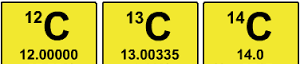
What do these isotopes of carbon all have in common?
a)
neutrons & mass number
b)
atomic number and neutrons
c)
atomic number and electrons
d)
protons, atomic number, and mass number
30.
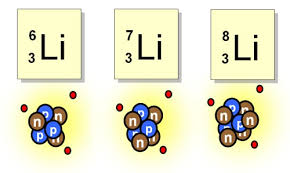
How many neutrons does the isotope of lithium have?
a)
8
b)
3
c)
4
d)
5
31.
In a correctly written symbol what would be located in the "A" position?
a)
number of neutrons
b)
atomic number
c)
number of electrons 
d)
mass number
32.
which atom has  4 neutrons?
a)
Li-6
b)
Li-7
c)
Li-8
d)
they have the same # of neutrons
33.
Isotopes are atoms of the same element with different #’s of __________ & therefore different __________.
a)
n0 ;  atomic #’s
b)
p+ ; atomic #’s
c)
e- ; atomic masses
d)
n0 ; atomic masses
34.
If X is the symbol for an element, which of the following two symbols represent    isotopes of the same element?     I. 7735X  II. 7733X  III. 8137X  IV. 8135 X
a)
I and II
b)
III and IV
c)
I and IV
d)
I and III
35.
Four isotopes of lead include lead-204, lead-206, lead-207, and lead-208.  The average atomic mass of lead is 207.2.  Which isotope of lead is likely to be the most abundant.
a)
204
b)
206
c)
207
d)
208
36.
24.1% of all the isotopes of a an element have a mass of 75.23 amu, 48.7% have a mass of 74.61 amu, and 27.2% have a mass of 75.20 amu.
What is the average mass of this element?
a)
74.92 amu
b)
24.97 amu
c)
75.01 amu
d)
74.51 amu
37.
Calcium has three different isotopes. One has a mass of 35.00 amu; another has a mass of 41.00 amu; and another has a mass of 40.00 amu. Which isotope is the most abundant of the three?
a)
40.00 amu
b)
41.00 amu
c)
35.00 amu
d)
impossible to tell
38.
An element has two naturally occurring isotopes. One is 10.013 amu and is 19.9% abundant. The other is 11.01 amu and is 80.1% abundant. What is the average atomic mass? What element is it?
a)
9.012, Beryllium
b)
12.011, Carbon
c)
6.941, Lithium
d)
10.812, Boron
39.

The atomic mass of an element is the ___.

a)

average of the mass number and the atomic number for the element

b)

weighted average of the masses of the isotopes of the element

c)

total mass of the isotopes of the element

d)

total number of subatomic particles in the nucleus
40.
Takes two small nuclei and combines them into a larger nucleus
a)
fission
b)
fusion
41.
The splitting of a nucleus into smaller nuclei is
a)
fusion
b)
fission
c)
half-life
d)
gamma radiation
42.
How do nuclear power-plants work?
a)
Fusion
b)
Half-life
c)
Fission
d)
Fusion or fission
43.
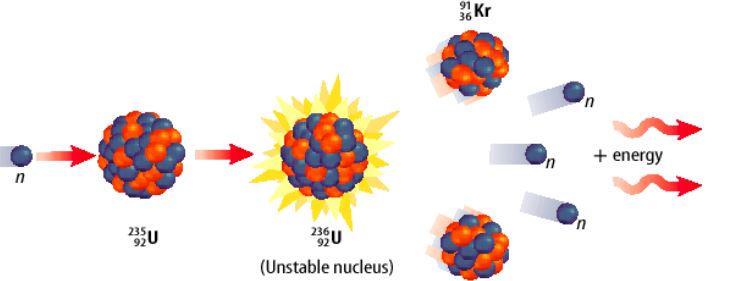
This is an example of...
a)
Fission  reaction
b)
Fusion reaction
c)
Decomposition reaction
d)
Decay
44.
An example of an uncontrolled fission reaction is _______________
a)
Nuclear power plants
b)
Radio active decay
c)
Atomic Bomb
d)
On the surface of the sun
45.
Very high temperature and pressure is required for:
a)
Fission
b)
 Fusion
c)
Radioactive Decay
46.
Which of the following is true about nuclear fission?
a)
The mass of the product is greater than the mass of the original nucleus
b)
The mass of the product is less than that of the original nucleus
c)
The mass of the product is the same as the mass of the original nucleus
d)
The mass of the product is 100 times greater than the original nucleus
47.
Which of the following is true about nuclear fusion?
a)
It is easy to implement.
b)
It produces less energy than nuclear fission.
c)
It produces more energy than nuclear fission.
d)
It has the ability to occur easily in everyday life.
48.

For the balanced equation, which particle is represented by X?

a)

0-1 e

b)

11 H

c)

42 H

d)

10 n

49.

Which reaction represents fusion?

a)
b)
c)
d)
50.

Which reaction represents fission?

a)
b)
c)
d)
51.
This is an example of ---
a)
Radioactive Decay
b)
Nuclear Fission
c)
Nuclear Fusion
d)
Fossil fuel reaction