wayground logo

Free Printable Worksheets

NEW

Font size

S
M
L
XL
Worksheets

Unit 4: Moon Phases, Eclipses and Tides

Total questions: 33

Worksheet time: 18mins

Name
Class
Date
1.
Why can we see the moon in the sky?
a)
The moon emits its own light
b)
The moon is a star
c)
The moon absorbs light from the Sun
d)
The moon reflects light from the Sun
2.
What event is shown in the diagram?
a)
Tides
b)
Moon phases
c)
Comet
d)
Eclipse
3.
Name the phase of the Moon is in:
a)
Waning crescent
b)
waxing gibbous
c)
waxing crescent
d)
waning gibbous
4.

How many high tides does a place on Earth experience a day?

a)

1

b)

2

c)

3

d)

4

5.
Name the phase of the Moon is in:
a)
waxing crescent
b)
waning crescent
c)
waxing gibbous
d)
waning gibbous
6.
A lunar eclipse can occur only during the _________________.
a)
Full moon
b)
New moon
c)
Waxing moon
7.
Name the phase of the Moon is in:
a)
Full 
b)
New
c)
1st
d)
3rd
8.
Name the phase of the Moon is in:
a)
New
b)
Full
c)
1st
d)
3rd
9.
What type of type of tide is it if the Moon is in Letter C
a)
spring
b)
neap
c)
solar
d)
lunar
10.
When more of the Moon is becoming "lit" up.
a)
waxing
b)
waning
c)
gibbous
d)
crescent
11.

What causes tides?

a)

Gravity between the Earth, Moon, and Sun.

b)

Only the Sun's gravity causes tides.

c)

Earth's own gravity.

12.
What type of type of tide is it if the Moon is in Letter A
a)
spring
b)
neap
c)
solar
d)
lunar
13.

Spring tides happen during which two Moon phases?

a)

First Quarter and Third Quarter

b)

Full Moon and new Moon

c)

Full Moon and Third Quarter

14.
If the Sun, Earth, and Moon are in perfect alignment, the Earth would have a _______ tide.
a)
Spring
b)
Neap
c)
Normal
15.
Name the phase of the Moon is in:
a)
waning gibbous
b)
waxing gibbous
c)
waning crescent
d)
waxing crescent
16.
If the Sun, Earth, and Moon create a 90 degree angle, the Earth would have __________.
a)
Spring tides
b)
Neap tides
c)
Normal tides
17.
Besides phases, what are 2 other events that the moon causes on Earth?
a)
tides and earthquakes
b)
tides and eclipses
c)
eclipses and volcanoes
d)
seasons and eclipses
18.
Name the phase of the Moon is in:
a)
Waxing gibbous
b)
waxing crescent
c)
waning gibbous
d)
waning crescent
19.
Type of eclipse
a)
Solar
b)
Lunar
c)
Neap
d)
Spring
20.
When more of the Moon is becoming "lit" up.
a)
waxing
b)
waning
c)
gibbous
d)
crescent
21.
Type of Tide
a)
Neap
b)
Spring
c)
Fall 
d)
Summer
22.

Why do we see phases of the moon?

a)

The tilt of Earth's axis as it rotates.

b)

The moon lights different portions of its surface throughout the month.

c)

As the moon revolves around the Earth, we see different portions of the lit side.

d)

The moon revolves and rotates at the same rate.
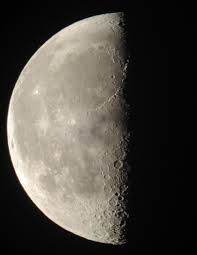
23.
Name the moon phase
a)
First Quarter
b)
Last Quarter or (third quarter)
c)
New Moon
d)
Full Moon
24.
A solar eclipse can occur only during the _________________.
a)
Full moon
b)
New moon
c)
Quarter moon
25.
Name the moon phase that would come AFTER this moon.
a)
waning crescent
b)
waxing crescent
c)
waning gibbous
d)
waxing gibbous
26.

How much of the moon is always illuminated?

a)

50%

b)

100%

c)

0%

d)

25%

27.
How long does it take for the moon to orbit the Earth?
a)
1 day
b)
1 week
c)
1 month
d)
1 year
28.
What type of type of tide is it if the Moon is in Letter B
a)
Neap
b)
Spring
c)
Lunar
d)
Solar
29.
A(n) __________________  occurs when the moon's shadow hits Earth or Earth's shadow hit the moon.
a)
eclipse
b)
tide
c)
gravity
d)
phase
30.
What phase is the moon when it is at position 1?
a)
new moon
b)
first quarter
c)
full moon
d)
last quarter
31.
What phase is the moon when it is at position 5?
a)
New Moon
b)
First Quarter
c)
Full Moon
d)
Last Quarter
32.
The _____ of the moon you see depends on how much of the sunlit side of the moon faces Earth.
a)
phase
b)
gravity
c)
tide
d)
shadow
33.

Patrick wants to go swimming during the highest high tides and the lowest low tides. He should go

a)

during a neap tide

b)

any day

c)

during a spring tide