

wayground logo

Free Printable Worksheets

Font size

S
M
L
XL
Worksheets

PreCal Midyear Review

Total questions: 152

Worksheet time: 11hrs 23mins

Name
Class
Date
1.
What is the definition of function?
a)
Has inputs and outputs
b)
Every input has only ONE output
c)
Inputs have different outputs every time
d)
x-values and y-values
2.
Determine the values of
a, b, and c for
the quadratic equation: 
4x2 – 8x = 3
a)
a = 4, b = -8, c = 3
b)
a = 4, b =-8, c =-3
c)
a = 4, b = 8, c = 3
d)
a = 4, b = 8, c = -3
3.
Solve using the quadratic formula.
2x2 - 9x - 35 = 0
a)
x = 7/2, x = -6
b)
x = -5/2, x =5
c)
x = -3/7, x =6
d)
x = -5/2, x = 7
4.
What is this formula?
a)
This is the speed of light formula.
b)
This is the quadratic formula.
c)
This is the zero product property.
d)
This is scary.
5.

f(x) = x, g(x) = 2x, h(x) = x3

Find g(h(x))

a)

8x2

b)

8x3

c)

3x2

d)

2x3

6.
f(x) = x + 5 and g(x) = x2 - 2x + 3
Find f(x) * g(x)
a)
x3 + 3x2 - 7x + 15
b)
x3 - 2x2 + 15
c)
x3 + 3x2 - 10x + 15
d)
x3 - 3x + 15
7.
Find the inverse of f(x) = -4x - 12
a)
f-1(x) = 4x - 3
b)
f-1(x) = -1/4x - 3
c)
f-1(x) = 1/4x + 3
d)
f-1(x) = -4x - 3
8.
Find the inverse of f(x) = 3x +8
a)
f-1(x) = 3x - 8/3
b)
f-1(x) = 8/3x - 1/3
c)
f-1(x) = 1/3x - 8/3
d)
f-1(x) = 1/3x + 8/3
9.
What is the equation for the line with a slope of 7 and passes through (0,1)?
a)
y = -7x + 1
b)
y = 7x + 1
c)
y = -1/7x - 1
d)
y = -1/7x + 1
10.
For the equation
y + 1 = -3 (x - 5),
the line contains the point (5, -1) and has a slope of?
a)
-1
b)
1
c)
-3
d)
5
11.

f(x) = 2x3\frac{2}{x-3}  and g(x) = xx+4\frac{x}{x+4}  , conduct (f/g)(x)

a)

2x+8x23x\frac{2x+8}{x^2-3x}  

b)

x+4x23\frac{x+4}{x^2-3}  

c)

6x3\frac{6}{x-3}  

d)

THIS IS NOT THE ANSWER!

12.

Create a Linear Function that is perpendicular to y = (1/2)x + 7 and goes through the point (4, -5)

a)

y = -2x + 3

b)

y = 2x - 3

c)

y = (1/2)x + 3

d)

y = (1/2)x - 3

13.

Create a Linear Equation between the points (-2, 4) and (3, 10)

a)

y = 65x + 325y\ =\ \frac{6}{5}x\ +\ \frac{32}{5}

b)

y = 65x  325y\ =\ -\frac{6}{5}x\ -\ \frac{32}{5}

c)

y = 56x + 532y\ =\ \frac{5}{6}x\ +\ \frac{5}{32}

d)

y = 56x + 532y\ =\ -\frac{5}{6}x\ +\ \frac{5}{32}

14.
What's the name of the inverse of g(x)?
a)
f(x)
b)
f-1(x)
c)
y
d)
g-1(x)
15.
What is the inverse of the function
f(x) = 2x + 4   ?
a)
f-1(x) = 4(x -2)
b)
f-1(x) = (x-4)/2
c)
f-1(x) = x/2 - 4
d)
f-1(x) = x/4 + 2
16.
Are these functions inverses of each other?
a)
Yes
b)
No
17.
If the equation of f(x) goes through (1, 4) and (4, 6), what points does f-1(x) go through?
a)
(1, 4) and (4, 6)
b)
(-4, -1) and (-6, -4)
c)
(-1, -4) and (-4, -6)
d)
(4, 1) and (6, 4)
18.

Find the domain of f(x)=x33xf\left(x\right)=\frac{x-3}{\sqrt{3-x}}  

a)

(,3]\left(-\infty,3\right]  

b)

(3,)\left(3,\infty\right)  

c)

(,3)(3,)\left(-\infty,3\right)\left(3,\infty\right)  

d)

(,3)(3,3)(3,)\left(-\infty,-3\right)\left(-3,3\right)\left(3,\infty\right)  

19.

f(x)=1x5f\left(x\right)=\frac{1}{x-5}  Find the domain of

a)

(,5)(5,)\left(-\infty,5\right)\left(5,\infty\right)  

b)

[5,)\left[5,\infty\right)  

c)

(,5]\left(-\infty,5\right]  

d)

(,)\left(-\infty,\infty\right)  

20.

Find the domain of f(x)=x27xf\left(x\right)=\frac{x^2}{\sqrt{7-x}}  

a)

(,0)(0,7]\left(-\infty,0\right)\left(0,7\right]  

b)

(,)\left(-\infty,\infty\right)  

c)

(,7]\left(-\infty,7\right]  

d)

(,7)(7,)\left(-\infty,7\right)\left(7,\infty\right)  

21.

Write the domain of f(x)=xx216f\left(x\right)=\frac{x}{x^2-16}  

a)

(,0)(4,)\left(-\infty,0\right)\left(4,\infty\right)  

b)

[4,)\left[4,\infty\right)  

c)

(,0)(0,4]\left(-\infty,0\right)\left(0,4\right]  

d)

(,4)(4,4)(4,)\left(-\infty,-4\right)\left(-4,4\right)\left(4,\infty\right)  

22.

Find the domain of g(x)=2x4g\left(x\right)=\sqrt{2x-4}  

a)

(,2)(2,)\left(-\infty,2\right)\left(2,\infty\right)  

b)

[2,)\left[2,\infty\right)  

c)

(,2]\left(-\infty,2\right]  

d)

(,12)(12,)\left(-\infty,\frac{1}{2}\right)\left(\frac{1}{2},\infty\right)  

23.

Find the domain of f(x)=1x5f\left(x\right)=\frac{1}{\sqrt{x-5}}  

a)

(,5]\left(-\infty,5\right]  

b)

(,5)(5,)\left(-\infty,5\right)\left(5,\infty\right)  

c)

(5,)\left(5,\infty\right)  

d)

[5,)\left[5,\infty\right)  

24.
What is the DOMAIN?
a)
(-∞, ∞)
b)
(-2, ∞)
c)
[-2, ∞)
d)
(-∞, 0) U (0, ∞)
25.
a)

Function

b)

Not a function

26.
a)

Function

b)

Not a function

27.
a)

Function

b)

Not a function

28.
a)

Function

b)

Not a function

29.
What is f(4) if f(x) = 2x - 2? 
a)
6
b)
19
c)
12
d)
22
30.
You can identify a function from a graph by using the.....
a)
Horizontal Line Test
b)
Eye Test
c)
Vertical Line Test
d)
Diagonal Line Test
31.

End Behavior: f(x) = 3x2 + 5x - 9

a)

UP and UP

b)

DOWN and DOWN

c)

UP and DOWN

d)

DOWN and UP

32.

End Behavior: f(x) = -3x2 - 5x + 12

a)

UP and UP

b)

DOWN and DOWN

c)

UP and DOWN

d)

DOWN and UP

33.

End Behavior: f(x) = -3x5 + 5x4 - 7x3 + 2x - 12

a)

UP and UP

b)

DOWN and DOWN

c)

UP and DOWN

d)

DOWN and UP

34.

End Behavior: f(x) = 4 + 3x - 6x7 + 3x4

a)

UP and UP

b)

DOWN and DOWN

c)

UP and DOWN

d)

DOWN and UP

35.

Describe the end behavior of the graph.

a)

down, down

b)

down, up

c)

up, down

d)

up, up

36.

Describe the end behavior of the graph.

a)

up, up

b)

down, down

c)

up, down

d)

down, up

37.

In the above graph complete the following end behavior:

As x --> -∞, f(x) --> ____

As x --> +∞, f(x) --> ____

a)

down, down

b)

up, down

c)

down, up

d)

up, up

38.

In the above graph complete the following end behavior: (f(x)=y)

As x --> -∞, f(x) --> ____

As x --> +∞, f(x) --> ____

a)

down, down

b)

up, down

c)

down, up

d)

up, up

39.
The end behavior of a polynomial function is determined by the degree and the sign of the leading coefficient.
Identify the degree of the polynomial and the sign of the leading coefficient 
a)
Leading Coefficient Positive
Degree - Even
b)
Leading Coefficient Positive
Degree - Odd
c)
Leading Coefficient Negative
Degree - Even
d)
Leading Coefficient Negative
Degree - Odd
40.
The end behavior of a polynomial function is determined by the degree and the sign of the leading coefficient.
Identify the degree of the polynomial and the sign of the leading coefficient 
a)
Leading Coefficient Positive
Degree - Even
b)
Leading Coefficient Positive
Degree - Odd
c)
Leading Coefficient Negative
Degree - Even
d)
Leading Coefficient Negative
Degree - Odd
41.
(2x3 + 5x2 + 9) ÷ (x + 3)
a)
2x2 - x + 3
b)
2x3 - x2 + 3x
c)
2x2 + 11x + 33 + 108/x+3
d)
2x2 - 5x + 12
42.
(2x3 - 5x2 + 3x + 7) ÷ (x - 2)
a)
2x3 - x2 + x + 9
b)
2x2 - x + 1
c)
2x2 - x + 1 + 9/x-2
d)
2x2 - 9x - 15 - 23/x-2
43.
(3x3 - 2x2 - 7x + 6) ÷ (x + 1)
a)
3x3 - 5x2 - 2x + 8
b)
3x2 + x - 6
c)
3x2 - 5x - 2 + 8/x+1
d)
3x3 + x2 - 6x
44.
(2x3 + 7x2 - 6x - 8) ÷ (x + 4)
a)
2x2 - x - 2
b)
2x3 - x2 - 2x
c)
2x2 + 15x + 54 + 208/x+4
d)
2x3 + 15x2 + 54x + 208
45.
What should be the order of the polynomial coefficients if
(3x - 4x3 + 6x4 + 1) / (x + 3)
a)
3   0   -4   6   1
b)
6   -4   3   1   0
c)
6   -4   0   3   1
d)
-6   4   0   -3   -1
46.
If you were dividing x6 + 4x3 + 2, how many 0's would you need when setting up the top row of your synthetic division?
a)
0
b)
2
c)
4
d)
6
47.
4x4+4x3-9x2-x+2 ÷ x-1
a)
4x3+8x2-7x-2
b)
4x3+19x2-x-2
c)
4x3+8x2-x-9
d)
4x3+8x2-x-2
48.
(3x3 + 5x - 1) ÷ (x + 1)
a)
3x3 - 3x2 + 8x - 9
b)
3x2 - 3x + 8 - 9/x+1
c)
3x2 + 3x + 8 + 7/x+1
d)
3x3 + 3x2 + 8x + 7
49.
(2x3 - 5x - 7) ÷ (x - 2)
a)
2x3 - 4x2 + 3x - 13
b)
2x3 + 4x2 +3x - 1
c)
2x2 - 4x + 3 - 13/x-2
d)
2x2 + 4x + 3 - 1/x-2
50.
x3-3x2-10x+24 ÷ x+3
a)
x2-7x+5
b)
x-8
c)
x2-6x+8
d)
x+9
51.
-2x2+4x+48 ÷ x+4
a)
-2x+12
b)
2x+12
c)
-4x+9
d)
4x+9
52.
Use synthetic division:
(2x3 - 5x - 7) ÷ (x - 2)
a)
2x3 - 4x2 + 3x - 13
b)
2x3 + 4x2 +3x - 1
c)
2x2 - 4x + 3 - 13/x-2
d)
2x2 + 4x + 3 - 1/x-2
53.

A student divided (x4 + 3x2 - 4x - 2) by factor of (x-2) using synthetic division. His work is shown above. Which best describes his mistake?

a)

They wrote the remainder incorrectly.

b)

They did not use a zero place holder for the x3 term.

c)

They added instead of subtracting the rows.

d)

They should have used -2 as his division since the factor was x-2.

54.

Find the choice that is correct

a)

The leading coefficient is 2, the degree is 4

b)

The leading coefficient is 3, the degree is 2

c)

The leading coefficient is 3, the degree is 4

d)

The leading coefficient is 2, the degree is 2.

55.

Which graph is NOT a polynomial function?

a)
b)
c)
d)
56.

Determine the end behavior of the polynomial function.

a)

Up left, up right

b)

Down left, down right

c)

Up left, down right

d)

Down left, up right

57.

Which choice is correct?

a)

This function has and even degree

b)

This function has a negative leading coefficient

c)

This function has a zero at 1.

d)

The zero at −2 has even multiplicity.

58.

What is another way to say "where a function crosses the x-axis"?

a)

x-intercept

b)

zero

c)

root

d)

all of these.

59.

The degree of the polynomial determines the max number of roots.

a)

True

b)

False

60.
Factor
x-16x + 48
a)
(x - 12)(x - 4)
b)
(x + 6)(x - 8)
c)
(x + 12)(x - 4)
d)
(x -16)(x - 3)
61.
How could you determine    if x-2 is a factor of 2x³-5x²+x-2?
a)
Use synthetic division and see if the quotient is even
b)
Ask the person sitting next to me
c)
Use synthetic division and see if the remainder is zero
d)
Flip a coin
62.

f(x) = 2x3 - 3x2 + 4x -10

What is the degree of f(x)?

a)

3

b)

2

c)

1

d)

0

63.
How many roots or zeros does the equation
f(x) = 5x4-8x3+4x2-6x+3 have?
a)
3
b)
4
c)
5
d)
0
64.
What does it mean to be a factor of a number?
a)
Divides evenly with a remainder of zero.
b)
Divides unevenly with a remainder of 1.
65.

Factor Completely:

k4 - 10k2 - 39

a)

(k2 - 13)(k2 + 3)

b)

(k - 13)(k + 3)

c)

(k2 + 15)(k2 - 3)

d)

(k + 13)(k - 3)

66.
What is this?
a)
This is the speed of light formula.
b)
This is the quadratic formula.
c)
This is the zero product property.
d)
This is scary.
67.
Solve     8x2 - 6x + 1 = 0
a)
No Solution
b)
0 or 1
c)
-0.5 or -0.25
d)
0.25 or 0.5
68.
Solve    2x2 + 7x - 15 = 0
a)
-1.5 or 5
b)
No Solution
c)
-5 or 1.5
d)
0.7 or 5
69.

Use the quadratic formula to find the solutions for

y = 2x2 - 9x + 5

a)

-8.14 and 6.14

b)

-4.07 and 3.07

c)

3.9 and 0.6

d)

ZERO solutions

70.
Complete the square.
x2 + 14x + ____
a)
x2 + 14x - 196
b)
x2 + 14x + 49
c)
x2 + 14x - 49
d)
x2 + 14x + 196
71.
Solve by factoring: x2 - 9x + 20 = 0
a)
x = -4 and x = -5
b)
x = 20 and x = -9
c)
x = 4 and x = 5
d)
x = -4 and x = 5
72.

Given x22x35, is x=7 a zero?Given\ x^2-2x-35,\ is\ x=-7\ a\ zero?  


(Remainder Theorem, do synthetic)

a)

yes

b)

no

73.

Given x3x26x is x=0 a zero?Given\ x^3-x^2-6x\ is\ x=0\ a\ zero?  

a)

yes

b)

no

74.

Given x34x2+5x2, is x=2 a zero?Given\ x^3-4x^2+5x-2,\ is\ x=2\ a\ zero?  


(Remainder Theorem, do synthetic)

a)

yes

b)

no

75.

Given 3x35x23x7, is x=1 a zero?Given\ 3x^3-5x^2-3x-7,\ is\ x=-1\ a\ zero?  (Remainder Theorem, do synthetic)

a)

yes

b)

no

76.

What are the zeros of the function f(x)=3x(x4)(x+5)f\left(x\right)=3x\left(x-4\right)\left(x+5\right)  ?

a)

4, 0, 5-4,\ 0,\ 5  

b)

4, 3, 5-4,\ 3,\ 5  

c)

5, 3, 4-5,\ -3,\ 4  

d)

5, 0, 4-5,\ 0,\ 4  

77.
Simplify
a)
5i
b)
-5i
c)
±5i
d)
±
78.
Simplify:
(2 - 4i) + (5 + 6i)
a)
7 + 2i
b)
7 - 2i
c)
7 + 2i2
d)
7 - 2i2
79.
Simplify:
2i(4 - 3i)
a)
6 + 8i
b)
6 - 8i
c)
8i - 6i2
d)
8i + 6i2
80.
Simplify:
(2 - 3i)(5 + 4i)
a)
22 - 7i
b)
22 + 7i
c)
22 - 7i2
d)
22 + 7i2
81.
What does i=  ?
a)
1
b)
-1
c)
√-1
d)
√1
82.
Find all the real zeros of the function 
f(x) = 2x3 - 19x2 + 38x + 24 given that x-4 is a factor.
a)
x = 1/2, -6
b)
x = -1/2, 6
c)
x = 4, -1/2, 6
d)
x = -4, 1/2, -6
83.
How could you determine    if x-2 is a factor of 2x³-5x²+x-2?
a)
Use synthetic division and see if the quotient is even
b)
Ask the person sitting next to me
c)
Use synthetic division and see if the remainder is zero
d)
Flip a coin
84.

Find all solutions, one factor has been given.

f(x) =x3-3x2-25x+75; (x-5)

a)

5,-3,5

b)

5,5,5

c)

3,-5,5

d)

1,1,1

85.

Describe the end behavior of the graph.

a)

down, down

b)

down, up

c)

up, down

d)

up, up

86.

Describe the end behavior of the graph.

a)

up, up

b)

down, down

c)

up, down

d)

down, up

87.
The end behavior of a polynomial function is determined by the degree and the sign of the leading coefficient.
Identify the degree of the polynomial and the sign of the leading coefficient 
a)
Leading Coefficient Positive
Degree - Even
b)
Leading Coefficient Positive
Degree - Odd
c)
Leading Coefficient Negative
Degree - Even
d)
Leading Coefficient Negative
Degree - Odd
88.
The end behavior of a polynomial function is determined by the degree and the sign of the leading coefficient.
Identify the degree of the polynomial and the sign of the leading coefficient 
a)
Leading Coefficient Positive
Degree - Even
b)
Leading Coefficient Positive
Degree - Odd
c)
Leading Coefficient Negative
Degree - Even
d)
Leading Coefficient Negative
Degree - Odd
89.
Let f(x) = 4x^2 -33x -27.  Is k = 9 a zero of the function?
a)
yes
b)
no
90.
Is the binomial k - 9 a factor of 4x2 -33x -27?
a)
yes
b)
no
91.
            Is (x-2) a factor of             f(x)= x3-8x2+14x-4?
a)
Yes, (x-2) is a factor. There is a remainder.
b)
No, (x-2) is  not a factor. The remainder is zero.
c)
Yes, (x-2) is a factor. The remainder is zero.
d)
No, (x-2) is  not a factor. There is a remainder. 
92.
What should be the order of the polynomial coefficients if
(3x - 4x3 + 6x4 + 1) / (x + 3)
a)
3   0   -4   6   1
b)
6   -4   3   1   0
c)
6   -4   0   3   1
d)
-6   4   0   -3   -1
93.

(x2+4x-45)⁄(x+9) (use synthetic division)

a)

x+5

b)

-x+5

c)

-x-5

d)

x-5

94.
What is the proper way to write the answer for the following problem? 
a)
2x3-x2-25x-12
b)
2x4-x3-25x2-12x+0
95.

How can I tell, when doing synthetic division, if the binomial is a FACTOR of the dividend?

a)

The remainder is zero

b)

They are all factors

c)

We can't tell

d)

The remainder is a constant

96.

Cam divided (x4 + 3x2 - 4x - 2) by factor of (x-2) using synthetic division. His work is shown above. Which best describes his mistake?

a)

Cam wrote the remainder incorrectly.

b)

Cam did not use a zero place holder for the x3 term.

c)

Cam added instead of subtracting the rows.

d)

Cam should have used -2 as his division since the factor was x-2.

97.

What is the proper way to write the answer for the following problem?

a)

2x3-x2-25x+12

b)

2x4-x3-25x2-12x+0

c)

2x3-x2-25x-12

d)

2x4-x3-25x2-12x-0

98.

What would be the coefficients we use to solve:

(5x7+3x69x4+4x3+2x37)x+1\frac{\left(5x^7+3x^6-9x^4+4x^3+2x-37\right)}{x+1}  

a)

5,  3,9,  4,  2,375,\ \ 3,-9,\ \ 4,\ \ 2,-37  

b)

5,  3,  0,9,  4,  0,  2,375,\ \ 3,\ \ 0,-9,\ \ 4,\ \ 0,\ \ 2,-37  

c)

5,  3,  0,9,  4,  2,375,\ \ 3,\ \ 0,-9,\ \ 4,\ \ 2,-37  

d)

5,  3,  0,9,  4,  25,\ \ 3,\ \ 0,-9,\ \ 4,\ \ 2  

99.

For synthetic division, what would be the number in the left hand box?

a)

0

b)

1

c)

2

d)

3

100.

Was this problem done correctly?

a)

Yes

b)

No

101.

Was this problem done correctly and is the answer the correct interpretation?

a)

Yes

b)

No

102.

What does this tell me?

a)

f(-2)= -27 and -27 is the remainder

b)

-2 is a solution of the function

c)

(x+2) is a factor of the function

d)

(x-2) is a factor of the function

103.

When can we use Synthetic Division to divide polynomials?

a)

Any time we need to divide.

b)

When dividing by a binomial

c)

When dividing by a trinomial

104.

How can I tell, when doing synthetic division, if the binomial is a FACTOR of the dividend?

a)

The remainder is zero

b)

They are all factors

c)

We can't tell

d)

The remainder is a constant

105.
log2(x + 5) = 3
a)
3
b)
4
c)
5
d)
6
106.
Divide: 

(4x2 - 24x + 35) / (2x - 5)
a)
2x - 7
b)
2x - 12
c)
2x + 12
d)
2x + 7
107.
What is the remainder of the following problem? 
x4-3x3+6x2-2x+8 Divide by x-3
a)
-224
b)
56
c)
224
d)
-83
108.
Convert to vertex form.
a)
y=3(x+1)2 - 8
b)
y=3(x-1) 2 - 8
c)
y=3(x+2)2 - 8
d)
y=3(x-2)2 - 8
109.
What is f(2)?
a)
0
b)
1
c)
2
d)
-1
110.
Rewrite 34 = 81 in logarithmic form.
a)
log34 = 81
b)
log813 = 4
c)
log381 = 4
d)
log481 = 3
111.
Expand
a)
A
b)
B
c)
C
d)
D
112.
Divide (m²-7m-11) by (m-8).
a)
m+2 + 3/(m-8)
b)
m+1 -3/(m-8)
c)
m-4
d)
m-8 +1/(m-8)
113.
Factor
81m2 - 1 
a)
not factorable
b)
(m-9)(m+9)
c)
9m(9m-1)
d)
(9m-1)(9m+1)
114.
 Solve the equation.
a)
36
b)
18
c)
-18
d)
27
115.
Rewrite logpt = m in exponential form.
a)
pt = m
b)
tm = p
c)
mt = p
d)
pm = t
116.
Rewrite 34 = 81 in logarithmic form.
a)
log34 = 81
b)
log813 = 4
c)
log381 = 4
d)
log481 = 3
117.
Multiply
x2(2x+3)
a)
x2+2x+3
b)
2x+3
c)
2x2+3x
d)
2x3+3x2
118.
Solve for x: 92x = 27
a)
x = 3/4
b)
x = 81
c)
x = 3
d)
x = 3/2
119.
log7(x - 48) + log7x = 2
a)
7
b)
49
c)
-1
d)
undefined
120.
What is the domain of:
a)
All real numbers
b)
x ≠ -5/9
c)
x < -5/9
d)
x > -5/9
121.
What is the domain of : 
a)
x > -2
b)
x ≠ -2
c)
x ≠ 2
d)
x > 2
122.
Is f(x) = 3x4 - 6x2 even, odd or neither?
a)
Even
b)
Odd
c)
Neither
123.
x5 - 3x3 - x even, odd, or neither?
a)
Even
b)
Odd
c)
Neither
124.
Write the equation in slope-intercept form of the line that is perpendicular y = -5x + 1 and goes through the point (2, -1).
a)
y = -5x + 11
b)
y = -5x + 9
c)
y = (1/5)x - (2/5)
d)
y = (1/5)x - (7/5)
125.

Solve for x.  e2x - 6ex + 8 = 0

(Hint: factor this like you would with normal x's)

a)
x = ln 2
b)
x = ln 4 and x = ln 2
c)
x = ln 4
d)
No solution
126.
Given g(x) = (2 - 3x)/(5x), write an equation for g-1(x).
a)
g-1(x) = 2/(5x - 3)
b)
g-1(x) = (2 - 3x)/(5x)
c)
g-1(x) = (2 + 3x)/(5x)
d)
g-1(x) = 2/(5x + 3)
127.
f(x) = 3x + 10
g(x) = x - 2
Find f(g(5))
a)
19
b)
23
c)
-10
d)
None of these.
128.
Olivia would like to buy some new furniture for her home. She decides to buy the furniture on credit with 9.5% interest compounded quarterly. If she spent $7,400, how much will she owe if she makes no payments for 8 years?
a)
$15,415.94
b)
$15,683.28
c)
$15,927.56
d)
$16,109.05
129.
Solve log5(4x-7)=log5(x+5).
a)
x=4
b)
x=-4
c)
x=3
d)
x=-2
130.
Function - Vertical Line Test
Is this a function?
a)
Yes
b)
No
c)
Not enough information to decide
131.
Choose the correct translated function.
a)
f(x)= |x|+2
b)
f(x)= |x|-2
c)
f(x)= -|x|
d)
f(x)= -|x|+2
132.
Find the difference quotient when f(x) = 3 - 7x
a)
7
b)
21
c)
-7
d)
-21
133.
Use the Quadratic Formula:
x=[-b +/- sq rt(b^2-4ac)]/2a
a)
x=3, x=-2
b)
x=-3, x= 1/2
c)
x=-3, x=2
d)
x=3, x=-1/2
134.
What is the relative max of this function?
a)
x = 5
b)
infinity
c)
there is no relative maximum
d)
2.5 and it occurs at x = 5
135.
What is the inverse of this function?
a)
A
b)
B
c)
C
d)
D
136.
Simplify completely.
a)
(12√15)/15
b)
(4√15)/5
c)
4/5
d)
Can't Simplify
137.
Function - Domain
Give the domain of this relation:
{(2, 5), (3, 6), (5, 2), (0, 5), (8, 1), (9, 3)}
a)
{2, 3, 5, 0, 8, 9}
b)
{5, 6, 2, 1, 3}
c)
{(2, 5), (3, 6), (5, 2), (0, 5), (8, 1), (9, 3)}
138.
Where is the function increasing?
a)
x≤1
b)
x≥1
c)
y≤-4
d)
y≥-4
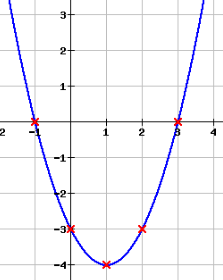
139.
What equation represents the quadratic function?
a)
y = (x - 4)2
b)
y = (x + 4)2
c)
y = x2 - 4
d)
y = x2 + 4
140.
What equation represents the quadratic function?
a)
y = -(x - 6)2 - 3
b)
y = -(x - 6)2 + 3
c)
y = -(x + 6)2 - 3
d)
y = -(x + 6)2 + 3 
141.
g(n)=4n-4
f(n)=n3+4
Find (g+f)(n)
a)
-2n2-n+9
b)
-n3-4n
c)
-3n3-3n-5
d)
n3+4n
142.
p(x) = 3x + 4
q(x) = 2x2
Find (p∘q)(x)
a)
10x2
b)
18x2 + 4
c)
6x2 + 4
143.
Identify the vertex and whether the graph opens up or down.
a)
(-1, 4); opens up
b)
(-1, 4); opens down
c)
(1, 4); opens up
d)
(1, 4); opens down
144.
List all possible rational zeros
f(x) = 3x5-5x2+x+6
a)
1, 2, 3, 6, -1, -2, -3, -6
b)
1/3,2/3,1,2,3,6,-1/3,-2/3,-1,-2,-3,-6
c)
1/3,2/3,1,2,3,6
145.
Tisha deposited $200 in a savings account earning 12% interest, compounded annually.
To the nearest cent, how much will she have in 3 years?
a)
$280.99
b)
$224
c)
$80.99
d)
$136.29
146.
Compare f(x) = 3x- 4 with the basic function g(x) = 3x.. What translation happens to the parent function?
a)
4 units up
b)
4 units to the left
c)
4 units to the right
d)
4 units down
147.
Evaluate. 
a)
A
b)
B
c)
C
d)
D
148.
Condense
a)
A
b)
B
c)
C
d)
D
149.
Simplify log443x
a)
3x
b)
3
c)
4
d)
43x
150.
5= 15,625
a)
3
b)
4
c)
5
d)
6
151.
Find all rational zeros, one zero has been given.
f(x) = x3-5x2-2x+24;   -2
a)
-2,1,0
b)
-2,-3,-4
c)
4,3,-2
d)
0,0,0
152.
Function notation
If f(x) = 3x2 - 4 + 2x,find f(6)
a)
332
b)
116
c)
84
d)
-16
