wayground logo

Free Printable Worksheets

Font size

S
M
L
XL
Worksheets

B2A2 TR Ch. 1

Total questions: 154

Worksheet time: 7hrs 27mins

Name
Class
Date
1.
A repeating decimal or decimal that terminates is called a 
a)
Natural Number
b)
Irrational Number
c)
Rational Number
d)
Whole Number
2.

Name the set or sets to which each real number belongs.
133\frac{13}{3}  

a)

Natural Number

b)

Whole Number

c)

Integer

d)

Rational

e)

Irrational

3.

Name the set or sets to which each real number belongs.
6-6  

a)

Natural Number

b)

Whole Number

c)

Integer

d)

Rational

e)

Irrational

4.

What is the set of numbers that includes all positive and negative numbers with no decimals?

a)
Whole Numbers
b)
Integers
c)
Rational Numbers
d)
Natural Numbers
5.
-4 is not a whole number because:
a)
It's negative and whole numbers are positive.
b)
it's irrational.
c)
it cannot be turned into a fraction.
d)
it is even.
6.
Classify this number:  -12
a)

irrational

b)

rational

c)

real, irrational

d)

rational, integer

7.
Which number is an irrational number?
a)
2.5
b)
5.72314.....
c)
-17
d)
1/2
8.

Between what 2 whole numbers is 6\sqrt{6}  ?

a)

1 and 2

b)

2 and 3

c)

3 and 4

d)

4 and 5

9.

Between what 2 whole numbers is the 8\sqrt{8}  ?

a)

1 and 2

b)

2 and 3

c)

3 and 4

d)

4 and 5

10.

Between what 2 whole numbers is 35\sqrt{35}  ?

a)

2 and 3

b)

3 and 4

c)

4 and 5

d)

5 and 6

11.

To which whole number is π\pi  closest on a number line?

a)

1

b)

2

c)

3

d)

4

12.
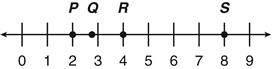
Which point most closely corresponds to the √8 on the number line below? (Click the question to see the picture)
a)
P
b)
Q
c)
R
d)
S
13.

Which point on the number line best represents 90\sqrt{90}  ?

a)

A

b)

B

c)

C

d)

D

e)

E

14.

Which number is irrational?

a)

9.6

b)

√45

c)

3/8

d)

3.4444...

15.
What is the approximate value of √12
a)
2
b)
3.5
c)
4.5
d)
6
16.
What is the set of numbers that includes π?
a)
Rational Numbers
b)
Irrational Numbers
17.
What is the set of numbers that doesn't include 0?
a)
Whole Numbers
b)
Real Numbers
c)
Irrational Numbers
d)
Natural Numbers
18.
Which name does not apply to this number?
 -10
a)
whole number
b)
integer
c)
real number
d)
rational number
19.
Which name does not apply to this number?
-17.84
a)
rational number
b)
real number
c)
irrational number
20.
Which name does not apply to this number?
7/8
a)
rational number
b)
real number
c)
whole number
21.
8 + 2 ⋅ 7
a)
22
b)
70
c)
20
d)
42
22.
8 ÷ 8 + 6 × 2
a)
8
b)
13
c)
14
d)
23
23.
Solve This Expression - 
( 7 x 3 ) + 9
a)
29
b)
30
c)
31
d)
32
24.
6 + (4)3
a)
18
b)
30
c)
13
d)
42
25.
(7 x 5) + (6 x 4)
a)
48
b)
69
c)
59
d)
72
26.

4 x 6 -2 =

a)

20

b)

24

c)

22

d)

18

27.

(3x3) + 6-4 =

a)

10

b)

11

c)

15

d)

9

28.

6(8) =

a)

40

b)

42

c)

49

d)

48

29.

3(4+2+1) =

a)

10

b)

20

c)

21

d)

7

30.

Three squared is:

a)

3 x 3 = 9

b)

3 x 2 = 6

c)

3 + 3 = 6

d)

3 + 2 = 5

31.

5x(6-3)

a)

19

b)

27

c)

15

d)

23

32.
(7 x 5) + 5
a)
40
b)
70
c)
17
d)
755
33.
2 + (9- 4)
a)
16
b)
77
c)
79
34.
Which is equivalent to 5 x 5 x 5 x 5
a)
53
b)
54
c)
45
d)
55
35.
What does 32 mean?
a)
3 x 2
b)
3 x 3
c)
2 x 2 x 2
36.
4 + 9 + 8 ÷ 4
a)
5.25
b)
5
c)
25
d)
15
37.

Solve: (2×10)+4

a)

20

b)

26

c)

7

d)

24

38.
2 x 9 ÷ 3
a)
5
b)
7
c)
8
d)
6
39.

4 + 2 x 8

a)

48

b)

20

c)

14

d)

40

40.
(6 + 2) x (3 + 2)
a)
18
b)
26
c)
16
d)
40
41.

12+13\frac{1}{2}+\frac{1}{3}  

(a)  

42.

8913=\frac{8}{9}-\frac{1}{3}=  

(a)  

43.

Convert to an improper fraction.

5 375\ \frac{3}{7}  

(a)  

44.

What would be the least common denominator for these two fractions?

78and 16\frac{7}{8}and\ \frac{1}{6}  

(a)  

45.

7816=\frac{7}{8}-\frac{1}{6}=  

(a)  

46.

8956=\frac{8}{9}-\frac{5}{6}=  

(a)  

47.

2 79 + 1 13=2\ \frac{7}{9}\ +\ 1\ \frac{1}{3}=  

(a)  

48.

Simplify the fraction. 1618\frac{16}{18}  

(a)  

49.

In preparation for a picnic, Sarah made a salad with 14\frac{1}{4}   of a bag of iceberg lettuce and 58\frac{5}{8}   of a bag of romaine lettuce. How many bags of lettuce did Sarah use in all?

(a)  

50.

Peggy made cookies. She used 34\frac{3}{4}  of a cup of flour and 512\frac{5}{12}   of a cup of sugar. How much more flour than sugar did Paula use? Make sure to simplify your answer.

(a)  

51.

Colton and Hayley made a stir-fry for dinner. They used 16\frac{1}{6}   of a pound of bell peppers, 13\frac{1}{3}   of a pound of mushrooms, and 19\frac{1}{9}   of a pound of snow peas. How many pounds of vegetables did they use in the stir-fry?

(a)  

52.

Leslie and Greg own neighboring cornfields. Leslie harvested 59\frac{5}{9}   acre of corn on Monday and Greg harvested 512\frac{5}{12}  of an acre. How many more acres did Leslie harvest than Greg?

(a)  

53.

In Brooke's history class, 18\frac{1}{8}   of the students are making videos for their final project  and 34\frac{3}{4}   are making dioramas. What fraction of the students are making either a video or diorama?

(a)  

54.

Convert the mixed number to an improper fraction.

102310\frac{2}{3}  

(a)  

55.

James needs 7157\frac{1}{5}  feet of yarn to complete a project. He has two small pieces measuring 1131\frac{1}{3}  feet and 2452\frac{4}{5}  feet. James needs to purchase how many more feet to complete his project?

(a)  

56.

12÷23\frac{1}{2}\div\frac{2}{3}  

a)

12×23\frac{1}{2}\times\frac{2}{3}  

b)

21×23\frac{2}{1}\times\frac{2}{3}  

c)

12×32\frac{1}{2}\times\frac{3}{2}  

d)

21×32\frac{2}{1}\times\frac{3}{2}  

57.

12÷12\frac{1}{2}\div\frac{1}{2}  

(a)  

58.

56÷23\frac{5}{6}\div\frac{2}{3}  


(a)  

59.

1012÷12\frac{10}{12}\div\frac{1}{2}  


(a)  

60.

44÷14\frac{4}{4}\div\frac{1}{4}  


(a)  

61.
a)

640\frac{6}{40}

b)

34\frac{3}{4}

c)

12\frac{1}{2}

d)

1220\frac{12}{20}

62.

What is the rule for Dividing Fractions?

a)

"Keep, Keep, Flip"

b)

"Keep, Change, Flip"

c)

"Keep, Change, Keep

d)

I don't know!

63.

What is another word for "Flip"?

a)

Same

b)

Fraction

c)

Equal

d)

Reciprocal

64.

Solve:

12\frac{1}{2}   ÷\div    1 34\frac{3}{4}  

a)

74\frac{7}{4}  

b)

38\frac{3}{8}  

c)

414\frac{4}{14}  

d)

5

65.

25÷4\frac{2}{5}\div4  

a)

1/10

b)

10

c)

1/20

d)

2/20

66.

25÷3\frac{2}{5}\div3  

a)

2/15

b)

1/7

c)

6/5

d)

6/15

67.

67÷3\frac{6}{7}\div3  

a)

2/7

b)

7/2

c)

18/7

d)

7/18

68.

Find the reciprocal of 711\frac{7}{11}  

a)

1 17\frac{1}{7}  

b)

1111\frac{11}{11}  

c)

117\frac{11}{7}  

d)

77\frac{7}{7}  

69.
What is the quotient of these fractions in lowest terms?
a)
6/40
b)
6/10
c)
3/5
d)
12/20
70.

Solve:   45÷2 = Solve:\ \ \ \frac{4}{5}\div2\ =\  

a)

85\frac{8}{5}  

b)

104\frac{10}{4}  

c)

25\frac{2}{5}  

d)

810\frac{8}{10}  

71.

Patrick is making a kite for a science fair project. He must cut 14\frac{1}{4}   inch pieces out of a 8 inch piece of plastic. How many  14\frac{1}{4}   inch pieces can he cut out in total?

a)

16 pieces

b)

132\frac{1}{32}   piece

c)

32 pieces

d)

116\frac{1}{16}   piece

72.
  Find the Product
 
a)
-0.2052
b)
-2.050
c)
2.050
d)
-0.2058
73.
Find the Product
a)
-41.81
b)
418.07
c)
416.52
d)
-435.212
74.
The numbers {0, 1, 2, 3, ...} etc. There is no fractional/decimal part or negatives.
a)
Rational Numbers
b)
Whole Numbers
c)
Integers
75.
A set of numbers that contains all whole numbers and their opposites.
a)
Rational Numbers
b)
Integers
c)
Whole Numbers
76.
Same Signs=Positive Answer
DIfferent Signs=Negative Answer
a)
Adding Integers
b)
Subtracting Integers
c)
Multiplying or Dividing Integers
77.

7.13 x −5.5

a)

39.215

b)

3.9215

c)

392.15

d)

3921.5

e)

−39.215

78.

5.78 x 3.5

a)

0.223

b)

2.23

c)

22.3

d)

20.23

e)

−20.23

79.

−1.2 x −3.4

a)

−4.08

b)

−4.8

c)

40.8

d)

4.08

80.

(8.6)(0.07)(-8.6)(-0.07)  

a)

0.602

b)

-0.62

c)

6.02

d)

-0.602

81.
Which of the REAL # classifications given in the answer choices does the number in the picture most fully fit?
a)
Irrational Numbers
b)
Rational Numbers
c)
Natural Numbers
d)
Integers
82.

(0.8)(17)(0.02)\left(-0.8\right)\left(17\right)\left(-0.02\right)  

a)

-0.272

b)

0.0272

c)

-2.72

d)

0.272

83.
Choose the best definition of the term INTEGERS...
a)
Whole numbers
b)
Negative numbers
c)
Negative Numbers and Positive Numbers
d)
Positive whole #s and their opposites and zero
84.
Choose the best definition of the term RATIONAL NUMBERS...
a)
Numbers that can think on their own
b)
Numbers that are or can turn into FRACTIONS
c)
Decimals that never repeat or terminate
d)
Repeating decimals
85.
Which statement is true?
a)
The absolute value of 3 is -3
b)
The opposite of 7 is 7
c)
The absolute value of 5 is equal to the opposite of 5
d)
The opposite of -4 is equal to the absolute value of -4
86.
Compare |-5| to the |-10|
a)
|-5| > |-10|
b)
|-5| = |-10|
c)
|-5| < |-10|
87.

Simplify the expression.

(3a4+3+8a2)(13a47a2a2)\left(-3a^4+3+8a^2\right)-\left(13a^4-7a-2a^2\right)  

a)

(16a4+5a2+18a+3)\left(-16a^4+5a^2+18a+3\right)  

b)

16a4+7a+3-16a^4+7a+3  

c)

16a4+10a2+7a+3-16a^4+10a^2+7a+3  

d)

16a4+18a+3-16a^4+18a+3  

88.

Simplify the expression.

(6p+4p5+11p3)+(4p2p5+4p)\left(6p+4p^5+11p^3\right)+\left(-4p^2-p^5+4p\right)  

a)

3p5+11p321p2+10p3p^5+11p^3-21p^2+10p  

b)

3p5+11p34p2+10p3p^5+11p^3-4p^2+10p  

c)

3p5+11p318p2+10p3p^5+11p^3-18p^2+10p  

d)

3p5+11p316p2+10p3p^5+11p^3-16p^2+10p  

89.

Simplify the expression.

(10a47a2+11)(9+10a25a4)\left(-10a^4-7a^2+11\right)-\left(9+10a^2-5a^4\right)  

a)

5a429a2+2-5a^4-29a^2+2  

b)

5a429a2+15-5a^4-29a^2+15  

c)

5a417a2+2-5a^4-17a^2+2  

d)

19a429a2+15-19a^4-29a^2+15  

90.

Simplify the expression.

(7x5+2x48x)(13x3x43x5)\left(7x^5+2x^4-8x\right)-\left(13x-3x^4-3x^5\right)  

a)

7x5+5x421x7x^5+5x^4-21x  

b)

x5+5x418x-x^5+5x^4-18x  

c)

x5+5x421x-x^5+5x^4-21x  

d)

10x5+5x421x10x^5+5x^4-21x  

91.

Simplify the expression.

(11k2+3k49)+(10k2+14k413)\left(-11k^2+3k^4-9\right)+\left(10k^2+14k^4-13\right)  

a)

17k4k22817k^4-k^2-28  

b)

17k4k22217k^4-k^2-22  

c)

11k421k2+4-11k^4-21k^2+4  

d)

17k4k22917k^4-k^2-29  

92.

Simplify the expression.

(6x+13x2x5)+(5x22x5+6x)\left(-6x+13x^2-x^5\right)+\left(5x^2-2x^5+6x\right)  

a)

13x5+18x2+6x-13x^5+18x^2+6x  

b)

13x5+18x2-13x^5+18x^2  

c)

3x5+18x2-3x^5+18x^2  

d)

3x5+18x2+6x-3x^5+18x^2+6x  

93.

The the product.

5n(7n25n+4)5n\left(7n^2-5n+4\right)  

a)

36n3+36n236n36n^3+36n^2-36n  

b)

24n212n+4224n^2-12n+42  

c)

9n2+18n159n^2+18n-15  

d)

35n325n2+20n35n^3-25n^2+20n  

94.

Find the product.

(2r+5)(8r+5)\left(-2r+5\right)\left(-8r+5\right)  

a)

16r250r+2516r^2-50r+25  

b)

16r2+2516r^2+25  

c)

16r230r2516r^2-30r-25  

d)

16r2+30r2516r^2+30r-25  

95.

Find the product.

(x+3)(4x2+3x2)\left(x+3\right)\left(4x^2+3x-2\right)  

a)

56x3+9x2+99x56-56x^3+9x^2+99x-56  

b)

4x3+15x2+7x64x^3+15x^2+7x-6  

c)

48x322x2+79x24-48x^3-22x^2+79x-24  

d)

7x3+20x226x+12-7x^3+20x^2-26x+12  

96.

Find the product.


(xy+3)(2xy4)(xy+1)\left(xy+3\right)\left(2xy-4\right)\left(-xy+1\right)  

a)

2x3y3+14xy12-2x^3y^3+14xy-12  

b)

2x3y34x2y2+14xy12-2x^3y^3-4x^2y^2+14xy-12  

c)

2x3y3+4x2y2+14xy12-2x^3y^3+4x^2y^2+14xy-12  

d)

2x3y3+14xy+12-2x^3y^3+14xy+12  

97.
Evaluate 4y  if       y = 3
a)
7
b)
12
98.
Evaluate 2a + 4b 
if a = 10     and    b = 6
a)
20
b)
24
c)
44
d)
4
99.
Evaluate when a = 15:
2(a - 5) + 2
a)
22
b)
27
c)
14
d)
7
100.
b2 + 4
when b = 3
a)
10
b)
12
c)
13
d)
11
101.
Evaluate the expression.   Let g = 3    h = 9 
4h + 2g + 4
a)
42
b)
46
c)
34
d)
58
102.
Evaluate the expression when
x =5    and   z = 4
z2  - 2x
a)
6
b)
2
c)
17
d)
26
103.
evaluate bc + 5a  
when  a = 3, b = 4, and c = -6
a)
9
b)
38
c)
-38
d)
-9
104.

Evaluate 3x - 7 if x = 6

a)

9

b)

11

c)

29

d)

25

105.

Evaluate 6y - 13 if y = 4

a)

51

b)

11

c)

37

106.

Evaluate:

(y+z)2\left(y+z\right)^2  

when y = -4 and z = -3

(a)  

107.

Evaluate:

x2zx^2-z  

when x = 1 and z = -1

(a)  

108.

Evaluate:

3(z+x)x3\left(z+x\right)-x  

when x = 2 and z = 1

(a)  

109.

Evaluate

a+b36a+b^3-6  

when a = 5 and b = 3

(a)  

110.
b2 + 4
when b = 3
a)
10
b)
12
c)
13
d)
11
111.
Evaluate when a = 15:
2(a - 5) + 2
a)
22
b)
27
c)
14
d)
7
112.
6a - 3d
when a = 1, d = 2
a)
3
b)
12
c)
1
d)
0
113.
Evaluate 3x + 8   if x = 2
a)
13
b)
14
c)
15
d)
16
114.
Evaluate when x = 8:
2x + x - 10
a)
34
b)
22
c)
14
d)
24
115.
Evaluate the expression when x = 3. 
2x2 - 5
a)
31
b)
12
c)
7
d)
13
116.

Evaluate 3d if d = 5

a)

3

b)

5

c)

12

d)

15

117.

Evaluate m2 if m = 7

a)

42

b)

43

c)

49

d)

51

118.

Evaluate y + 17 if y = 11

a)

11

b)

17

c)

27

d)

28

119.

Evaluate x ÷ 4 if x = 80

a)

4

b)

20

c)

40

d)

80

120.

Evaluate n3 if n = 4

a)

12

b)

16

c)

32

d)

64

121.

Evaluate m - n if m = 29 and n = 11

a)

29

b)

28

c)

19

d)

18

122.

Evaluate m + n if m = 29 and n = 11

a)

40

b)

38

c)

20

d)

18

123.

Evaluate b2 + 3 if b = 9

a)

9

b)

12

c)

81

d)

84

124.

Evaluate c2 - 11 if c = 8

a)

64

b)

63

c)

54

d)

53

125.
Identify the property
a + b = b + a
a)
Identity of addtion
b)
commutative of addition
c)
associative of addition
d)
symmetric
126.

Identify the property

a + 0 = a

a)

identity property of addition

b)

identity property of multiplication

c)

inverse property of addition

d)

multiplication property of zero

127.

Identify the property

(a ⋅ b) ⋅ c = (c ⋅ b) ⋅ a

a)

commutative property of addition

b)

identity property of multiplication

c)

inverse property of multiplication

d)

associative property of multiplication

128.
(19 x 5) x 2 = 19 x (5 x 2)
a)
Associative Property of Multiplication
b)
Commutative Property of Multiplication
c)
Identity Property of Multiplication
d)
Associative Property of Addition
129.
x 12 =12
a)
Identity Property of Multiplication
b)
Commutative Property of Multiplication
c)
Multiplication Property of One
d)
Distributive Property
130.

Which property says changing the order of the terms in addition or multiplication will not change the result

a)

Commutative

b)

Associative

c)

Inverse

d)

Identity

131.

This is an example of which property:
(23)4=2(34)\left(2\cdot3\right)\cdot4=2\cdot\left(3\cdot4\right)  

a)

Associative

b)

Commutative

c)

Inverse

d)

Identity

132.
x 2 = 2 x 9
a)
Commutative Property of Multiplication
b)
Associative Property of Multiplication
c)
Multiplicative Inverse Property
d)
Distributive Property
133.
What property is this?
77+(8+3) = (8+3)+77
a)
Commutative
b)
Associative
c)
Additive Identity
d)
Distributive
134.
(19 x 5) x 2 = 19 x (5 x 2)
a)
Associative Property of Multiplication
b)
Commutative Property of Multiplication
c)
Identity Property of Multiplication
d)
Associative Property of Addition
135.
Identify the property
a + b = b + a
a)
Identity of addtion
b)
commutative of addition
c)
associative of addition
d)
symmetric
136.
Identify the property
(a ⋅ b) ⋅ c = (c ⋅ b) ⋅ a
a)
commutative of multiplication
b)
identity of multiplication
c)
inverse of multiplication
d)
associative of multiplication
137.
Identify the property
a + 0 = a
a)
identity of addition
b)
identity of multiplication
c)
inverse of addtion
d)
multiplication of zero
138.
Pick the answer that is an example of the inverse property of multiplication
a)
5 ⋅ 0 = 5
b)
5 ⋅ 1/5 = 1
c)
5 - 5 = 0
d)
5 ⋅ 1 = 5
139.
Pick the answer that is an example of the identity property of addtion
a)
a + (-a) = 0
b)
1 + 1 = 2
c)
a + 0 = a
d)
a + b = b + a
140.
Identify the property
a(b + c) = ab + ac
a)
Associative of addtion
b)
Distributive
c)
Commutative of addition
d)
Inverse
141.
Identify the property 
a + (-a) = 0
a)
Inverse of addition 
b)
Identity of addtion
c)
associative of addition 
d)
symmetric
142.

If you multiply a number and its multiplicative inverse, what do you get?

a)

0

b)

1

c)

Not enough information

d)

None of these

143.

What is the additive inverse of 2/3?

a)

-2/3

b)

3/2

c)

2/3

d)

-3/2

144.

Any number you multiply by zero is equal to zero.

a)

True

b)

False

145.
(19 x 5) x 2 = 19 x (5 x 2)
a)
Associative Property of Multiplication
b)
Commutative Property of Multiplication
c)
Identity Property of Multiplication
d)
Associative Property of Addition
146.
x 12 =12
a)
Identity Property of Multiplication
b)
Commutative Property of Multiplication
c)
Multiplication Property of One
d)
Distributive Property
147.

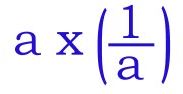
What property is this?

a)

Multiplicative Inverse

b)

Multiplicative Identity

c)

Commutative

d)

Associative

148.
What property is this?
(n+13) + 4 = n + (13+4)
a)
Associative Property
b)
Commutative Property
c)
Additive Identity
d)
Distributive Property
149.
What is the ADDITIVE INVERSE of
-7
a)
-7
b)
-1/7
c)
1/7
d)
7
150.
What is the MULTIPLICATIVE INVERSE of
8
a)
-8
b)
-1/8
c)
1/8
d)
1
151.

Fill in the blank to properly show the DISTRIBUTIVE PROPERTY:

7(11 + 4) = 77 + ____

a)

3

b)

4

c)

7

d)

28

152.
What property is this?
1a = a
a)
Commutative Property of Multiplication
b)
Multiplicative Inverse
c)
Multiplicative Identity
d)
Distributive Property
153.
This is an example of which property:
(2⋅3)4=(3⋅2)4
a)
Associative
b)
Commutative
c)
Inverse
d)
Identity
154.
What property is this?
9(b + 0.5) = 9b + 4.5
a)
Commutative
b)
Associative
c)
Distributive
d)
Additive Inverse