
 Worksheets
Force, Pressure and Refraction
Total questions: 25
Worksheet time: 13mins
Force acting per unit area is called
non-contact forces
contact forces
force
pressure
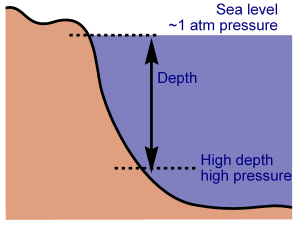
When you increase your depth under water, the water pressure on your body
increases
decreases
stays the same
Why won't you sink in mud if you wear boots?
Because the surface area is larger creating less pressure.
Has air in it to keep you floating.
Because the mud won't want you.

Diagram shows the design of a dam. Why does the thickness of the dam increase with its depth?
The design of this structure is stronger.
Water pressure increases with depth.
The cost of construction is lower.
Water pressure acts uniformly in all directions.

A student placed a pencil in a cup of water. The pencil appears broken because light
always travels in a straight line.
bends when it passes through water.
makes the water in the glass evaporate.
reflects the pencil on the water's surface.
When light passes at an angle to the normal from one medium into another in which its speed is higher
it is bent toward the normal.
it always lies along the normal.
it is unaffected.
it is bent away from the normal.
When light passes at an angle to the normal from one medium into another in which its speed is lower
it is bent towards the normal.
it always lies along the normal.
it is unaffected.
it is bent away from the normal.
flint glass n=1.70
barium glass n=1.60
crown glass n=1.523
water n=1.33
diamond n=2.45


Based on the image, as light passes from medium 1 to medium 2
light speeds up and bends towards the normal
light speeds up and bends away from the normal
light slows down and bends towards the normal
light slows down and bends away from the normal
Why is the component of colour in a rainbow can be seen when light passes through a glass prism?
phenomena of scattering of light
phenomena of dispersion of light
phenomena of reflection of light
phenomena of diffraction of light

Look at the diagram given. This is the first prism. What happen if A SECOND inverted prism is placed behind the first prism?
the various colours pass through it and form brighter spectrum
the various colours pass through it and form a white light back
the various colours pass through it and form an opposite spectrum colours
nothing will happen

Identify the mirror
Plane mirror
Convex mirror
concave mirror
None of the above
Which of the following best relates R and f ?
R=f/2
R=2f
R=4f
R=f/4
The distance from the pole to the focus of the spherical mirror is called--------
Radius of curvature
centre of curvature
Focus
Focal length
The ray parallel to the principal axis, after reflection from a concave mirror will----------
pass through C
pass through P
pass through F
retrace its path
The radius of curvature of a spherical mirror is 20 cm, What is its focal length?
20 cm
10 cm
40 cm
1/20 cm
-------------mirror is used as rear view mirrors in vehicles.
Convex
Concave
Plane
Which mirrors are used in the reflectors of torches?
convex mirrors
concave mirrors
plane mirrors
____________mirrors are used by dentists to see the large images of teeth of patients.
concave
convex
plane

