
 Worksheets
General knowledge - Programming and computers
Total questions: 60
Worksheet time: 34mins

Ancient accounting tools like the quipu and abacus were used to __________,
Store Data
Replace Money
Solve Math Problems
What is the building block of all PC's? A special kind of electrical switch.
Computer
Transistor
Hard Drive

Punch cards used in mechanical computers were the earliest example of ____________.
braille
a computer program
encryption
What does CPU stand for?
Central Processing Unit
Computer Parts Unlimited
Central Programming Unit

The first electronic computers were used for _____________.
Stock Trading
Calculating Trajectory and Code Breaking
Astronomy
What are the only numbers you can use in binary?
0 and 1
1 and 2
0, 1, 2, 3, 4, 5, 6, 7, 8, 9

This technology was critical in creating microcomputers and launching the digital age.
transistor
conductor
internet
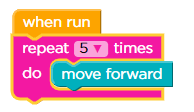
What does this code do?
Moves forward 1 time
Moves forward forever
Moves forward 5 times

Instead of focusing on making devices smaller, modern computing is about ____________________.
making them last longer
making them cheaper
making them work together

Charles Babbage designed the Difference Engine and the Analytical Engine. What were these?
Mechanical Computers
Thermometers
Rulers
Who is the worlds first computer programmer?
Herman Hollerith
Konrad Zuse
Augusta Ada Byron
What programming language is design for numeric and scientific computation?
BASIC
COBOL
FORTRAN
This programming language was used to developed SKYPE.
JAVA
PASCAL
C
Created by Dennis Ritchie at Bells Lab
C++
C #
C
Extension for C.
C++
C #
Object Oriented
Expanded on C
C #
C++
Object C
Creator of Ruby
Guido Van Rossum
Yukihiro Matsumoto
James Gosling
PHP stands for?
Philippine Peso
Person in Home Page
Personal Home Page
Javascript was created in what year?
1995
1996
1994
PHP was created in what year?
1995
1996
1994
Python was created in what year?
1993
1994
1991
C was created in what year?
1980
1972
1983
Machine code written for one computer can run on all computers
True
False
One example of an instruction at the level of machine code is to:
Store a number
Delete a word
Add an image
Make a noise
What are the 2 parts of the instruction?
Opinstruction and Opmemory
Opcommand and Opstate
Opcode and Operand
Opcommand and Opmemory
Assembly language is a high level language
True
False
A programming language using words and commands easy for humans to understand and organize, but which must be translated into machine language or object code for the computer to understand and execute is generally described as a:
Functional language
Object-oriented language
High-level language
Low-level language
The language directly understood and executed by a computer, consisting of pure 0s and 1s.
COBOL language
Pascal language
Machine language
Assembly language
Which term below best describes the process where the instructions from a program are converted all at once from a high level language to a low level language, and then executed?
Compiling
Interpreting
Assembling
One of the original high level languages created by John Backus to make programming easier for math and science applications.
C++
Fortran
A compiled, English-like computer programming language designed for business use, designed under the leadership of Commodore Grace Hopper.
COBOL
Pascal

This is an example of ...
Machine Code
Low level programming language
High level programming language
What is Machine Code?
The language of the computer
The brains of the computer
The eyes of the computer
The toes of the computer
What is Python classed as?
A high level language
An animal
An Operating System
A Mnemonic
What does a high level language do?
Removes the complexity of binary
Make life more difficult for programmers
Makes use of Transistors
Makes use of permanently stored instructions

What is pseudocode?
Simplified programming language, that is not a specific language
Complicated programming language
Simple programming language, which is linked to a specific language
A type of cheese
ESCRIBO MI NOMBRE COMPLETO Y GRADO:
ESCRIBO MI NOMBRE COMPLETO Y GRADO:

1. Grip cap with index finger and thumb
2. Remove cap
3. Twist counter-clock-wise until seal is broken
What is a computer program?
a collection of instructions that performs a specific task when executed by a computer
Something you can use to write a document
What is an algorithm?
a well-defined procedure that allows a computer to solve a problem
The first step of a computer program
Coding
the act of creating a computer program
a collection of instructions that performs a specific task when executed by a computer
a loop is a sequence of instructions that is continually repeated until a certain condition is reached
a named section of a program that performs a specific task. In this sense it is like a type of procedure or routine
step
function
loop
conditional statement
Each repetition of the process used to make improvements
bug
iteration
input
an error, flaw, failure or fault in a computer program or system that causes it to produce an incorrect or unexpected result
iteration
virus
bug
variable
set of rules performed if a certain condition is me, often referred to as if/then statements
computer program
conditional statement
function
algorithm
some known or unknown quantity of information
number
variable
equation
algorithm
refers to physically or automatically adding data to a system
input
output
coding
bug
Data generated by a computer
input
output
bug
loop
Which of the following is an example of an output device?
mouse
keyboard
printer
Which of the following is an example of an input device?
speakers
monitor
keyboard
printer

"Repeat until basket empty" is what part of the code?
step
variable
loop
conditional
"place" is what part of the code?
step
variable
loop
conditional

