wayground logo

Free Printable Worksheets

NEW

Font size

S
M
L
XL
Worksheets

Geologic Time

Total questions: 47

Worksheet time: 54mins

Name
Class
Date
1.

When did the first birds appear?

a)

Cambrian

b)

Permian

c)

Cretaceous & Triassic

d)

Mesozoic and Jurassic

2.

The period of geologic time when the biodiversity of life on the planet increased dramatically was

a)

Jurassic

b)

Triassic

c)

Permian

d)

Cambrian

3.

There have been how many major extinction events on planet Earth?

a)

3

b)

4

c)

5

d)

2

4.

When did this creature live?

a)

Triassic-Jurassic

b)

Jurassic-Silurian

c)

Cretaceous-Tertiary

d)

Eocene-Oligocene

5.

The Cenozoic is a

a)

eon

b)

era

c)

period

d)

epoch

6.

The period when trilobites and eurypterids appeared was the

a)

Hadean

b)

Cambrian

c)

Holocene

d)

Jurassic

7.

The time when the first jawed fishes and amphibians appeared

a)

Devonian

b)

Jurassic

c)

Cambrian

d)

Hadean

8.

Mammals are a dominant group in which era?

a)

Cenozoic

b)

Mesozoic

c)

Paleozoic

d)

Cambrianozoic

9.

What type of event usually marks the end of an Era

a)

A Mass Extinction

b)

A Quinceanera

c)

An earthquake

d)

A Volcanic Eruption

10.
The Geologic Time Scale is a record of what?
a)
old geologists
b)
sweet geology music
c)
the known history of rocks and fossils
d)
a list of every living thing ever
11.
The Law of Superposition helps scientists to determine what?
a)
The absolute age of rock layers
b)
The age of fossils
c)
The relative age of rock layers
d)
the super powers of rocks
12.
What type of rock do fossils form in?
a)
Igneous
b)
Sedimentary
c)
Metamorphic
d)
Classic
13.
According to the law of superposition, which layer is the youngest?
a)
A
b)
B
c)
C
14.
The Law of SUPERposition tells us that....
a)
New layers form on top of old layers
b)
The oldest layers are above the newer layers
c)
You can't assume a layers age based on its order
d)
The position of the layers is super
15.
Which layer is the oldest? 
a)
c
b)
a
c)
b
d)
d
16.
How many LAYERS are there?
a)
6
b)
7
c)
5
d)
2
17.
What fossil is the oldest?
a)
d
b)
b
c)
a
d)
c
18.
What layer has the least fossils?
a)
5
b)
3
c)
6
d)
4
19.
Letter "F" is a....
a)
inclusion
b)
intrusion
c)
fault
d)
unconformity 
20.
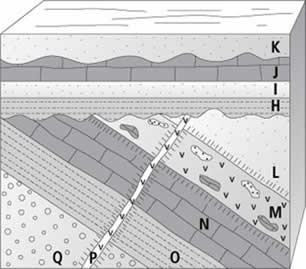
The rock formation labeled "P" is a(n)...
a)
fault
b)
intrusion
c)
inclusion
d)
unconformity
21.

Which principles states that the physical, chemical, and biological processes that work today are the same forces that work in the past?

a)

Principle of Intrusions

b)

Principle of Unconformities

c)

Principle of Uniformitarianism

d)

Principle of Original Horizontality

22.
Which of the following causes Earth's tectonic plates to move?
a)
Energy from the Sun
b)
Magnetic Pole Reversal
c)
Convection currents in the mantle
d)
Faults in Mountain Ranges
23.
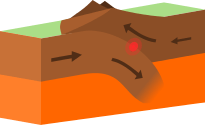
What type of plate boundary is this?
a)
Plate
b)
Divergent
c)
Convergent
d)
Transform
24.
A divergent boundary occurs when plates ....
a)
Pull apart
b)
Come together
c)
Slide past each other
d)
subducting
25.

Which of the following is the name of the ancient supercontinent formed 280 Million Years ago.

a)

Pangea

b)

Gondwanda

c)

Laurasia

d)

Neverland

26.
What geologic feature/event would you most likely to find at a divergent boundary between two pieces of oceanic crust?
a)
Rift Valley
b)
Mid-Ocean Ridge
c)
Island Arc
d)
Flat land
27.
How are scientist able to estimate the thickness of each layer of the Earth?By studying __________
a)
 radio waves
b)
sonar waves
c)
laser waves
d)
seismic waves
28.
This layer is divided into pieces called tectonic plates.
a)
Mesosphere
b)
Asthenosphere
c)
Mantle
d)
Lithosphere
29.
Which types of magma contains the least amount of SiO2
a)
rhyolitic
b)
andesitic
c)
felsic
d)
basaltic
30.
The composition of magma determines its _____.
a)
viscosity
b)
darkness
c)
color
d)
none of the above
31.
Volcanoes that are made of basalt lava flows are called _____.
a)
shield volcanoes
b)
composite volcanoes
c)
stratovolcanoes
d)
cone volcanoes
32.
Once magma reaches the earth's surface it is called.....
a)
Silica
b)
Rock
c)
lava
33.
A huge hole that is left behind when a volcano collapses is called a
a)
Batholith
b)
Caldera
c)
Geyser
34.
What is pyroclastic material?
a)
Dust, ash and other material that comes out of a volcano.
b)
A type of magma that is in a volcano.
c)
A type of volcano.
35.

The long tube in the ground that connects the magma chamber to Earth's surface is called the _____________.

a)

Crater

b)

Pipe

c)

Vent

d)

Magma Chamber

36.

What provides the force that causes a volcano to become explosive?

a)

Mafic flows

b)

Magma density

c)

Dissolved gases trapped in magma

d)

Extreme heat

37.

This is where the volcanic materials that erupt are stored

a)

Vent

b)

Conduit

c)

Side Vent

d)

Magma Chamber

38.

Chunks of magma that are cooled into rocks as they are thrown in the air are

a)

Volcanic bombs

b)

Pyroclastic Flow

c)

Lahars

d)

Blocks

39.

What type of volcano is this

a)

composite volcano

b)

shield volcano

c)

cinder cone volcano

40.

What type of Volcano is this?

a)

composite

b)

shield

c)

cinder cone

41.
The epicenter of an earthquake is
a)
The point below the surface where rock begins to break and the first motion occurs
b)
The seismic station closest to the earthquake
c)
The place where the greatest damage occurs
d)
The point on the surface directly above the focus
42.
Most earthquakes happen along the _________________. 
a)
coast
b)
faults
c)
desert
d)
directions
43.
Many earthquakes happen along the borders of...
a)
Countries
b)
Tetonic Plates
c)
Climate Zones
d)
None of the above.
44.
This earthquake is......?
a)
Convergent
b)
Transform
c)
Divergent
d)
Rift Zone
45.
This earthquake is......?
a)
Convergent
b)
Transform
c)
Divergent
d)
Rift Zone
46.

The place where an earthquake originates inside the Earth's surface is called...

a)

Epicenter

b)

Focus

c)

Underground

d)

Crust

47.

This is created by earthquakes that occur on the ocean floor.

a)

longshore current

b)

gulf stream

c)

tsunamis

d)

high tide