wayground logo

Free Printable Worksheets

Font size

S
M
L
XL
Worksheets

Math 10

Total questions: 58

Worksheet time: 2hrs 29mins

Name
Class
Date
1.
Complete the Table.
a)
25, 32, 39, 46
b)
7, 32, 57, 82
c)
32, 39, 46, 53
d)
7, 14, 21, 28
2.
What is the common difference?
a)
−16
b)
84
c)
16
d)
0
3.
Write the first four terms in the sequence.
a)
12, 14, 16, 18
b)
12, 10, 8, 6
c)
14, 12, 10, 8
d)
14, 16, 18, 20
4.
A sequence can be generated by using an = a(n − 1) + 10, where a1 = 23 and n is a whole number greater than 1. What are the first five terms in the sequence?
a)
33, 43, 53, 63, 73
b)
23, 33, 43, 53, 63
c)
23, 230, 2300, 23000, 230000
d)
23, 13, 3, −7, −17
5.
Using this explicit rule an = 2n + 5, write the first four terms in the sequence.
a)
7, 9, 11, 13
b)
5, 7, 9, 11
c)
7, 5, 3, 1
d)
5, 3, 1, −1
6.
Is the sequence arithmetic: 78, 785, 7855, 78555, ...
a)
Yes
b)
No
7.
Find the common difference: -18, -23, -28, -33, ...
a)
d = -5
b)
d = 5
c)
d = -3
d)
d = 3
8.
Find the next three terms in the arithmetic sequence: 25, 34, 43, 52, ...
a)
63, 72, 81
b)
79, 88, 97
c)
70, 79, 88
d)
61, 70, 79
9.
Find 26th term in the arithmetic sequence: -15, -35, -55, -75, ...
a)
-515
b)
-490
c)
-535
d)
460
10.

Which of the the following are examples of arithmetic sequence?

a)

14,12,34,1\frac{1}{4},\frac{1}{2},\frac{3}{4},1

b)

6,11,16,21,...6,11,16,21,...

c)

100,95,90,85,80,75100,95,90,85,80,75

d)

100,50,25, ...100,50,25,\ ...

11.

If the third term of an arithmetic sequence is 13 and the 9th term is 37, what is the first term?

(a)  

12.

If the third term of an arithmetic sequence is 13 and the 9th term is 37, what is the 53rd term?

(a)  

13.

The first three terms and the last term of a finite arithmetic sequence are - 92, - 88, - 84, ...,12.Find the number of terms in the sequence.

a)

20

b)

25

c)

27

d)

30

14.

Insert two arithmetic means between 30 and 48

a)

35, 41

b)

36, 42

c)

37, 43

d)

38, 44

15.

Insert three arithmetic means between 22 and 42.

a)

24, 29 34

b)

25, 30, 35

c)

26, 31, 36

d)

27, 32, 37

16.

What is the missing term in 21, _______, 47?

a)

32

b)

33

c)

34

d)

35

17.

Find the missing term


 _______,  53,43\frac{5}{3},\frac{4}{3}  

a)

0

b)

1

c)

2

d)

12\frac{1}{2}  

18.

What is the arithmetic mean between 6.5 and 17.9 ?

a)

12.2

b)

11.2

c)

10.2

d)

9.2

19.

Insert one arithmetic mean between the first and last term of the sequence.
20, -20,\   (a)  40-40  .

20.

Insert one arithmetic mean between the first and last term of the sequence.
23,-23,   (a)  3-3  .

21.

What does r represent?

a)

Radical

b)

Common difference

c)

Common ratio

22.

What does a1 represent?

a)

Any term

b)

First term

c)

Last term

23.
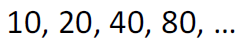
Find the common ratio for the geometric sequence.
a)
10
b)
1/2
c)
2
d)
4
24.

What are the next 3 terms in the following geometric sequence:

512, 256, 128, ___, ___, ___, ...

a)

1024, 2048, 4096

b)

32, 8, 2

c)

64, 32, 16

d)

92, 66, 38

25.
Find the first four terms of the sequence given the rule:
an = 4(5)n-1
a)
20, 100, 500, 2500
b)
5, 20, 80, 320
c)
4, 20, 100, 500
d)
4, 9, 14, 19
26.

Given the sequence:

125, 25, 5, ....

Write the rule an using the geometric sequence formula:

a)

an = (125)(1/5)(n-1)

b)

an = 625(1/5)(n-1)

c)

an = 625(5)(n-1)

d)

an = 125 + 5n

27.

Daisy received $2 on her first birthday. Each year, the amount of money she received tripled. How much money will she receive on her 5th birthday?

a)

$10

b)

$300

c)

$162

d)

$416

28.

What is the common ratio of this sequence ? 5, 25, 125, ...

a)

4

b)

2

c)

5

d)

6

29.

Solving for the nth term of geometric sequence, given that a1 = 1 and r= 2, what is the value of the 4th term?

a)

2

b)

8

c)

4

d)

16

30.

Find the sum of the first four terms of the geometric sequence that begins with 1 with a common ratio of 3.

a)

25

b)

37

c)

40

d)

80

31.

Determine the next three temrs of the sequence

3, −6, 12, −24, ...

a)

−512, −2048, −8192

b)

512, −2048, 8192

c)

48, −96, 192

d)

1250, 6250, 31250

32.

What is the formula for the nth term of the given sequence

3, −15, 75, −375, ...

a)

an=(5)(3)n1a_n=\left(-5\right)\left(3\right)^{n-1}  

b)

an=(3)(5)n1a_n=\left(3\right)\left(5\right)^{n-1}  

c)

an=(3)(5)n1a_n=\left(3\right)\left(-5\right)^{n-1}  

d)

an=3(5)n1a_n=3\left(5\right)^{n-1}  

33.

Find the sum of the geometric sequence

1/8, 1/16, 1/32, . . .

a)

2

b)

1

c)

1/2

d)

1/4

34.

Find the 2 positive geometric means between 3 and 192.

a)

-12, 48

b)

12, 36

c)

9, 27

d)

12, 48

35.

Find the 3 geometric means between 1/2 and 1/32.

a)

1/4, 1/6, 1/8 or -1/4, 1/6, -1/8

b)

1/6, 1/12, 1/16 or -1/6, 1/12, -1/16

c)

1/4, 1/8, 1/16 or -1/4, -1/8, -1/16

d)

1/4, 1/8, 1/16 or -1/4, 1/8, -1/16

36.

Find the geometric mean between 16 and 4

a)

8 or -8

b)

12 or -12

c)

6 or -6

d)

8 or 10

37.
Find S14 
7, 2, -3, ...
a)
-812
b)
119
c)
-945
d)
-357
38.
The sequence 28, 34, 40, 46, 52, ..., 88 has 11 terms. Evaluate the related series. 
a)
550
b)
638
c)
610
d)
288
39.
Find Sn for the given series:
a1=22
d=-8
n=21
a)
1911
b)
-1449
c)
-2436
d)
-1218
40.
Find the missing terms of the arithmetic sequence:
145, ___, ___, ___, 205
a)
160, 175, 190
b)
165, 185, 195
c)
155, 165, 175
d)
190, 175, 160
41.
Evaluate the arithmetic series described:
2 + (-2) + (-6) + (-10)..., S10
a)
-160
b)
-328
c)
-320
d)
-336
42.
Evaluate the arithmetic series described:
0 - 7 - 14 - 21..., S17
a)
-959
b)
-1904
c)
-952
d)
-1918
43.
Evaluate the arithmetic series described:
a1 = 5, an = 145, Find S15
a)
1125
b)
2255
c)
2250
d)
2258
44.
You are sitting in row 23 and notice there are 65 seats in your row. The row in front of you has 63 seats and the row behind you has 67 seats. There are 42 rows in the auditorium. How many seats does the auditorium contain? (Hint: Find the number of seats in the first and last rows)
a)
2,604
b)
2,163
c)
2,422
d)
2,803
45.
Which of the following would be a Fibonacci sequence?
a)
1, 2, 3, 4, 5, 6
b)
2, 4, 6, 10, 16, 26
c)
3, 6, 9, 12, 15, 18
d)
4, 2, 1, 1/2, 1/4, 1/8
46.
What was Fibonacci's real name?
a)
Leonardo Pisano
b)
Leo Pisa
c)
The Big Fibber
d)
Leonardo Fibo
47.
What is the Fibonacci number pattern?
a)
Counting up starting from 1 by 1.
b)
Adding the two numbers before it to get the next number.
c)
Multiplying the two numbers before it to get the next number.
d)
Subtracting the two numbers before it to get the next number.
48.

What is the approximate number for the Golden Ratio?

a)

1.1

b)

0.000465

c)

1.61913398875…

d)

1.61803398875…

49.

Select two that fills in one of the blanks


3, 5, __, 13, 21, __, 55, 89,...

a)

34

b)

9

c)

8

d)

28

50.
What Greek Symbol represents The Golden Ratio?
a)
Phi
b)
Psi
c)
Pi
d)
Theta
51.

2, 3, 5, 8, _____

a)

11

b)

12

c)

13

d)

14

52.

_____, _____, 21, 34, 55, 89

a)

2, 3

b)

5, 8

c)

8, 13

d)

13, 21

53.

89, 144, _____, 377, 610, 987, 1597

a)

233

b)

266

c)

333

d)

366

54.

Which of the terms below may form a harmonic sequence?

a)

3, 5, 7, 9, ....

b)

1/2. 1/4, 1/8, 1/16, ...

c)

1/3, 1/6, 1/9, 1/12, ....

d)

2,4,8,16,.....

55.

What do we call this sequence: 1/2, 1/4, 1/6, 1/8...,

a)

Fibonacci Sequence

b)

Harmonic Sequence

c)

Square Sequence

d)

Cube Sequence

56.

What do we call this sequence: 1, 1, 2, 3, 5, 8,...

a)

Fibonacci Sequence

b)

Harmonic Sequence

c)

Square Number Sequence

d)

Triangular Sequence

57.

What is the next term of the sequence: 1/5, 1/18, 1/31, 1/44,...

a)

57

b)

1/57

c)

57/1

d)

None of the above

58.

Given the Fibonacci sequence: 1, 1, 2, 3, 5, 8, 13, 21, ...

Evaluate the sum:

Fib (1) + Fib (3) + Fib (5)

a)

2

b)

3

c)

7

d)

8