wayground logo

Free Printable Worksheets

NEW

Font size

S
M
L
XL
Worksheets

ENV SCI Chapter 5- Ecosystems

Total questions: 35

Worksheet time: 32mins

Name
Class
Date
1.
a stable ecological community that has reached equilibrium
a)
ecological succession 
b)
climax community
c)
secondary succession
d)
pioneer speciles
2.
succession that occurs in an area where soil is already present
a)
ecological succession 
b)
primary succession 
c)
secondary succession
d)
pioneer speciles
3.
Organisms that do not decompose can be buried and become what?
a)
water
b)
nutrients
c)
air
d)
fossil fuels
4.
What process occurs when coal (fossil fuel) is used for energy?
a)
Decomposition
b)
Combustion
c)
Pressurization 
d)
Respiration 
5.
the first organisms that appear in an ecological community
a)
ecological succession 
b)
primary succession 
c)
secondary succession
d)
pioneer speciles
6.

This is NOT a part of the phosphorus cycle.

a)

Phosphate is incorporated into sedimentary rocks

b)

Phosphate bound to soil

c)

Atmospheric phosphate

d)

Phosphate is absorbed from the soil by plants

7.
What does NOT produce carbon dioxide?
a)
Photosynthesis
b)
Burning Fossil Fuels
c)
Animal respiration
d)
Plants decaying
8.
Which is a producer?
a)
deer
b)
tall grass
c)
lion
d)
worm
9.
Which of the following is the correct equation for PHOTOSYNTHESIS?
a)
CO+ light + H2O --> O+ Sugar
b)
CO+ sugar + H2O --> O+ light
c)
O2 + light + H2O --> CO+ Sugar
d)
CO+ O2 + H2O --> Light+ Sugar
10.

Which of these nitrogen cycle processes converts atmospheric nitrogen to a soil form of nitrogen that is usable by plants?

a)

nitrogen fixation

b)

nitrification

c)

denitrification

d)

ammonification

e)

assimilation

11.
If a frog is the prey, what could be the predator?
a)
Grass
b)
Insect
c)
Snake
d)
Snail
12.
succession that occurs in an area with no soil
a)
ecological succession 
b)
primary succession 
c)
secondary succession
d)
pioneer speciles
13.
An organism that lives by breaking apart dead organic matter into simpler parts is...
a)
scavenger
b)
consumer
c)
decomposer
d)
carnivore
14.
An animal that eats other animals is a....
a)
carnivore
b)
omnivore
c)
herbivore
d)
decomposer
15.
What does a food web represent?
a)
All connections of energy flow throughout all organisms in a ecosystem.
b)
The specific ways that mutualism is carried out.
c)
A single pathway or energy flow between organisms. 
d)
How carnivores get their food. 
16.

What is the correct equation for cellular respiration?

a)

oxygen + sugar -> carbon dioxide + water + Energy

b)

carbon dioxide + sugar + Energy -> carbon dioxide + water

c)

carbon dioxide + water -> oxygen + sugar + Energy

d)

carbon dioxide + water + Energy -> oxygen + sugar

17.
__________ is an organism that eats BOTH plants and animals for energy.
a)
Omnivore
b)
Darnivore
c)
Carnivore
d)
Herbiovre
18.
Which statement about photosynthesis is correct?
a)
Plants get the energy they need for photosynthesis from water.
b)
Plants get the energy they need for photosynthesis from soil.
c)
Plants get the energy they need for photosynthesis from sunlight.
d)
Plants get the energy they need for photosynthesis from carbon dioxide.
19.
What is this called?
a)
Food Web
b)
Food Chain
c)
Abiotic Factors
20.

What is important about cellular respiration?

a)

It produces energy from the sun.

b)

It forms sugar.

c)

It transforms sugar into a usable form of energy (ATP)

d)

Only plants perform this process.

21.

At which trophic level can you find an herbivore?

a)

1st Level

b)

2nd Level

c)

3rd Level

d)

4th Level

22.

Heterotrophs that eat producers and other heterotrophs are called...

a)

autotrophs

b)

herbivores

c)

carnivores

d)

omnivores

23.

How much energy moves from trophic level to trophic level?

a)

100%

b)

50%

c)

1%

d)

10%

24.

Energy enters an ecosystem as...

a)

chemicals

b)

food

c)

minerals

d)

sunlight

25.

On a food web, the arrows show...

a)

what eats what.

b)

where the energy is going.

c)

what each organism hunts.

d)

who is friends with whom.

26.
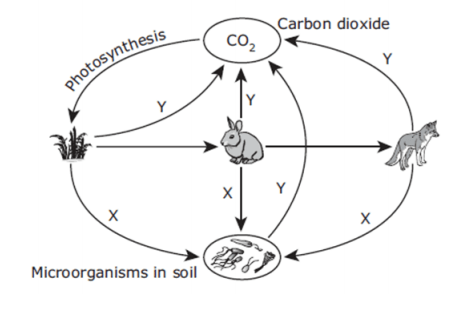
The diagram shows the flow of organic molecules through an ecosystem. What two processes are identified by the labels X and Y?
a)
X : Respiration
Y : Predation
b)
X : Adaptation
Y : Decomposition
c)
X : Fermentation
Y : Nitrogen Fixation
d)
X : Decomposition
Y : Respiration
27.

Which of the following are fossil fuels?

a)

Coal, water, oil

b)

Oxygen, coal, oil

c)

Coal, Oil, Natural Gas

d)

None of the above

28.
Which of the following is the best conclusion that can be made from this graph?
a)
atmospheric carbon dioxide levels have been decreasing since 1960
b)
Hawaii has a lot of carbon dioxide
c)
humans have been working hard to decrease carbon dioxide levels
d)
atmospheric carbon dioxide levels have increased steadily since 1960
29.
Organisms require nitrogen to make which of the following?
a)
glucose and starch
b)
lipids and nucleic acids
c)
proteins and nucleic acids
d)
carbohydrates and proteins
30.
Process where excess nutrients enter body of water causing overgrowth of aquatic plants and algae...
a)
Eutrophication
b)
Acid Precipitation
c)
Nitrogen Fixation
d)
Decomposition
31.
How much of the atmosphere is composed of nitrogen gas?
a)
87%
b)
38%
c)
78%
d)
21%
32.
Bacteria fix nitrogen on plant roots. Plant roots provide sugar to bacteria. This is an example of _______.
a)
mutualism
b)
parasitism
c)
commensalism
d)
competition
33.
How do plants get the nitrogen they need?
a)
from the air
b)
from the soil or water in which they live
c)
from the Sun
d)
from broken-down rocks
34.
Organisms that break down dead plants & animals and release nitrogen back into atmosphere...
a)
bacteria
b)
plants
c)
animals
d)
producers
35.

In order to make a complete cycle for phosphorus, you need to make new rocks through heat, time, and pressure.

a)

TRUE

b)

FALSE