wayground logo

Free Printable Worksheets

Font size

S
M
L
XL
Worksheets

8th Revolutionary War Final Quiz

Total questions: 86

Worksheet time: 44mins

Name
Class
Date
1.
The 3/5 Compromise settled the argument of--
a)
Representation in the Senate
b)
How slaves should be counted for representation
c)
How states should be represented
d)
Borders of states
2.
What did the northern states want?
a)
Slaves to count as population
b)
based on population
c)
Slaves to not count as population
d)
5 slaves count for 3 votes
3.
What did the southern states want?
a)
Slaves to count as population
b)
based on population
c)
Slaves to not count as population
d)
5 slaves count for 3 votes
4.
Where did the constitutional convention take place?
a)
Philadelphia
b)
Boston
c)
New York
d)
Jamestown
5.
What was the name of the plan that favored the large states?
a)
New Jersey
b)
Virginia
c)
Delaware
d)
New York
6.
What was the name of the plan that favored the small states?
a)
Virginia
b)
Rhode Island
c)
New Jersey
d)
New York
7.
What was the name of the compromise made between the large and small states
a)
The Missouri Compromise
b)
The Representation Agreement
c)
The Iowa Caucus
d)
The Great Compromise
8.
Northern and Southern states disagreed over what major issue at the convention?
a)
Whether to count slaves in the population
b)
Whether to free the slaves
c)
The amount of taxes each state would have to pay
d)
How new states would be admitted to the country
9.

What was the original purpose of the Constitutional Convention?

a)

To rewrite the Declaration of Independence

b)

To revise the Articles of Confederation

c)

To write the Treaty of Paris

d)

To elect the first president

10.
Before the U.S. Constitution was ratified, the United States was governed by which document?
a)
Magna Carta
b)
Articles of Confederation
c)
Mayflower Compact
d)
Declaration of Independence
11.

Which of these statements is TRUE about the Great Compromise?

a)

Large states had more power in the Senate and House of Representatives.

b)

Small states had more power in the Senate and House of Representatives.

c)

States had equal power in the Senate, but larger states had more power in the House of Representatives.

d)

Large states had more power in the Senate, but small states had more power in the House of Representatives.
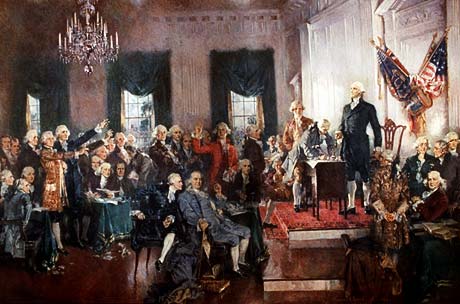
12.
What solves the issue of "can slaves be counted?"
a)
The 3/5ths Compromise
b)
The 1/2 Compromise
c)
The 3/4ths Compromise
d)
The 4/4 Compromise
13.

When people give up some of what they want so that they can all agree, this is called ____________.

a)

a convention

b)

a promise

c)

a compromise

14.
Each branch has powers over the other branches to make sure that one branch does not become too powerful
a)
Checks and Balances
b)
Federalism
c)
Bill of Rights
d)
Federalists Papers
15.

One of the major issues debated at the Constitutional Convention in Philadelphia was -

a)

proposing a new strategy to proceed with the abolition of slavery

b)

creating a plan for representation of both large and small states

c)

whether or not to remain neutral in the French Revolution

d)

if Missouri should be allowed to join the country as a free state

16.
These people favored war with the British. 
a)
Patriot
b)
mercenary 
c)
radical
d)
Loyalist
17.
These people favored peaceful solutions to the conflict with the British. 
a)
Loyalist
b)
Patriot
c)
radical 
d)
mercenary 
18.
These people worked for hire as a professional soldier. 
a)
Patriot
b)
mercenary 
c)
radical 
d)
ally
19.
Patriots had certain advantages. They included Washington's leadership, fighting for their homes and _________________________. 
a)
skill with individually owned weapons
b)
unwillingess to fight far from home
c)
willingess to enlist for long term service
d)
skilled sailors and plentiful ships
20.
Which of the following was the final battle of the Revolutionary War? 
a)
Cowpens
b)
Saratoga
c)
King's Mountain
d)
Yorktown
21.
How did Britain try to persuade enslaved African Americans to join their army? 
a)
offered them their freedom 
b)
promised they could return to Africa
c)
offered them large sums of money 
d)
offered to give them Patriot plantations
22.
Diary, Albigence Waldo, December 14, 1777
"I am sick- discontented- and out of humor. Poor food- hard lodging-cold weather-fatigue-nasty clothes-nasty cookery..." 
The quotation above was most likely written by: 
a)
a British officer in New York
b)
a delegate to the Continental Congress
c)
an American soldier at Valley Forge
d)
an American soldier at Yorktown
23.
Diary, Albigence Waldo, December 14, 1777
"I am sick- discontented- and out of humor. Poor food- hard lodging-cold weather-fatigue-nasty clothes-nasty cookery..." 
In addition to the arrival of warmer weather, what else helped ease the harsh conditions described in the quotation? 
a)
ammunition from Britain
b)
better housing
c)
the Patriot victory at Saratoga
d)
necessities collected and delivered by women
24.
What strategy did British Commander in Chief Clinton hope to use when he shifted the focus of the war to the south? 
a)
to use guerrilla warfare against Patriot armies
b)
to launch a series of naval battles in southern waters
c)
to supplement his troops with backcountry southern geography 
d)
to use the British generals' firsthand knowledge of southern geography
25.
Which battle become a turning point of the war because it prompted the French to join the Patriots? 
a)
Saratoga
b)
Yorktown
c)
Bunker Hill
d)
Trenton
26.
What crucial mistake did British General Cornwallis makke that led to the defeat of the British army?
a)
He attacked Charlottesville. 
b)
He refused to attack Lafayette's troops in the South. 
c)
He depends on Benedict Arnold for reinforcements. 
d)
He disregarded an order and retreated to Yorktown Peninsula. 
27.

George Washington

a)

Wrote the Declaration of Independence.

b)

Famous inventor and delegate of the Continental Congress; convinced France to join the Americans against Britain.

c)

Wrote “Common Sense” and “The American Crisis” to gain support for the American Revolution.

d)

Commander of the Continental Army in the American Revolution.

28.

American colonists who remained loyal to Britain and opposed the war for independence

a)

loyalist

b)

Minutemen

c)

rebel

d)

turncoat

29.

Member of a militia during the American Revolution who could be ready to fight in sixty secondse

a)

Minutemen

b)

rebel

c)

patriot

d)

calvary

30.

American colonist who favored American independence

a)

patriot

b)

rebel

c)

loyalist

d)

calvary

31.

a volunteer army

a)

miliita

b)

blockade

c)

Calvary

d)

rebel

32.

a person who rises in opposition or armed resistance against an established government or ruler.

a)

rebel

b)

loyalist

c)

militia

d)

turncoat

33.

a unit of soldiers who rides horses

a)

Calvary

b)

Minutemen

c)

boycott

d)

Redcoat

34.

A nickname for the British soldiers

a)

Redcoats

b)

blockade

c)

militia

d)

loyalists

35.

A refusal to buy or use goods and services

a)

boycott

b)

turncoat

c)

blockade

d)

rebel

36.

an act or means of sealing off a place to prevent goods or people from entering or leaving

a)

blockade

b)

boycott

c)

rebel

d)

Patriot

37.

Colonists dumped 342 chests of tea into the Boston Harbor protesting the

a)

stamp act

b)

tea act

c)

sugar act

d)

Townshend act

38.

What did the Treaty of Paris 1783 do?

a)

Ended the Revolutionary War

b)

Ended the French and Indian War

c)

Ended WWI

d)

Ended Pontiac's War

39.

What was the name of the Patriot Army?

a)

US Army

b)

Continental Army

c)

British Army

d)

Privateer Army

40.

What was a Hessian?

a)

German soldier fighting for the British

b)

French soldier fighting for the Patriots

c)

Spanish soldier fighting for the Patriots

d)

African American soldier fighting for the British

41.

What was a mercenary?

a)

person who did not take sides during the war

b)

spy

c)

voluntary soldier

d)

soldier hired to serve in a foreign army

42.

Which was NOT a major military strategy of the Americans?

a)

form alliances

b)

attrition

c)

blockades

d)

guerilla warfare

43.

Commander-in-chief of the Continental Army.

a)

John Adams

b)

Thomas Jefferson

c)

George Washington

d)

Crispus Attucks

44.

Why was it so devastating when the Patriots took control of the city of Philadelphia?

a)

It was the center of American trade and commerce

b)

It was the capital city

c)

It cut off the north from the south

d)

George Washington was killed when the British captured the city

45.
Which of the following is an example of Patriots (Americans who supported the Continental Army) engaging in a violent battle against Loyalists (Americans who supported the Royal Army)?
a)
The Battle of Camden
b)
The Battle of King's Mountain
c)
The Battle of Fort Sullivan
d)
The Battle of Cowpens
46.
When did the "Shot heard around the world " occur? 
a)
October 10, 1855
b)
April 19, 1775
c)
December 21, 1955 
d)
May 22, 1588
47.
Which of the following statements is true about the battles of the American Revolution that took place in North and South Carolina?
a)
Several battles were fought in the Carolinas even after the British surrendered because colonists in the area did not know that the war was over.
b)
The majority of the fighting in the Carolinas took place during the Southern Campaign of 1780 and 1781.
c)
 no battles were actually fought in the Carolinas.
d)
Several key battles were fought in the Carolinas at the beginning of the war, but after 1778 all of the battles were fought in the Northern colonies.
48.
Who was the famous South Carolina patriot the movie "The Patriot" portrays?
a.  Andrew Pickens  b.  Thomas Sumter c.  Francis Marion  d.  William Moultrie
a)
 Andrew Pickens 
b)
 Thomas Sumter 
c)
Francis Marion
d)
William Moultrie
49.
One of the major disasters of the Southern Campaign was the Battle of Camden.  American forces were unprepared and were overwhelmed by the British Army.  However, the battle did have one positive outcome.    What was it?
a)
After the defeat, George Washington decided to put a new leader in charge of the Southern Campaign.  He chose Nathanael Greene, who proved to be a great leader.
b)
During the battle, American forces captured a British officer who knew that the Royal Army had plans to invade Yorktown.
c)
Despite the victory, the British suffered so much during the battle that the Royal Army was never able to fully recover for the rest of the war.
d)
Prior to the battle, few people in South Carolina supported the war.  The defeat was a "wake-up" call and motivated citizens to join the Continental Army.
50.
Which of the following best describes the major contribution of militia troops (or partisan troops) during the American Revolution?  
a)
They frustrated the British troops with surprise attacks and guerilla warfare. 
b)
  They spied on British troops and gave the Colonial Army critical information.
c)
They overpowered the British Regulars in several major battles throughout the war. 
d)
They gave civilians frequent updates about what was going on in the war.
51.
Which of the following best describes a "militia" or "partisan" soldier?   a.  
a)
A person who is forced to fight for the army, but does not agree with the cause. 
b)
A person who travels with the army and performs various duties, but does not carry an actual weapon. 
c)
 A person who claims to be loyal to one side, but is actually spying for the opposing side. 
d)
A person who is trained to fight as a soldier, but is not part of the regular army.
52.
Who was the king of England during the American Revolution?   a. George II b. George III c. 
a)
George II
b)
George III
c)
George IV
d)
Charles II
53.
Why was the British capture of Charleston in 1780 such a major blow for the American colonists?    
a)
The American colonists had not expected the British Army to launch an attack on Charleston.
b)
  Charleston served as a major port, and it was the most important city in the colonies south of Philadelphia.
c)
When Charleston was captured, all of the armies of North and South Carolina had no choice but to surrender.
d)
The majority of the Colonial army was stationed in Charleston.
54.
What treaty ends the War of Independence?  
a)
Treaty of Rome
b)
Treaty of Utrecht
c)
Treaty of London
d)
Treaty of Paris
55.
On June 15, 1775, the Colonial Congress formed the Continental Army and named George Washington the commander-in-chief.  As a Virginian, Washington helped unite both the northern or southern colonies in the war.  He was also chosen because:  
a)
He was a man of dignified character and had more experience than other American soldiers.
b)
 He was extremely radical and aggressive, which was the only way to fight the British. 
c)
He didn't believe in an organized army, and decided to use primarily militia troops to fight the British.
d)
He had a history of clashing with the British and a personal hatred for the King of England.
56.
The last major battle fought by George Washington's Continental Army was the:  
a)
Battle of Saratoga
b)
 Battle of Yorktown
c)
Battle of Long Island
d)
 Battle of Trenton
57.
What happen event occurred at Lexington and Concord? 
a)
Sugar Act
b)
Signing of the Declaration of Independence
c)
Mercantilism
d)
The first shots fired of the American Revolution
58.
Under the Articles of Confederation, the government consisted of _______________ branch of government.
a)
3
b)
2
c)
1
d)
4
59.
Under the Articles of Confederation Congress could only pass a law if ____________ out 13 states agreed. 
a)
13
b)
8
c)
9
d)
10
60.
One weakness of the Articles of the Confederation was ____________. 
a)
The ability of Congress to tax.
b)
The inability of Congress to tax.
c)
The ability of Congress to declare war.
d)
The ability of Congress to create courts.
61.
In order to change (amend) the Articles of Confederation,  __________ out of 13 states had to agree. 
a)
9
b)
10
c)
13
d)
15
62.

Why was the national government created by the Articles of Confederation intentionally made WEAK?

a)

fearful it would abuse its power like the British king & Parliament

b)

fearful of upseting the King of England

c)

fearful of being in charge of their own country

d)

fearful of harming Native Americans

63.
Under the Articles, the national government had no __________ branch (in other words, NO president).
a)
executive
b)
legislative
c)
judicial
64.
Under the Articles, the national government had no __________ branch (in other words, NO federal court system).
a)
legislative
b)
judicial
c)
executive
65.
Under the Articles, the central government could not regulate (control) ___________.
a)
trade
b)
warfare
c)
the army
d)
the members of Congress
66.
What was the name of the country's first constitution?
a)
Declaration of Independence
b)
Charter of 1777
c)
Intolerable Act
d)
Articles of Confederation
67.
Under the Articles, the federal government was TOO
a)
powerful.
b)
oppressive.
c)
tyrannical.
d)
weak.
68.
What best describes the form of government referred to as a confederation (confederacy)?
a)
strong central government/weak state governments
b)
weak central government/strong state governments
c)
communist regime
d)
power federal government with no forms of local governments
69.

anarchy

a)

the absence of a central government or authority

b)

the large-scale buying and selling of goods, such as between states or countries

c)

a partnership among countries or states in which authority over all is loosely shared

d)

a document containing the fundamental political principles on which a state or nation is governed

e)

the ability to obtain loans from individuals, businesses, or countries based on trust that the repayment will be made

70.

commerce

a)

the absence of a central government or authority

b)

the large-scale buying and selling of goods, such as between states or countries

c)

a partnership among countries or states in which authority over all is loosely shared

d)

a document containing the fundamental political principles on which a state or nation is governed

e)

the ability to obtain loans from individuals, businesses, or countries based on trust that the repayment will be made

71.

confederation

a)

the absence of a central government or authority

b)

the large-scale buying and selling of goods, such as between states or countries

c)

a partnership among countries or states in which authority over all is loosely shared

d)

a document containing the fundamental political principles on which a state or nation is governed

e)

the ability to obtain loans from individuals, businesses, or countries based on trust that the repayment will be made

72.

constitution

a)

the absence of a central government or authority

b)

the large-scale buying and selling of goods, such as between states or countries

c)

a partnership among countries or states in which authority over all is loosely shared

d)

a document containing the fundamental political principles on which a state or nation is governed

e)

the ability to obtain loans from individuals, businesses, or countries based on trust that the repayment will be made

73.

credit

a)

the absence of a central government or authority

b)

the large-scale buying and selling of goods, such as between states or countries

c)

a partnership among countries or states in which authority over all is loosely shared

d)

a document containing the fundamental political principles on which a state or nation is governed

e)

the ability to obtain loans from individuals, businesses, or countries based on trust that the repayment will be made

74.

democracy

a)

a government controlled by the people, sometimes through elected representatives

b)

a system of government that finely balances power between a central power and smaller component governments

c)

a type of representation where the number of representatives from a state or territory depends on its population

d)

to formally approve a treaty, agreement, or law in order to make it valid

75.

federalism

a)

a government controlled by the people, sometimes through elected representatives

b)

a system of government that finely balances power between a central power and smaller component governments

c)

a type of representation where the number of representatives from a state or territory depends on its population

d)

to formally approve a treaty, agreement, or law in order to make it valid

76.

proportional representation

a)

a government controlled by the people, sometimes through elected representatives

b)

a system of government that finely balances power between a central power and smaller component governments

c)

a type of representation where the number of representatives from a state or territory depends on its population

d)

to formally approve a treaty, agreement, or law in order to make it valid

77.

ratify

a)

a government controlled by the people, sometimes through elected representatives

b)

a system of government that finely balances power between a central power and smaller component governments

c)

a type of representation where the number of representatives from a state or territory depends on its population

d)

to formally approve a treaty, agreement, or law in order to make it valid

78.

the ability to obtain loans from individuals, businesses, or countries based on trust that the repayment will be made

a)

anarchy

b)

confederation

c)

constitution

d)

democracy

e)

credit

79.

a partnership among countries or states in which authority over all is loosely shared

a)

anarchy

b)

confederation

c)

constitution

d)

democracy

e)

credit

80.

the absence of a central government or authority

a)

anarchy

b)

confederation

c)

constitution

d)

democracy

e)

credit

81.

a document containing the fundamental political principles on which a state or nation is governed

a)

anarchy

b)

confederation

c)

constitution

d)

democracy

e)

credit

82.

a government controlled by the people, sometimes through elected representatives

a)

anarchy

b)

confederation

c)

constitution

d)

democracy

e)

credit

83.

a system of government that finely balances power between a central power and smaller component governments

a)

federalism

b)

proportional representation

c)

ratify

d)

commerce

e)

credit

84.

a type of representation where the number of representatives from a state or territory depends on its population

a)

federalism

b)

proportional representation

c)

ratify

d)

commerce

e)

credit

85.

to formally approve a treaty, agreement, or law in order to make it valid

a)

federalism

b)

proportional representation

c)

ratify

d)

commerce

e)

credit

86.

the large-scale buying and selling of goods, such as between states or countries

a)

federalism

b)

proportional representation

c)

ratify

d)

commerce

e)

credit