
 Worksheets
SCIENCE 10 - FIRST QUARTER (SUMMATIVE TEST) MODULAR
Total questions: 50
Worksheet time: 18mins
Which of these statements correctly describe Asthenosphere?
Soft, weak upper portion of the mantle where the lithospheric plates float and move around
The topmost, solid part of the Earth that is composed of several plates
The boundary that separates the crust and the mantle
The process in which the crust plunges back into the Earth
It is the rigid outermost shell of the Earth which is composed of the crust and the top part of the upper mantle
Convergent plate
Oceanic plate
Lithosphere
Continental plate
How are oceanic crust being formed?
By freezing of the mantle
By partial melting of the mantle at mid-ocean ridges
By movement of plates
By destroying the crust
An instrument that detects and measures earthquakes is a
Seismogram
Focus seismic map
Focus
Seismograph
Why is it important to identify areas which are prone to earthquakes?
so that necessary preacutions can be done
be familiar with the area
for record purposes
economic concern
Where can you find the location of most earthquake epicenters?
At the center of the continent
Across bodies of water
Situated at same locations of volcanoes
In between every continent
Which of these processes refers to when the ocean floor plunges back into Earth’s interior?
Conduction
Radiation
Subduction
Convection
Which of these refers to the force applied to an object or material that causes change or deformation on it?
Fault
Stress
Strain
Fracture
Crustal plate A is moving away from crustal plate B. What type of plate boundary is described by the motion of the two plates?
Convergent plate boundary
Divergent plate boundary
Transform fault boundary
All of these
What type of plate undergoes subduction at oceanic-continental convergent plate boundaries and why does it subduct?
The continental plate. It is less dense than the oceanic plate.
The continental plate. It is denser than the oceanic plate.
The oceanic plate. It is less dense than the continental plate.
The oceanic plate. It is denser than the continental plate.
Divergent plate boundary is best described as:
A boundary between two plates that are not moving.
A boundary between two plates that are crashing together.
A boundary between two plates that are moving apart
A boundary between two plates that are sliding past each other.
A transform plate boundary is best described as…
Where two plates move toward and collide with each other.
Where two plates slide alongside each other.
Where two plates interact in any way.
Where two plates move apart from one another.
Who are the two scientists who proposed the theory of seafloor spreading in the early 1960s?
Charles Darwin and James Hutt
Harry Hess and Robert Dietz
John Butler and Arthur Smite
Vine and D. Mathew
In 1912, Alfred Wegener proposed theory that the Earth is once a single landmass. What is the name of the Mesozoic supercontinents that consisted of all the present continents?
Eurasia
Laurasia
Pangaea
Gondwanaland
The Theory of Plate Tectonics is a combination of which two theories?
Seafloor Spreading and Continental Drift
Seafloor Spreading and Tidal Theory
Continental Drift and Fossil Theory
Continental Drift and Big Bang Theory
The older seafloor sinks, the weight of the uplifted ridge pushes the oceanic crust toward the trench at the subduction zone. This process is called _____.
ridge push
slab pull
subduction
earthquake
Where does convection current occurs?
crust
mantle
core
inner core
If you are a cartographer, what would give you an idea that the continents were once joined?
ocean depth
position of the South Pole
shape of the continents
size of the Atlantic Ocean
Which of the following can you infer from the continuous movement of the lithospheric plates over the asthenosphere?
all the continents will cease to exist
all the volcanoes in the Philippines will become inactive
the continents will not be located in the same place as they are now
the islands of the Philippines will become scattered all over the world
The lithospheric plates are believed to be moving slowly. What is the driving force that facilitates this movement?
gravitational force of the moon
magnetic force at the poles
convection current in the mantle
the force of the atmosphere
If all the inner layers of the Earth are firm solid, what could have happened to Pangaea?
it remained as supercontinent
it would have become as it is today
it would have slowly disappeared in the ocean
it would have stretched and covered the whole world
As the new seafloor is formed at the mid-ocean ridge, the old seafloor farthest from the ridge is destroyed. Which of the stated processes describes how the oceanic crust plunges into the Earth and destroyed at the mantle?
convection
construction
diversion
subduction

This German scientist first proposed continental drift theory
Harry Hess
Alfred Wegener
Archimedes
Thomas Warner

Wegener noticed that the Appalachian Mountains and Caledonian Mountains line up and are made of the same rock types. This was a type of ....
Fossil Evidence
Rock Formation Evidence
Climate Evidence
Objective Evidence

Wegener found fossils of land reptiles on two different continents. This was important because
Land reptiles are often found all over the world, showing that they can survive in most climates
Land reptiles cannot swim, so the continents must have been connected for them to get across
Land reptiles are never moved around the Earth by humans, so they must have travels to these continents by themselves
Land reptiles fossilized much better than other animal species

Wegener found fossils of ancient ferns on Antarctica, this shows
That some ferns can survive temperatures well below freezing
That humans put ferns on Antarctica millions of years ago
That Antarctica drifted from a warmer climate where plants could grow
That fossils can be formed in cold climates

This layer is made of hot flowing rock (magma).
Crust
Mantle
Core

The layer made of iron and nickel.
Crust
Mantle
Core

The layer with the highest temperatures.
Crust
Mantle
Core
Which layer is best described as liquid iron and nickel?
inner core
outer core
mantle
crust
The northern continent group formed million years ago.
Pangaea
Laurasia
Ridges
Gondwanaland
Subduction does not occur at which convergent plate boundary?
Oceanic - Oceanic
Oceanic - Continental
Continental - Continental
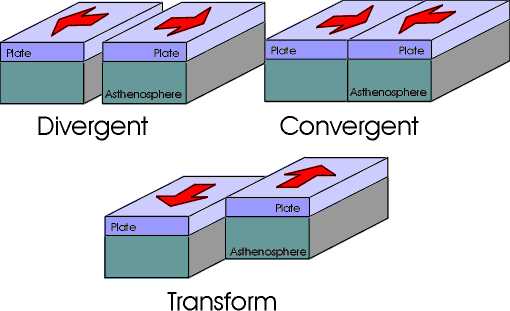
Type of stress that causes rocks to move apart and becomes thin in the middle is ____________.
Compression
Tension
Shear
Type of stress that causes the middle of the rock to get thicker is called __________.
Shear
Tension
Compression
Type of stress that causes the rock to slide past each other is called _________.
Shear
Tension
Compression
What boundary separates the inner and the outer core?
Lehman's Discontinuity
Conrad Discontinuity
Mohorovic Discontinuity
Gutenberg Discontinuity
What boundary separates the lower mantle and the outer core?
Lehman's Discontinuity
Conrad Discontinuity
Mohorovic Discontinuity
Gutenberg Discontinuity
What boundary separates the upper and lower crust?
Lehman's Discontinuity
Conrad Discontinuity
Mohorovic Discontinuity
Gutenberg Discontinuity
Which is not an evidence of seafloor spreading?
molten magma constantly erupting
drilling samples of rock
Magnetic stripes
Fossil evidence
Why were magnetic patterns found on the ocean floor puzzling?
They did not show alternating bands of normal and reversed polarity.
They showed alternating bands of normal and reversed polarity.
No rocks were magnetic.
All rocks were magnetic.
If you are a cartographer, what would give you an idea that the continents were once joined?
ocean depth
position of the South Pole
shape of the continents
size of the Atlantic Ocean
During the 1960s, scientist were already equipped with gadgets needed to explore the deep ocean. What discovery about the ocean floor is associated with the seafloor spreading?
mountains are denser than the mantle
the rotational poles of the Earth have migrated
the crust of the continents is denser than the crust of the ocean
the crust of the ocean is very young relative to the age of the crust of the continents.
Which of the following can you infer from the continuous movement of the lithospheric plates over the asthenosphere?
all the continents will cease to exist
all the volcanoes in the Philippines will become inactive
the continents will not be located in the same place as they are now
the islands of the Philippines will become scattered all over the world
The lithospheric plates are believed to be moving slowly. What is the driving force that facilitates this movement?
gravitational force of the moon
magnetic force at the poles
convection current in the mantle
the force of the atmosphere
If all the inner layers of the Earth are firm solid, what could have happened to Pangaea?
it remained as supercontinent
it would have become as it is today
it would have slowly disappeared in the ocean
it would have stretched and covered the whole world
Which among the evidences are under the Continental Drift theory?
rock evidences
magnetic evidence in rocks
fossil evidences
puzzle like fit of continents
Which of the following changes would end Earth's tectonic activity?
A. Earth's crust becomes a cooler solid
B. Earth's mantles become a warmer semiliquid
C. Earth's mantle becomes cooler and solid.
D. Earth's outer core becomes warmer

