
 Worksheets
WPEMIC Unit Review
Total questions: 58
Worksheet time: 1hrs 20mins

What is the kinetic energy of a ball with a mass of 65.0 kg while rolling at a rate of 2.50 m/s?
81.3 J
203 J
406 J
110 J
Calculate the potential energy of a rock with a mass of 55.0 kg as it sits on a cliff that is 27.0 m high.
1490 J
13500 J
14600 J
1290 J

A kid throws a ball with a force of 70.0 N over 1.1 meters. How much work did he do?
77 joules
70 joules
7.7 joules
11 joules
A worker climbs a ladder and does 8 J of work on a 2 N object. What is the distance they lift the object?
18 m
4 m
10 m
6 m
What is mechanical energy?
total kinetic energy
the energy of motion
total kinetic and potential energy
temperature plus heat

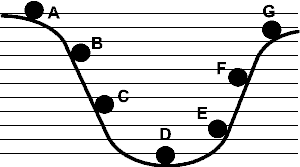
At which point of this roller coaster is the energy 1/2 kinetic and 1/2 potential?
A
B
C
D
A 40-kg person is climbing 3 m up a flight of stairs in 6 seconds. How much work did they do climbing the stairs?
400 J
1200 J
200 J
120 J
A 40-kg person is climbing 3 m up a flight of stairs in 6 seconds. How much power did they exert climbing the stairs?
400 W
1200 W
200 W
120 W
How does conservation of energy explain why something that is falling should speed up?
It gains kinetic energy because it gains potential energy.
It loses kinetic energy because no work was done on it.
It gains kinetic energy because it loses potential energy.
It loses kinetic energy because the Earth gains potential energy.
An object has 12.4 J of potential energy and 23.5 J of kinetic energy. What is the mechanical energy of the system?
11.1 J
1.895 J
35.9 J
291.4 J
An 80 kg skier stands at the top of a 40 meter slope. What is her gravitational potential energy before she skies down the slope?
3200 J
31,360 J
15,680 J
19.6 J
If a rock falls from a cliff, at what point are its kinetic energy and its potential energy the same? Ignore air resistance.
Just as it starts to fall
just before it hits the bottom
halfway down
never
If two rocks are launched through the air at the same speed, but one has twice as much mass as the other, how do their kinetic energies compare?
The kinetic energy of the two rocks is the same because they have the same speed
The rock with the greater mass will only move a small distance and then fall straight to the ground
The two rock could not have the same speed if they have different masses
The rock with the greater mass has more kinetic energy than the rock with less mass even though they are traveling at the same speeds because both mass and speed affect kinetic energy.
What would happen to the kinetic energy of an object if you doubled the mass?
The kinetic energy would be cut in half
The kinetic energy would double
The kinetic energy would triple
It would stay the same because mass does not effect kinetic energy
For work to be done on an object,
some force need only be exerted on the object.
the object must move some distance as a result of a force.
the object must move, whether or not a force is exerted on it.
the object must not move.
________________ is the rate at which work is done.
Power
Work
Time
Energy
This theorem states, "Whenever work is done, energy changes.
Work-Energy Theorem
Paul-Newman Theorem
Action-Reaction Theorem
Study-Now Theorem
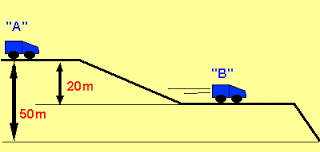
In diagram 2, if the mass of the car is 600 kg, what is the change in potential energy from point A to point B?
411,600 J
294,000
176,400 J
117,600 J
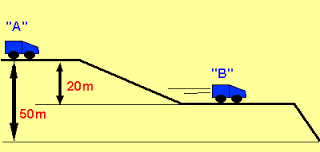
In diagram 2, if the 600 kg cart is initially at rest, what is its velocity at point B?
19.8 m/s
15.0 m/s
10.3 m/s
3.8 m/s

What's the total work done of a force equal to 450 N at 35 ° and which moved the object for 3.5 m. Neglect friction
1575 J
903.38
1290.16 J
1000 J
The units for Impulse are
N/s
N·s
N
m/s
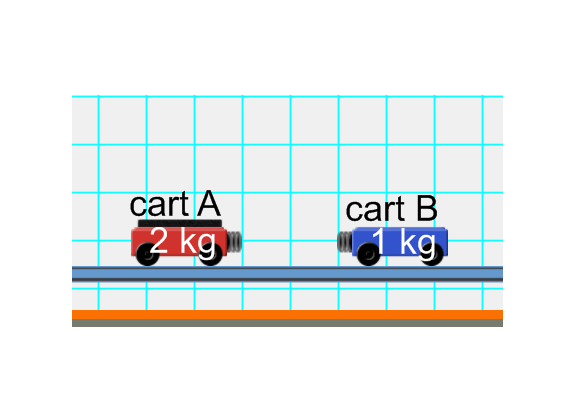
A boy kicks a football with a force of 20 N, the time the force acts for is 0.3 s.
Calculate the impulse on the ball.
1 N·s
6 N·s
66 N·s
None of these
A 5 N force is applied to a 3 kg ball to change its velocity from +9 m/s to +3 m/s. The impulse on the ball is ______ N·s.
-2.5
.
.
-10
-18
-45
A constant force of 4.5 N acts on a 7.2-kg object for 10.0 s. What is the change in the object's momentum?
45 kg m/s
72 kg m/s
32.4 kg m/s
0.45 kg m/s
The momentum of an object depends upon the object's ___________&_____________.
size and shape
mass and speed
mass and veloctiy
mass and energy
_________________ causes and is equal to a change in momentum
Impulse
Force
Joule
Watt
Determine the momentum of 1,000-kg car moving northward at 20 m/s.
20,000 N
20,000 Joules
20,000 Kg * m/s
20,000 kg * m/s north
When the speed of an object is doubled, its momentum...
remains unchanged in accord with the conservation of momentum.
doubles.
quadruples.
decreases.

After collision, the two objects move off with different velocity. What type of collision is this?
Inelastic
Elastic
Calculate the impulse on the ball.

