wayground logo

Free Printable Worksheets

NEW

Font size

S
M
L
XL
Worksheets

VESPR and Molecular Geometry Test Review

Total questions: 35

Worksheet time: 1hrs 5mins

Name
Class
Date
1.

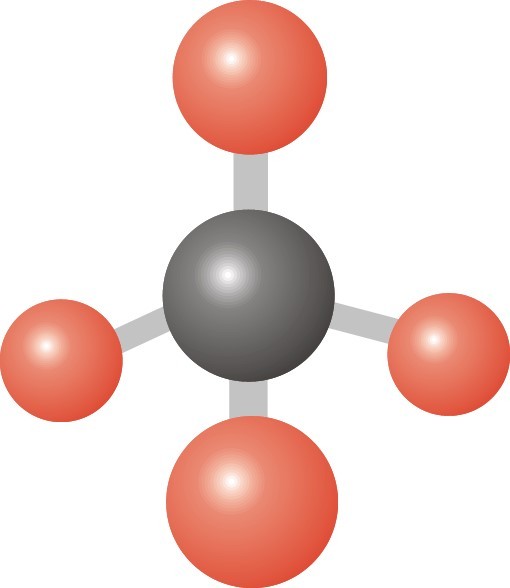
Determine the molecular geometry of the given structure.

a)

Trigonal Pyramidal

b)

Trigonal Bipyramidal

c)

Trigonal Planar

d)

Tetrahedral

2.

The geometry of a molecule with 4 bonded pairs of electrons and 0 lone pairs of electrons.

a)

Tetrahedral

b)

Trigonal Planar

c)

Bent

d)

Trigonal Pyramidal

e)

Linear

3.

The geometry of a molecule with 2 bonded pairs of electrons and 2 lone pairs of electrons.

a)

Tetrahedral

b)

Trigonal Planar

c)

Bent

d)

Trigonal Pyramidal

e)

Linear

4.

The geometry of a molecule with 3 bonded pairs of electrons and 0 lone pairs of electrons.

a)

Tetrahedral

b)

Trigonal Planar

c)

Bent

d)

Trigonal Pyramidal

e)

Linear

5.
SiClhas what shape?
a)
square planar
b)
square pyramidal
c)
tetrahedral
d)
octahedral
6.
What is the shape of H2O?
a)
linear
b)
tetrahedral
c)
bent
d)
trigonal pyramidal
7.
According to the octet rule most elements need _______ valence electrons.
a)
2
b)
8
c)
6
d)
18
8.
Who could this be? 
a)
CO2
b)
NH3
c)
H2S
d)
CH4
9.
Who could this be?
a)
H2O
b)
NH3
c)
CO2
d)
CH4
10.

What is the molecular geometry of CO2?

a)

Bent

b)

Trigonal planar

c)

Trigonal pyramidal

d)

Linear

11.
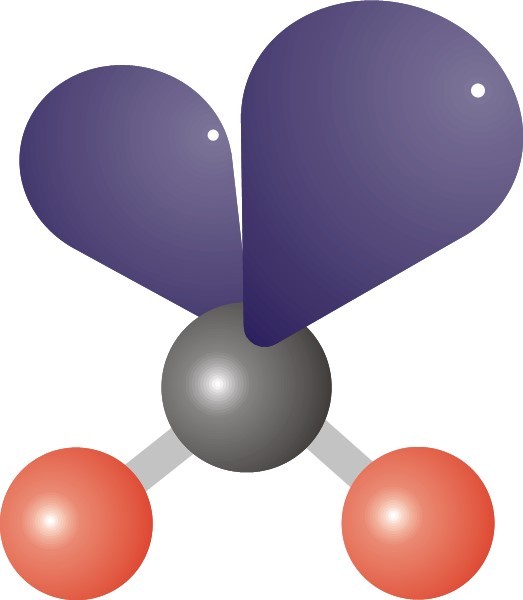
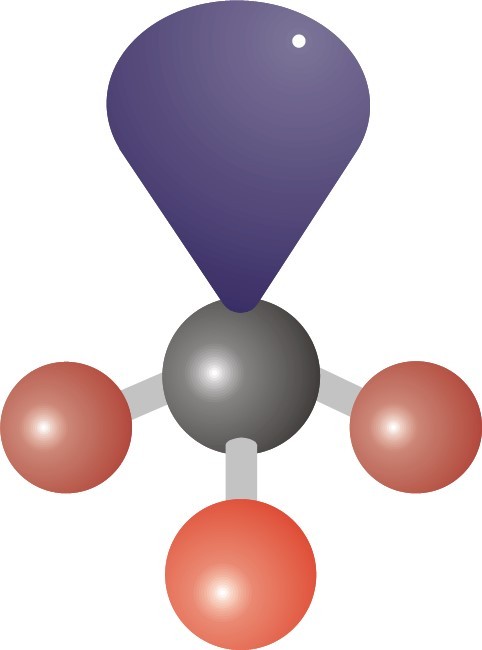
Choose the correct shape for this molecule:
a)
linear
b)
Trigonal pyramidal
c)
Bent
d)
Tetrahedral
12.
Choose the correct shape for this molecule:
a)
Bent
b)
Trigonal pyramidal
c)
Tetrahedral
d)
Trigonal planar
13.
Choose the correct shape for this molecule:
a)
Bent
b)
Linear
c)
Tetrahedral
d)
Trigonal pyramidal
14.
What is the VSEPR theory used to predict?
a)
Bond Strength
b)
Polarity
c)
Molecular Shape
d)
Electronegativity
15.
 A lone pair is defined as
a)
A pair of bonding electrons
b)
One non-bonding electron
c)
A pair of non-bonding electrons
d)
A pair of electrons on the central atom
16.
What two types of atoms make a covalent bond?
a)
2 Nonmetals
b)
1 Nonmetal and 1 Metal
c)
2 Metals
d)
2 Noble Gases
17.
In covalent bonds, electrons are ___________.
a)
transferred
b)
gained
c)
lost
d)
shared
18.
How many electrons should Oxygen have around its Lewis dot model?
a)
5
b)
6
c)
7
d)
8
19.

Is this molecule polar or non-polar?

a)

Polar

b)

Non-polar

20.

Is this molecule polar or non-polar?

a)

Polar

b)

Non-polar

21.
In a polar covalent bond, electrons are shared ___________.
a)
equally
b)
unequally
c)
between non-metals with similar electronegativities
d)
between a metal and a non-metal
22.

Why is the molecule polar?

a)

There is a non bonding pair electrons on the central atom.

b)

There are different types of elements bonded to the central atom.

c)

There are no non bonding pairs on the central atom and all of the atoms bonded to the central atom are the same.

23.

Classify the above molecule.

a)

Polar

b)

Non polar

24.

Is this molecule polar or non-polar?

a)

Non-polar

b)

Polar

25.
According to VSEPR, molecules adjust their shapes to keep which of the following as far away as possible?
a)
Pairs of valence electrons
b)
Inner shell electrons
c)
Mobile Electrons
d)
Electrons closest to the nucleus
26.
Who could this molecule be?
a)
CH4
b)
CO2
c)
PCl5
d)
BF3
27.

Which Lewis Dot Model drawing correctly shows an O2 molecule?

a)
b)
c)
d)
28.

Which best describes a triple bond?

a)

3 shared pairs of electrons

b)

3 shared electrons

c)

a central electron with 3 atoms bonded around it

29.

Classify the above molecule.

a)

Polar

b)

Non polar

30.

Why is the molecule polar?

a)

There is a non bonding pair electrons on the central atom.

b)

There are different types of elements bonded to the central atom.

c)

There are no non bonding pairs on the central atom and all of the atoms bonded to the central atom are the same.

31.
A diatomic molecule like O2 is always_______ because electrons are shared ________.
a)
nonpolar; equally
b)
polar; equally
c)
nonpolar; unequally
d)
nonpolar; unequally
32.

Which of the following would have the strongest bond

a)

O2

b)

N2

c)

Cl2

d)

I2

33.

Which of the following would have the longest bond?

a)

H2

b)

N2

c)

O2

34.

What type of bond would result in 4 electrons being shared?

a)

Single Covalent Bond

b)

Double Covalent Bond

c)

Triple Covalent Bond

35.

Bond length is described as the distance between...

a)

the orbitals of two attached atoms

b)

the nuclei of two attached atoms

c)

the electrons of two attached atoms

d)

Two molecules of the same substance